

Ready & Packaged Foods
All →Vegetables & Legumes
All →Desserts & Confectionery
All →Meat & Protein
All →Grains & Bakery
All →Beverages
All →Milk & Dairy
All →

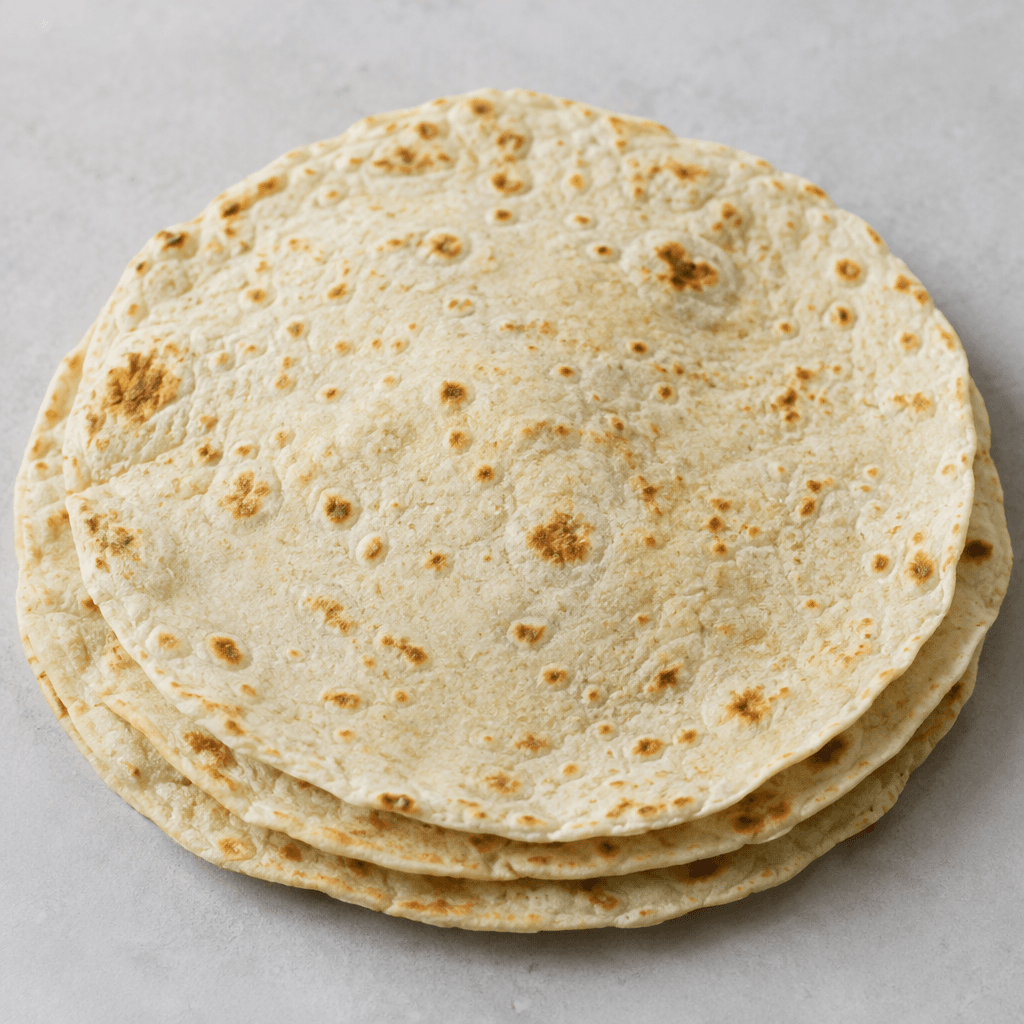
Flour Tortilla Calories
Soft, thin tortilla made from wheat flour
In season: Spring · Summer · Autumn · Winter
CALORIES
GI
POTASSIUM
FIBER
Quick answer
1 piece (medium) of Flour Tortilla (50 g) has 155 calories. That works out to 310 calories per 100 g. It contains 27 g of carbs, 4.3 g of protein, 3.3 g of fat and 1.4 g of fiber. Its 8 µg of Selenium covers 15% of the Daily Value. Its glycemic index is 70 (high), so it raises blood sugar quickly.
What is Flour Tortilla?
A flour tortilla is a thin, soft flatbread made from wheat flour, widely associated with northern Mexican cooking. It is cooked on a hot surface, where pale golden spots form, and stays pliable enough to fold or roll around a filling.
In Mexico and across the United States, it is a familiar base for burritos, quesadillas and wraps; elsewhere, it works well for quick lunches or as an alternative to sliced bread. It is mainly a source of carbohydrates, with some protein and fibre. For a lighter meal, fill it generously with vegetables and choose a lean filling.
Flour Tortilla Nutrition Facts
Selected: 100 g
310
KCAL / 100G
Carbs
54g
· 20% DV
Protein
8.5g
· 17% DV
Fat
6.5g
· 8% DV
Fiber
2.8g
· 10% DV
DV is the share of the daily value covered, on a 2,000 kcal reference diet.
Calories come from: Carbs 70% · Protein 11% · Fat 19%
Flour Tortilla Vitamins & Minerals
Vitamins
B1
0.32mg · 27% DV
B3
3.5mg · 22% DV
B2
0.13mg · 10% DV
Folate
35µg · 9% DV
Minerals
Selenium
16µg · 29% DV
Sodium
550mg · 24% DV
Iron
3mg · 17% DV
Phosphorus
110mg · 16% DV
How Nutritious Is Flour Tortilla?
Nutrient density
Low
How many vitamins, minerals and how much fiber this food carries per calorie. A high score means a lot of nutrition for few calories.
Satiety score
Medium
An EatBetter score computed from fiber, protein and calorie density. A high score means staying full longer on the same calories.
Both scores are calculated per 100 g and do not change with the selected portion. The satiety score is EatBetter's own calculation, not a clinical measure.
Flour Tortilla Glycemic Index
GLYCEMIC INDEX
GLYCEMIC LOAD
Accounts for portion size — a more realistic measure than GI alone.
How to Burn Off Flour Tortilla
To burn the 310 calories in 100 g:
🚶
Walking (5 km/h)
🏃
Running (8 km/h)
🚴
Cycling
🏊
Swimming
Times are calculated with the MET equation for a 70 kg adult. Actual burn varies with your weight, age and pace.
Is Flour Tortilla Processed?
NOVA 3
Processed
1. Unprocessed
2. Minimally Processed
3. Processed
4. Ultra-Processed
NOVA classifies foods into 4 groups by industrial processing. NOVA 1 (unprocessed) is the healthiest.
Does Flour Tortilla Contain Allergens?
Contains these allergens:
Which Diets Is Flour Tortilla Good For?
Vegan
— Not suitable
Vegetarian
✓ Suitable
Gluten-Free
— Not suitable
Dairy-Free
— Not suitable
Mediterranean
— Not suitable
Paleo
— Not suitable
Whole30
— Not suitable
DASH
— Not suitable
Keto
— Not suitable
Low FODMAP
— Not suitable
Flour Tortilla Fat Profile
SATURATED
1.7g
MONOUNSATURATED
2.2g
POLYUNSATURATED
2g
Omega 6:3 ratio 53.3:1
Above the ideal 4:1 (53.3:1).
Compare Flour Tortilla
Foods Similar to Flour Tortilla
Frequently Asked Questions About Flour Tortilla
What is a flour tortilla made of?
A flour tortilla is usually made from wheat flour, water, salt, and a fat such as oil or shortening. Some recipes also use a leavening agent. Ingredients vary by brand, which can change how soft, stretchy, or flavorful the tortilla is.
What is the difference between a flour tortilla and a corn tortilla?
A flour tortilla is made with wheat flour and is usually softer and more flexible, while a corn tortilla is made from corn and has a distinct corn flavor. Flour tortillas are often chosen for burritos; corn tortillas are common for tacos.
How do you warm a flour tortilla?
Warm a flour tortilla briefly in a dry, preheated skillet, turning it once, until soft and pliable. Stack warmed tortillas under a clean towel to hold in warmth and moisture. Avoid leaving one in the pan too long or it can dry out.
Why does a flour tortilla crack when I roll it?
A flour tortilla often cracks because it is cold, dried out, or overcooked. Warm it briefly before filling, and keep the rest of the stack covered with a clean towel. Avoid overfilling, which can also make rolling difficult.
How should you store flour tortillas after opening?
Keep flour tortillas sealed in their original packaging or an airtight container in a cool, dry place, and follow the package’s storage directions. Discard them if you see mold or notice an unusual smell or texture.
Can you freeze flour tortillas?
Yes, flour tortillas freeze well. Separate them with parchment paper so they do not stick together, then seal them in a freezer-safe bag. Thaw the amount you need and warm briefly in a skillet to restore flexibility.
How do you make flour tortillas at home?
To make flour tortillas at home, mix flour, water, salt, and fat into a dough, let it rest, then roll it into thin rounds. Cook each round in a hot, dry skillet until lightly spotted, avoiding overcooking so it stays pliable.
What can you make with flour tortillas besides burritos?
Flour tortillas work well for quesadillas, wraps, enchiladas, and pinwheels. For a quick quesadilla, add cheese and other fillings to one half, fold it over, and heat it in a skillet until the outside is lightly browned.
Can you eat a flour tortilla without heating it?
Yes, a flour tortilla can be eaten straight from its package if it is ready-to-eat and has been stored properly. Warming it is not required, but a brief turn in a skillet makes it softer and easier to fold.
How do you keep flour tortillas from sticking together?
To keep flour tortillas from sticking together, store them in a sealed package and avoid exposing the stack to moisture. If you are freezing them, place parchment paper between each tortilla so you can remove just the number you need.
Have another question about Flour Tortilla?
Ask the AI nutrition coach — calories, portions, alternatives and more, answered in seconds in the app.

Scan calories with your camera
Instant AI nutrition analysis

Nutrition data compiled from USDA FoodData Central and scientific sources.