

Ready & Packaged Foods
All →Vegetables & Legumes
All →Desserts & Confectionery
All →Meat & Protein
All →Grains & Bakery
All →Beverages
All →Milk & Dairy
All →

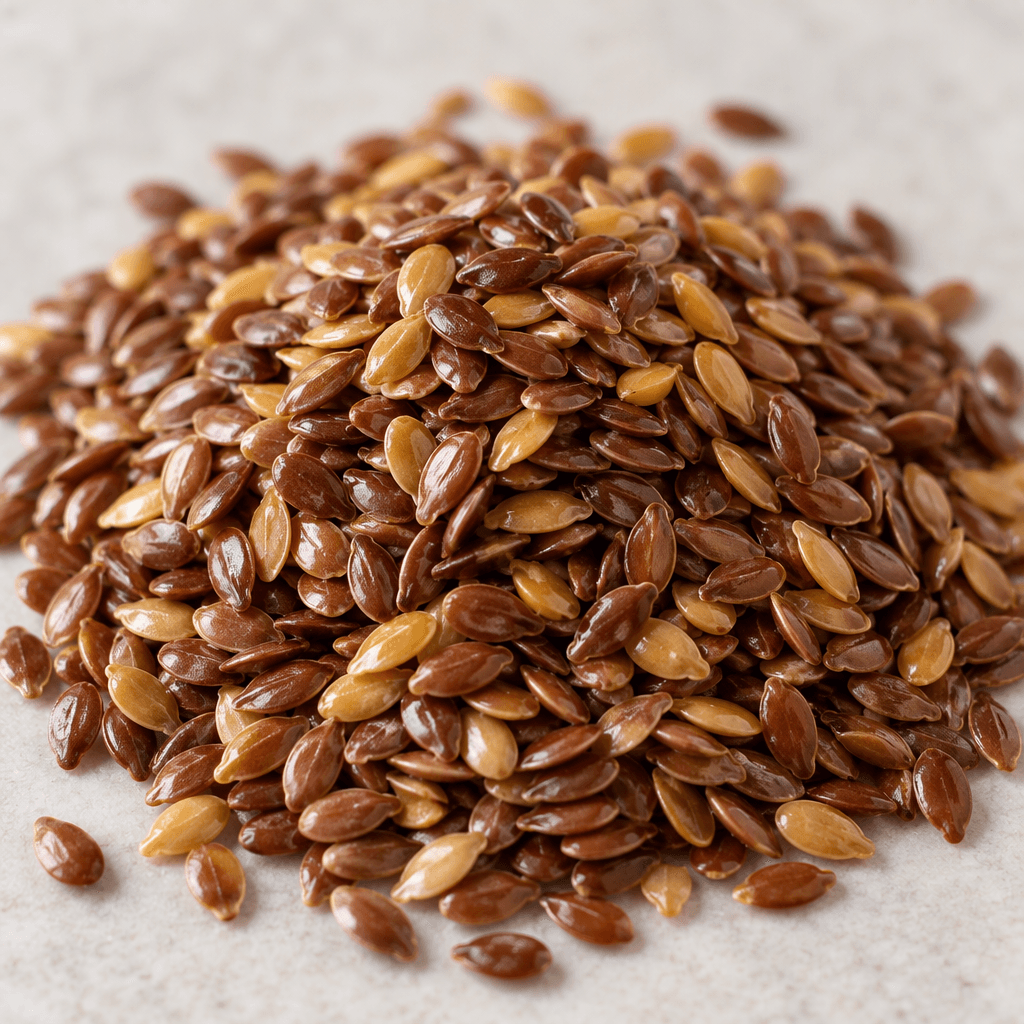
Flaxseed mix Calories
Rich in omega-3 and fiber
In season: Spring · Summer · Autumn · Winter
CALORIES · 100 G
GI
POTASSIUM · 100 G
FIBER · 100 G
Quick answer
1 tablespoon (whole) of Flaxseed mix (10 g) has 53 calories. That works out to 534 calories per 100 g. It contains 2.9 g of carbs, 1.8 g of protein, 4.2 g of fat and 2.7 g of fiber. Its 0.2 mg of B1 covers 14% of the Daily Value. Its glycemic index is 5 (low), so it raises blood sugar slowly.
Flaxseed mix Nutrition Facts
Selected: 1 tablespoon (whole) · 10 g
53
KCAL / 10G
Carbs
2.9g
· 1% DV
Protein
1.8g
· 4% DV
Fat
4.2g
· 5% DV
Fiber
2.7g
· 10% DV
DV is the share of the daily value covered, on a 2,000 kcal reference diet.
Calories come from: Carbs 20% · Protein 13% · Fat 67%
Flaxseed mix nutrition facts table · 1 tablespoon (whole) (10 g)
| Nutrient | Amount | % DV |
|---|---|---|
| Calories | 53 kcal | |
| Total fat | 4.2 g | 5% |
| Saturated fat | 0.37 g | 2% |
| Trans fat | 0 g | |
| Sodium | 3 mg | 0% |
| Total carbohydrate | 2.9 g | 1% |
| Fiber | 2.7 g | 10% |
| Protein | 1.8 g | 4% |
Calories: Calories measure energy. Average daily need is 2,000 kcal. Excess calories are stored as fat, too few cause weight loss.
Carbs: Your body's primary energy source. The brain runs exclusively on carbs. Daily need: 275g.
Protein: Essential for muscle repair and cell growth. Daily need: 50g. Keeps you full and boosts metabolism.
Fat: Needed for hormone production and vitamin absorption. Daily need: 78g. Limit saturated fats, choose unsaturated.
Fiber: Critical for digestive health and satiety. Daily need: 28g. Stabilizes blood sugar, lowers cholesterol.

Log this food in EatBetter
100,000+ people use it
- Get your daily calorie target
- Snap your meal, log it in seconds
- See every vitamin and mineral

📸 Scan the code to get the app free.

How Many Calories in 1 Tablespoon of Flaxseed mix?
| Serving | Amount | Calories |
|---|---|---|
| 1 tablespoon (whole) | 10 g | 53 kcal |
| 1 teaspoon (whole) | 3 g | 16 kcal |
| 1 serving (small) | 15 g | 80 kcal |
| 2 tablespoon (double) | 20 g | 107 kcal |
| 1 ounce (whole) | 28 g | 150 kcal |
| 1 serving (medium) | 30 g | 160 kcal |
| 0.25 cup (quarter) | 35 g | 187 kcal |
| 1 serving (large) | 50 g | 267 kcal |
| ½ cup (half) | 70 g | 374 kcal |
| 100 g | 100 g | 534 kcal |
| 1 cup (whole) | 140 g | 748 kcal |
Calculated from 534 calories per 100 g.
Frequently Asked Questions About Flaxseed mix
Can flaxseed mix replace eggs in baking?
Yes, ground flaxseed mix can replace an egg in some baked recipes when mixed with water to form a gel. It works best in pancakes, muffins, and similar bakes, but not where eggs provide most of the structure. Whole seeds or a mix with other large seeds may not bind as well.
Should flaxseed mix be ground before eating?
If the flaxseeds in the mix are whole, grinding them helps your body access their nutrients; whole seeds can pass through largely undigested. Use a small grinder, or buy a ground mix and keep it sealed and cool to slow rancidity.
How do you use flaxseed mix in a smoothie?
Add flaxseed mix to a smoothie and blend it with the other ingredients. A ground mix blends in more smoothly, while whole seeds add texture. Because the mix is high in fiber, start with a small amount if you are not used to it.
Does flaxseed mix need to be soaked?
No, soaking flaxseed mix is optional. When wet, flaxseeds release a gel that thickens smoothies, porridge, or overnight oats; stir the mix into the liquid and allow it to stand if you want that texture.
Can you eat flaxseed mix raw?
Yes, food-grade flaxseed mix can be eaten without cooking. Ground flaxseed is easier to digest than whole seed, and the mix can be stirred into yogurt or oatmeal. Store opened ground mix carefully, since its oils can turn rancid.
Does flaxseed mix help with constipation?
It can help, because the fiber in flaxseed mix supports bowel regularity and adds bulk to stool. Take it with enough fluid and increase the amount gradually; suddenly adding a lot of fiber can cause gas or bloating.
How should flaxseed mix be stored after opening?
Keep flaxseed mix in an airtight container away from heat, moisture, and light. Ground mix is more exposed to air and can go rancid sooner, so refrigeration is useful; discard it if it develops a bitter or stale smell.
Does cooking flaxseed mix destroy its omega-3?
Cooking does not instantly eliminate all the omega-3 in flaxseed mix, but prolonged high heat can damage some of its delicate oils. For the freshest taste, add it after cooking, or use it in recipes that bake for a moderate time.
Is flaxseed mix safe during pregnancy?
Ask your prenatal clinician before using flaxseed mix regularly or in large amounts during pregnancy. Flaxseed contains fiber and plant compounds, and evidence on safe amounts in pregnancy is limited; other seeds in the mix can also affect its contents.
Can flaxseed mix be used instead of chia seeds?
Sometimes: ground flaxseed mix can thicken a recipe, but it is not identical to chia seeds. Flaxseed has a distinct flavor, and extra seeds in the mix may change the texture; for a chia pudding, the result may not set the same way.
Flaxseed mix Vitamins & Minerals
Vitamins
B1
0.16mg · 13% DV
B6
0.05mg · 3% DV
Folate
8.7µg · 2% DV
B5
0.1mg · 2% DV
Minerals
Copper
0.12mg · 13% DV
Manganese
0.25mg · 11% DV
Magnesium
39mg · 9% DV
Phosphorus
64mg · 9% DV
Potassium ⭐
81mg · 2% DV
Sodium
3mg · 0% DV
Flaxseed mix Glycemic Index
GLYCEMIC INDEX
GLYCEMIC LOAD
Accounts for portion size — a more realistic measure than GI alone.
How to Burn Off Flaxseed mix
To burn the 53 calories in 1 tablespoon (whole) (10 g):
🚶
Walking (5 km/h)
🏃
Running (8 km/h)
🚴
Cycling
🏊
Swimming
Times are calculated with the MET equation for a 70 kg adult. Actual burn varies with your weight, age and pace.
What is Flaxseed mix?
Flaxseed mix is made from flaxseeds and may contain seeds in whole, cracked or ground form, depending on the product. Its mildly nutty, earthy flavour works in both sweet and savoury dishes; the texture can be crunchy or softer when the seeds are ground or stirred into moist foods.
Sprinkle it over porridge, yoghurt or cereal, stir it into smoothies, or add it to bread dough and salads. It is especially notable for its fibre and omega-3 content, with 27.3 g of fibre per 100 g. A small spoonful is an easy way to add it to a meal; ground flaxseed blends more smoothly into soft foods, while whole seeds add a little crunch.
How Nutritious Is Flaxseed mix?
Nutrient density
Very high
How many vitamins, minerals and how much fiber this food carries per calorie. A high score means a lot of nutrition for few calories.
Satiety score
Medium
An EatBetter score computed from fiber, protein and calorie density. A high score means staying full longer on the same calories.
Both scores are calculated per 100 g and do not change with the selected portion. The satiety score is EatBetter's own calculation, not a clinical measure.
Is Flaxseed mix Processed?
NOVA 2
Minimally Processed
1. Unprocessed
2. Minimally Processed
3. Processed
4. Ultra-Processed
NOVA classifies foods into 4 groups by industrial processing. NOVA 1 (unprocessed) is the healthiest.
Does Flaxseed mix Contain Allergens?
No known major allergens
Which Diets Is Flaxseed mix Good For?
Vegan
✓ Suitable
Vegetarian
✓ Suitable
Gluten-Free
✓ Suitable
Dairy-Free
— Not suitable
Mediterranean
✓ Suitable
Paleo
✓ Suitable
Whole30
— Not suitable
DASH
— Not suitable
Keto
✓ Suitable
Low FODMAP
— Not suitable
Flaxseed mix Fat Profile
SATURATED
0.37g
MONOUNSATURATED
0.75g
POLYUNSATURATED
2.87g
Omega 6:3 ratio 0.3:1
Below the ideal 4:1 — a good omega balance.
Compare Flaxseed mix
Foods Similar to Flaxseed mix
Have another question about Flaxseed mix?
Ask the AI nutrition coach — calories, portions, alternatives and more, answered in seconds in the app.

Scan calories with your camera
Instant AI nutrition analysis

Nutrition data compiled from USDA FoodData Central and scientific sources.