

Ready & Packaged Foods
All →Vegetables & Legumes
All →Desserts & Confectionery
All →Meat & Protein
All →Grains & Bakery
All →Beverages
All →Milk & Dairy
All →

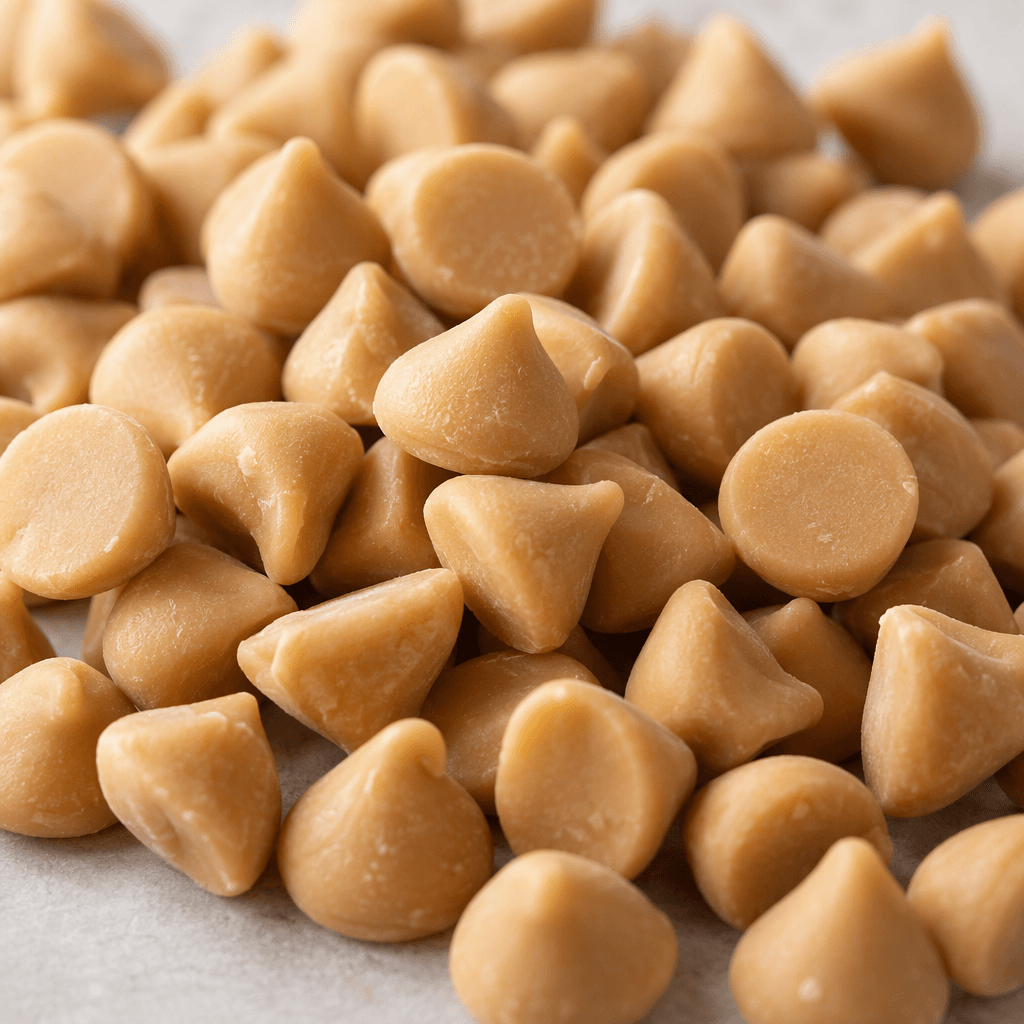
Peanut butter chips Calories
Sweet, peanut butter flavored, energy-dense snack
CALORIES
GI
POTASSIUM
FIBER
Quick answer
1 tablespoon (medium) of Peanut butter chips (15 g) has 78 calories. That works out to 520 calories per 100 g. It contains 8.3 g of carbs, 1.5 g of protein, 4.5 g of fat and 0.5 g of fiber. Its glycemic index is 55 (medium), so it raises blood sugar at a moderate pace.
What is Peanut butter chips?
Peanut butter chips are small, sweet morsels made to bring peanut-butter flavour to baking. Despite the word “chips,” they are not crisp potato-style snacks: they have a smooth, firm texture and are commonly stirred into cookie or cake batter, scattered over desserts, or used as a topping. Their rich, sweet taste pairs naturally with chocolate, oats and banana.
In the US, they’re a familiar baking addition; elsewhere, they work much the same way in home baking or as an occasional nibble with coffee or tea. They’re energy-dense, with 520 calories per 100 g, so a small handful or a spoonful is usually enough to add sweetness and flavour. Try them in oatmeal cookies or mixed into a simple trail-style snack.
Peanut butter chips Nutrition Facts
Selected: 100 g
520
KCAL / 100G
Carbs
55g
· 20% DV
Protein
10g
· 20% DV
Fat
30g
· 38% DV
Fiber
3g
· 11% DV
DV is the share of the daily value covered, on a 2,000 kcal reference diet.
Calories come from: Carbs 42% · Protein 8% · Fat 50%
Peanut butter chips Vitamins & Minerals
Vitamins
Vitamin E
2.5mg · 17% DV
B3
2.5mg · 16% DV
B5
0.5mg · 10% DV
B1
0.08mg · 7% DV
Minerals
Manganese
1mg · 43% DV
Phosphorus
110mg · 16% DV
Magnesium
60mg · 14% DV
Sodium
220mg · 10% DV
How Nutritious Is Peanut butter chips?
Nutrient density
Low
How many vitamins, minerals and how much fiber this food carries per calorie. A high score means a lot of nutrition for few calories.
Satiety score
Low
An EatBetter score computed from fiber, protein and calorie density. A high score means staying full longer on the same calories.
Both scores are calculated per 100 g and do not change with the selected portion. The satiety score is EatBetter's own calculation, not a clinical measure.
Peanut butter chips Glycemic Index
GLYCEMIC INDEX
GLYCEMIC LOAD
Accounts for portion size — a more realistic measure than GI alone.
How to Burn Off Peanut butter chips
To burn the 520 calories in 100 g:
🚶
Walking (5 km/h)
🏃
Running (8 km/h)
🚴
Cycling
🏊
Swimming
Times are calculated with the MET equation for a 70 kg adult. Actual burn varies with your weight, age and pace.
Is Peanut butter chips Processed?
NOVA 4
Ultra-Processed
1. Unprocessed
2. Minimally Processed
3. Processed
4. Ultra-Processed
NOVA classifies foods into 4 groups by industrial processing. NOVA 1 (unprocessed) is the healthiest.
Does Peanut butter chips Contain Allergens?
Contains these allergens:
Which Diets Is Peanut butter chips Good For?
Vegan
— Not suitable
Vegetarian
✓ Suitable
Gluten-Free
— Not suitable
Dairy-Free
— Not suitable
Mediterranean
— Not suitable
Paleo
— Not suitable
Whole30
— Not suitable
DASH
— Not suitable
Keto
— Not suitable
Low FODMAP
— Not suitable
Peanut butter chips Fat Profile
SATURATED
7g
MONOUNSATURATED
13g
POLYUNSATURATED
8g
Omega 6:3 ratio 110:1
Above the ideal 4:1 (110:1).
Compare Peanut butter chips
Foods Similar to Peanut butter chips
Frequently Asked Questions About Peanut butter chips
What are peanut butter chips?
Peanut butter chips are small, sweet baking morsels flavored with peanut butter. They are made to hold their shape in recipes such as cookies and muffins, rather than being the same thing as potato chips or spoonable peanut butter.
Can you bake peanut butter chips into cookies?
Yes, stir peanut butter chips into cookie dough before baking. They add sweet peanut flavor and usually remain as distinct morsels, so they work well in peanut butter cookies, chocolate cookies, and cookie bars.
Do peanut butter chips melt smoothly?
Not always. Peanut butter chips are formulated to keep their shape during baking, so melted chips can be thicker and less smooth than melted chocolate. Heat them gently and stir often; a little neutral oil can help loosen the mixture.
Are peanut butter chips the same as peanut butter?
No. Peanut butter chips are sweet, firm morsels designed for baking, while peanut butter is a spread. Their different texture and formulation mean you generally cannot replace one with the other measure for measure in a recipe.
Can peanut butter chips replace chocolate chips?
Yes, peanut butter chips can replace chocolate chips in many cookies, brownies, and muffins. They make the result sweeter and give it a distinct peanut flavor, so they pair especially well with chocolate, banana, and oats.
What are peanut butter chips made of?
Peanut butter chips typically contain sweeteners, peanut ingredients, and fats that help them hold their shape. Recipes differ by brand, so the exact ingredients can vary; their firm texture is what makes them useful as baking morsels.
Can you melt peanut butter chips in the microwave?
Yes, microwave peanut butter chips in a microwave-safe bowl using short bursts, stirring between each one. Stop while a few pieces remain and stir until smooth; continuing to heat them can make the mixture stiff or scorched.
How should you store peanut butter chips after opening?
Keep peanut butter chips tightly sealed in a cool, dry cupboard, away from heat and moisture. A well-sealed container helps prevent them from softening, sticking together, or picking up odors from other foods.
Can you freeze peanut butter chips?
Yes, peanut butter chips can be frozen in an airtight container or freezer bag. Let the sealed container come to room temperature before opening it, which helps prevent condensation from making the morsels damp or sticky.
Can dogs eat peanut butter chips?
No, peanut butter chips are not a suitable treat for dogs because they are sweet and rich, and some products may contain ingredients unsafe for dogs. Keep them out of reach and offer a dog-safe treat instead.
Have another question about Peanut butter chips?
Ask the AI nutrition coach — calories, portions, alternatives and more, answered in seconds in the app.

Scan calories with your camera
Instant AI nutrition analysis

Nutrition data compiled from USDA FoodData Central and scientific sources.