

Ready & Packaged Foods
All →Vegetables & Legumes
All →Desserts & Confectionery
All →Meat & Protein
All →Grains & Bakery
All →Beverages
All →Milk & Dairy
All →

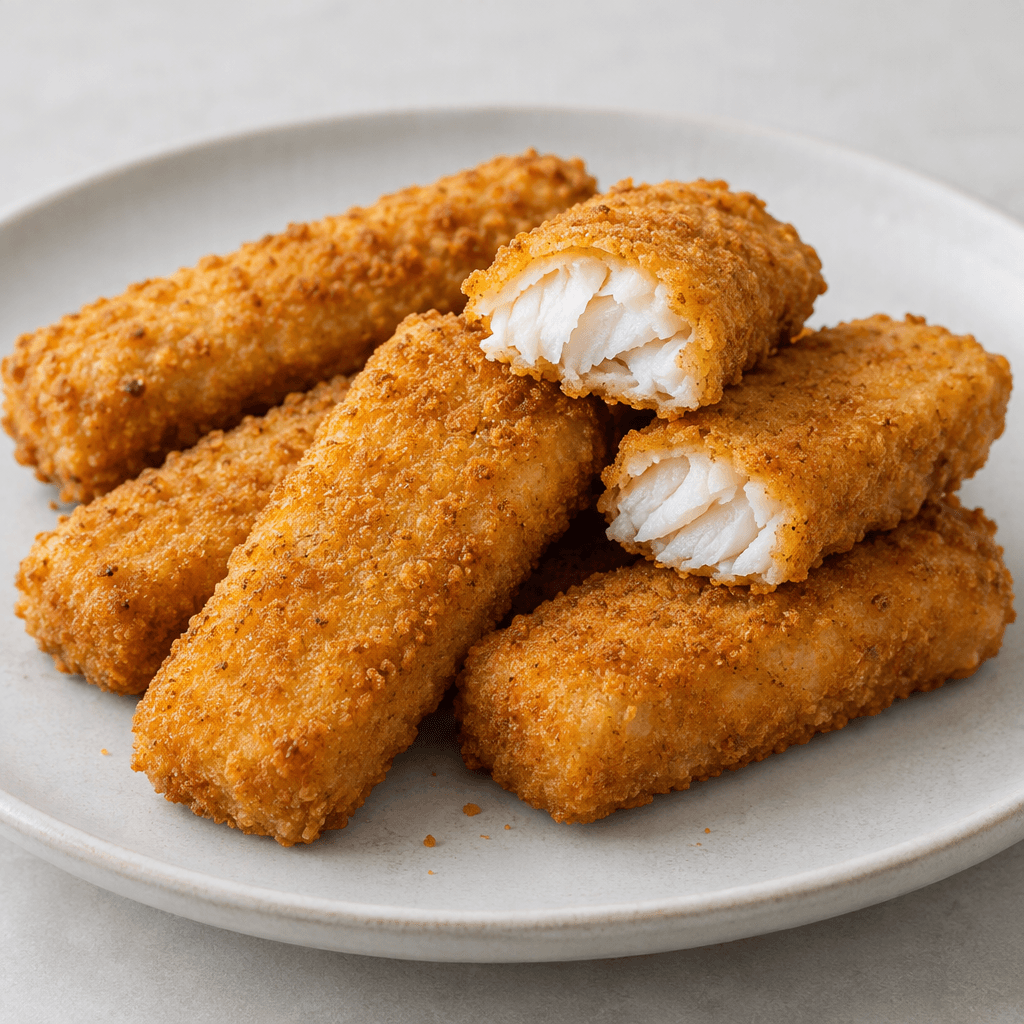
Fish fingers Calories
Popular snack, source of protein and omega-3
In season: Spring · Summer · Autumn · Winter
CALORIES
GI
POTASSIUM
FIBER
Quick answer
3 piece (medium) of Fish fingers (75 g) has 165 calories. That works out to 220 calories per 100 g. It contains 16.5 g of carbs, 9 g of protein, 6.8 g of fat and 1.1 g of fiber. Its 0.6 µg of B12 covers 25% of the Daily Value. Its glycemic index is 65 (medium), so it raises blood sugar at a moderate pace.
What is Fish fingers?
Fish fingers are rectangular pieces of fish coated in crumbs and cooked until golden. The coating turns crisp while the fish inside stays soft and flaky; their mild flavour makes them an easy option for family meals.
In the UK and elsewhere, they’re often served with chips and peas, tucked into a sandwich, or paired with salad and a dip. They provide protein, while the crumb coating adds carbohydrates. For a lighter meal, bake them rather than frying and serve with plenty of vegetables; a squeeze of lemon or a simple yoghurt-based dip works well too.
Fish fingers Nutrition Facts
Selected: 100 g
220
KCAL / 100G
Carbs
22g
· 8% DV
Protein
12g
· 24% DV
Fat
9g
· 12% DV
Fiber
1.5g
· 5% DV
DV is the share of the daily value covered, on a 2,000 kcal reference diet.
Calories come from: Carbs 41% · Protein 22% · Fat 37%
Fish fingers Vitamins & Minerals
Vitamins
B12
0.8µg · 33% DV
B3
1.2mg · 8% DV
Vitamin E
1.2mg · 8% DV
Biotin
2µg · 7% DV
Minerals
Selenium
12µg · 22% DV
Iodine
30µg · 20% DV
Sodium
380mg · 17% DV
Phosphorus
110mg · 16% DV
How Nutritious Is Fish fingers?
Nutrient density
Medium
How many vitamins, minerals and how much fiber this food carries per calorie. A high score means a lot of nutrition for few calories.
Satiety score
Medium
An EatBetter score computed from fiber, protein and calorie density. A high score means staying full longer on the same calories.
Both scores are calculated per 100 g and do not change with the selected portion. The satiety score is EatBetter's own calculation, not a clinical measure.
Fish fingers Glycemic Index
GLYCEMIC INDEX
GLYCEMIC LOAD
Accounts for portion size — a more realistic measure than GI alone.
How to Burn Off Fish fingers
To burn the 220 calories in 100 g:
🚶
Walking (5 km/h)
🏃
Running (8 km/h)
🚴
Cycling
🏊
Swimming
Times are calculated with the MET equation for a 70 kg adult. Actual burn varies with your weight, age and pace.
Is Fish fingers Processed?
NOVA 3
Processed
1. Unprocessed
2. Minimally Processed
3. Processed
4. Ultra-Processed
NOVA classifies foods into 4 groups by industrial processing. NOVA 1 (unprocessed) is the healthiest.
Does Fish fingers Contain Allergens?
Contains these allergens:
Which Diets Is Fish fingers Good For?
Vegan
— Not suitable
Vegetarian
— Not suitable
Gluten-Free
— Not suitable
Dairy-Free
— Not suitable
Mediterranean
✓ Suitable
Paleo
— Not suitable
Whole30
— Not suitable
DASH
— Not suitable
Keto
— Not suitable
Low FODMAP
— Not suitable
Fish fingers Fat Profile
SATURATED
1.8g
MONOUNSATURATED
2.6g
POLYUNSATURATED
2.2g
Omega 6:3 ratio 2.5:1
Below the ideal 4:1 — a good omega balance.
Compare Fish fingers
Foods Similar to Fish fingers
Frequently Asked Questions About Fish fingers
What fish are fish fingers made from?
Fish fingers are usually made from mild white fish such as pollock, cod or haddock. The species varies between products, so the fish named on the package is the best guide; the pieces are coated in breadcrumbs before cooking.
Can you cook fish fingers from frozen?
Yes, most fish fingers can be cooked straight from frozen. Cooking them without thawing helps the coating stay crisp; spread them out in a single layer and follow the cooking directions for that product.
How do you cook fish fingers in an air fryer?
Fish fingers cook well in an air fryer when arranged in a single layer with space around them. Turn or shake them partway through so they brown evenly, and use the product’s instructions for the time and temperature.
How do you cook fish fingers in the oven?
Bake fish fingers on a tray in a preheated oven, leaving space between each piece. Turn them once during cooking for an evenly crisp coating, and follow the package directions because sizes and products vary.
Can you cook fish fingers in a pan?
Yes, you can pan-fry fish fingers in a little oil over medium heat. Turn them as they cook so the coating browns on all sides; avoid high heat, which can brown the outside before the centre is hot.
What do you serve with fish fingers?
Fish fingers pair well with chips, peas, salad or coleslaw. For a quick sandwich, put them in a soft roll with lettuce and tartar sauce; lemon wedges also add a fresh contrast to the crisp coating.
Are fish fingers made from whole fish fillets?
Some fish fingers are cut from whole fillets, while others are made from minced or re-formed fish. The texture and shape can differ, so check the product description if you specifically want fillet pieces.
Can you make fish fingers at home?
Yes, homemade fish fingers are easy to make with firm white fish. Cut it into strips, coat each piece in flour, beaten egg and breadcrumbs, then bake or air-fry until golden and cooked through.
Are fish fingers healthy?
Fish fingers provide protein, but the breadcrumb coating and cooking method can add salt and fat. Baking or air-frying them and serving them with vegetables makes for a more balanced meal than pairing them only with chips.
Can you reheat cooked fish fingers?
Yes, cooked fish fingers can be reheated until piping hot throughout. An oven or air fryer usually keeps the coating crisper than a microwave; refrigerate leftovers promptly and avoid reheating them more than once.
Have another question about Fish fingers?
Ask the AI nutrition coach — calories, portions, alternatives and more, answered in seconds in the app.

Scan calories with your camera
Instant AI nutrition analysis

Nutrition data compiled from USDA FoodData Central and scientific sources.