

Ready & Packaged Foods
All →Vegetables & Legumes
All →Desserts & Confectionery
All →Meat & Protein
All →Grains & Bakery
All →Beverages
All →Milk & Dairy
All →

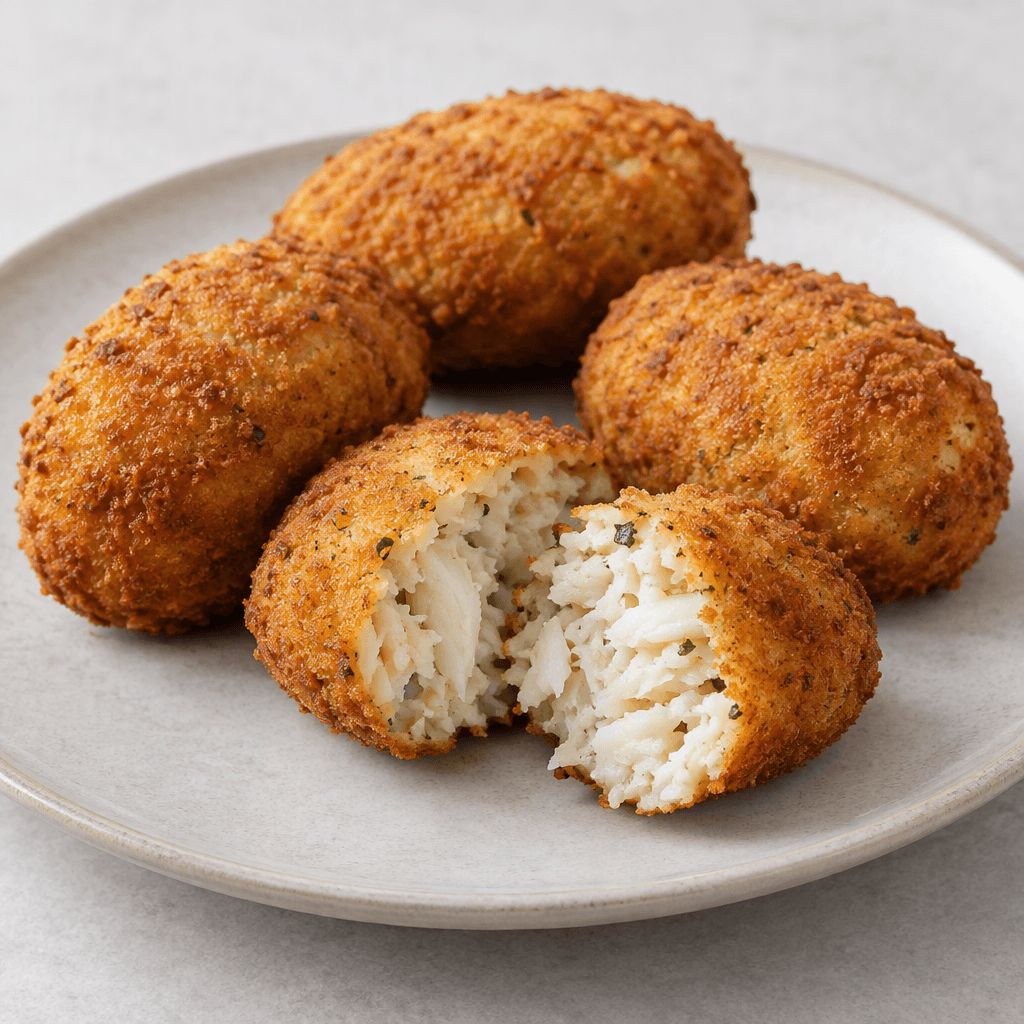
Fish Croquette Calories
Fried fish croquette, contains protein and omega-3, crispy outside, soft inside.
In season: Spring · Summer · Autumn · Winter
CALORIES · 100 G
GI
POTASSIUM · 100 G
FIBER · 100 G
Quick answer
2 piece (medium) of Fish Croquette (60 g) has 126 calories. That works out to 210 calories per 100 g. It contains 11.4 g of carbs, 7.2 g of protein, 5.4 g of fat and 0.7 g of fiber. Its 0.5 µg of B12 covers 20% of the Daily Value. Its glycemic index is 65 (medium), so it raises blood sugar at a moderate pace.
Fish Croquette Nutrition Facts
Selected: 2 piece (medium) · 60 g
126
KCAL / 60G
Carbs
11.4g
· 4% DV
Protein
7.2g
· 14% DV
Fat
5.4g
· 7% DV
Fiber
0.7g
· 3% DV
DV is the share of the daily value covered, on a 2,000 kcal reference diet.
Calories come from: Carbs 37% · Protein 23% · Fat 40%
Fish Croquette nutrition facts table · 2 piece (medium) (60 g)
| Nutrient | Amount | % DV |
|---|---|---|
| Calories | 126 kcal | |
| Total fat | 5.4 g | 7% |
| Saturated fat | 1.26 g | 6% |
| Trans fat | 0.05 g | |
| Sodium | 204 mg | 9% |
| Total carbohydrate | 11.4 g | 4% |
| Fiber | 0.7 g | 3% |
| Protein | 7.2 g | 14% |
Calories: Calories measure energy. Average daily need is 2,000 kcal. Excess calories are stored as fat, too few cause weight loss.
Carbs: Your body's primary energy source. The brain runs exclusively on carbs. Daily need: 275g.
Protein: Essential for muscle repair and cell growth. Daily need: 50g. Keeps you full and boosts metabolism.
Fat: Needed for hormone production and vitamin absorption. Daily need: 78g. Limit saturated fats, choose unsaturated.
Fiber: Critical for digestive health and satiety. Daily need: 28g. Stabilizes blood sugar, lowers cholesterol.

Log this food in EatBetter
100,000+ people use it
- Get your daily calorie target
- Snap your meal, log it in seconds
- See every vitamin and mineral

📸 Scan the code to get the app free.

How Many Calories in 2 Pieces of Fish Croquette?
| Serving | Amount | Calories |
|---|---|---|
| 2 piece (medium) | 60 g | 126 kcal |
| 1 piece (thin) | 20 g | 42 kcal |
| 1 piece (small) | 30 g | 63 kcal |
| 1 piece (thick) | 45 g | 95 kcal |
| 3 piece (large) | 90 g | 189 kcal |
| 100 g | 100 g | 210 kcal |
| 1 serving (large) | 120 g | 252 kcal |
| 5 piece (jumbo) | 150 g | 315 kcal |
| 1 pack (jumbo) | 250 g | 525 kcal |
Calculated from 210 calories per 100 g.
Frequently Asked Questions About Fish Croquette
What is a fish croquette made of?
A fish croquette is usually made with flaked fish mixed with mashed potato or a thick sauce, then shaped, crumbed and cooked. Recipes vary, and some include onion, herbs or seasoning in the filling.
How do you make fish croquettes at home?
To make fish croquettes, combine cooked, flaked fish with mashed potato or a thick sauce and chill the mixture until firm. Shape it, coat each piece in flour, egg and breadcrumbs, then fry or bake until crisp and golden.
Can you cook frozen fish croquettes without thawing them?
Usually, frozen fish croquettes can be cooked straight from frozen, but the method and cooking time depend on whether they are raw or pre-cooked. Follow the package’s cooking directions and make sure the centre is piping hot before serving.
What fish works best in fish croquettes?
Mild, flaky fish such as cod, haddock or pollock works well in fish croquettes because it blends easily with the filling. Remove all bones before mixing; oily fish can also be used but gives the croquettes a stronger flavour.
Why do fish croquettes fall apart when frying?
Fish croquettes often fall apart because the mixture is too wet, warm or loosely bound. Chill the filling before shaping, add a little more potato or thick sauce if needed, and coat each croquette thoroughly so the crumbs form a firm outer layer.
Are fish croquettes the same as fish cakes?
No, fish croquettes are typically shaped portions of fish filling coated in breadcrumbs, giving them a crisp shell. Fish cakes are usually broader patties and may be cooked without a separate breadcrumb coating, though recipes can overlap.
What sauce goes well with fish croquettes?
Tartar sauce is a classic match for fish croquettes, while lemon adds freshness. Garlic mayonnaise, a mustard sauce or a simple herbed yogurt dip also works; choose a lighter, tangy sauce to balance the crisp coating.
Can you freeze homemade fish croquettes?
Yes, homemade fish croquettes freeze well. Freeze uncooked pieces on a tray until firm, then transfer them to a sealed container; separating layers helps prevent sticking. Cook them from frozen or thaw them safely in the refrigerator first.
Are fish croquettes already cooked?
Not always: homemade fish croquettes are often made with cooked fish, but frozen or packaged versions may be raw, partly cooked or fully cooked. Their appearance alone does not tell you which, so use the product’s cooking instructions and heat them through.
Are fish croquettes healthy?
Fish croquettes provide fish protein and can contain omega-3, but the breadcrumb coating and frying add fat and often salt. Baking or air-frying them and serving them with vegetables makes for a lighter meal than deep-frying.
Fish Croquette Vitamins & Minerals
Vitamins
B12
0.48µg · 20% DV
B6
0.08mg · 5% DV
B3
0.72mg · 5% DV
Vitamin E
0.66mg · 4% DV
Minerals
Selenium
7.8µg · 14% DV
Phosphorus
66mg · 9% DV
Sodium
204mg · 9% DV
Iodine
11µg · 7% DV
Potassium ⭐
108mg · 3% DV
Fish Croquette Glycemic Index
GLYCEMIC INDEX
GLYCEMIC LOAD
Accounts for portion size — a more realistic measure than GI alone.
How to Burn Off Fish Croquette
To burn the 126 calories in 2 piece (medium) (60 g):
🚶
Walking (5 km/h)
🏃
Running (8 km/h)
🚴
Cycling
🏊
Swimming
Times are calculated with the MET equation for a 70 kg adult. Actual burn varies with your weight, age and pace.
What is Fish Croquette?
A fish croquette is made by shaping cooked, flaked fish with a binder—often potato or a thick white sauce—then coating it in crumbs and frying it. It belongs to the broad European croquette tradition, though the fish and filling vary between recipes.
The crumbed shell turns crisp while the middle stays soft and tender. It is served as a snack, starter or part of a meal, often with lemon, salad or a dipping sauce; frozen versions are also convenient to bake at home. Fish croquettes provide protein, with 12 g per 100 g. For a lighter plate, bake rather than fry them and pair with vegetables or a fresh salad.
How Nutritious Is Fish Croquette?
Nutrient density
Medium
How many vitamins, minerals and how much fiber this food carries per calorie. A high score means a lot of nutrition for few calories.
Satiety score
Medium
An EatBetter score computed from fiber, protein and calorie density. A high score means staying full longer on the same calories.
Both scores are calculated per 100 g and do not change with the selected portion. The satiety score is EatBetter's own calculation, not a clinical measure.
Is Fish Croquette Processed?
NOVA 3
Processed
1. Unprocessed
2. Minimally Processed
3. Processed
4. Ultra-Processed
NOVA classifies foods into 4 groups by industrial processing. NOVA 1 (unprocessed) is the healthiest.
Does Fish Croquette Contain Allergens?
Contains these allergens:
Which Diets Is Fish Croquette Good For?
Vegan
— Not suitable
Vegetarian
— Not suitable
Gluten-Free
— Not suitable
Dairy-Free
— Not suitable
Mediterranean
✓ Suitable
Paleo
— Not suitable
Whole30
— Not suitable
DASH
— Not suitable
Keto
— Not suitable
Low FODMAP
— Not suitable
Fish Croquette Fat Profile
SATURATED
1.26g
MONOUNSATURATED
1.86g
POLYUNSATURATED
1.32g
Omega 6:3 ratio 0.7:1
Below the ideal 4:1 — a good omega balance.
Compare Fish Croquette
Foods Similar to Fish Croquette
Have another question about Fish Croquette?
Ask the AI nutrition coach — calories, portions, alternatives and more, answered in seconds in the app.

Scan calories with your camera
Instant AI nutrition analysis

Nutrition data compiled from USDA FoodData Central and scientific sources.