

Ready & Packaged Foods
All →Vegetables & Legumes
All →Desserts & Confectionery
All →Meat & Protein
All →Grains & Bakery
All →Beverages
All →Milk & Dairy
All →

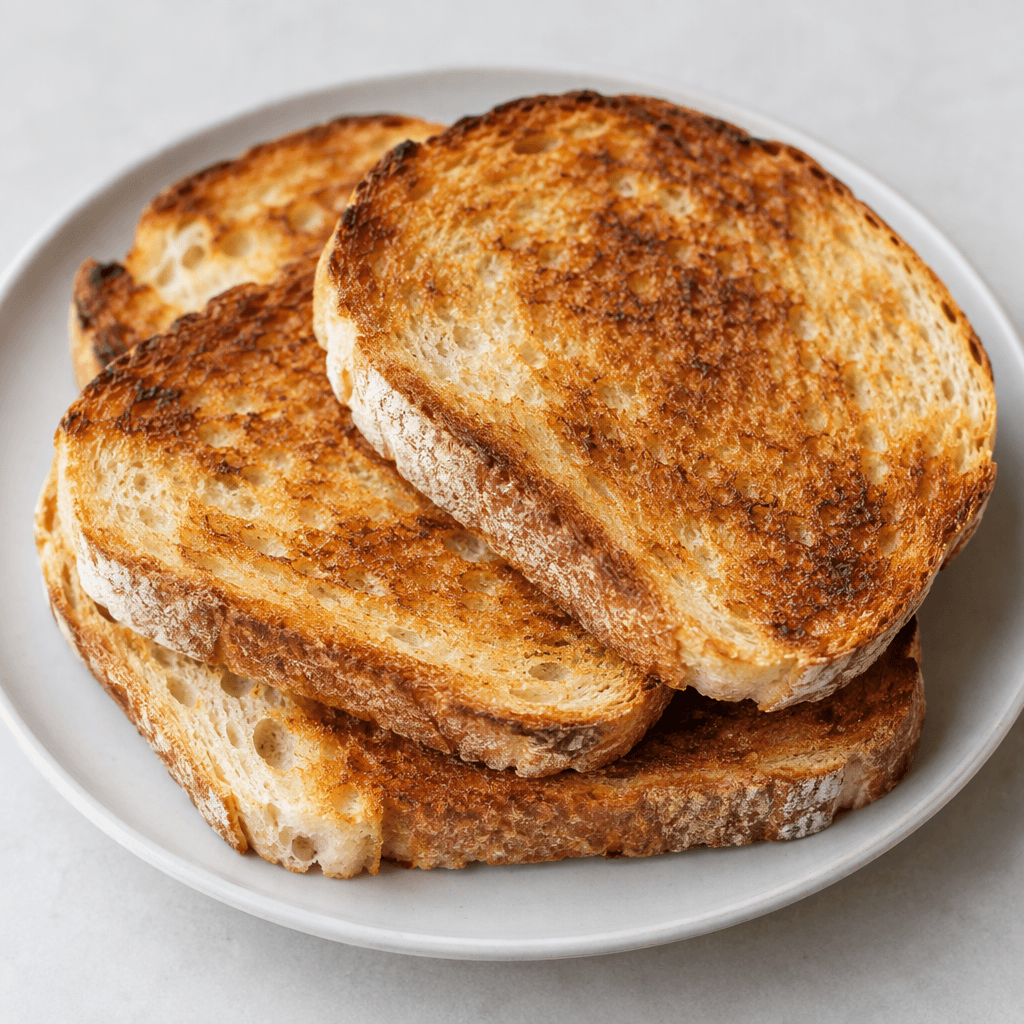
Toasted Bread Calories
Classic breakfast staple, lightly crisped bread.
In season: Spring · Summer · Autumn · Winter
CALORIES
GI
POTASSIUM
FIBER
Quick answer
1 slice (medium) of Toasted Bread (30 g) has 96 calories. That works out to 320 calories per 100 g. It contains 17.4 g of carbs, 2.7 g of protein, 1.2 g of fat and 0.9 g of fiber. Its 0.2 mg of Manganese covers 7% of the Daily Value. Its glycemic index is 75 (high), so it raises blood sugar quickly.
What is Toasted Bread?
Toasted bread is made by heating slices of bread until their surfaces turn golden and crisp. The centre usually stays soft and airy, while a deeper toast gives the slices a more pronounced, roasted flavour. The result depends on the bread and how long it is toasted.
It is a familiar breakfast staple in many places, served with butter, jam, eggs or avocado, and it also works well alongside soup or as the base for an open sandwich. It is mainly a source of carbohydrates, with 58 g per 100 g, plus 9 g of protein. Pair it with eggs, beans or another protein-rich topping for a more filling meal, or keep it simple as a side.
Toasted Bread Nutrition Facts
Selected: 100 g
320
KCAL / 100G
Carbs
58g
· 21% DV
Protein
9g
· 18% DV
Fat
4g
· 5% DV
Fiber
3g
· 11% DV
DV is the share of the daily value covered, on a 2,000 kcal reference diet.
Calories come from: Carbs 76% · Protein 12% · Fat 12%
Toasted Bread Vitamins & Minerals
Vitamins
B1
0.25mg · 21% DV
B3
2.5mg · 16% DV
B2
0.12mg · 9% DV
Folate
35µg · 9% DV
Minerals
Manganese
1mg · 43% DV
Selenium
12µg · 22% DV
Sodium
480mg · 21% DV
Phosphorus
70mg · 10% DV
How Nutritious Is Toasted Bread?
Nutrient density
Low
How many vitamins, minerals and how much fiber this food carries per calorie. A high score means a lot of nutrition for few calories.
Satiety score
Medium
An EatBetter score computed from fiber, protein and calorie density. A high score means staying full longer on the same calories.
Both scores are calculated per 100 g and do not change with the selected portion. The satiety score is EatBetter's own calculation, not a clinical measure.
Toasted Bread Glycemic Index
GLYCEMIC INDEX
GLYCEMIC LOAD
Accounts for portion size — a more realistic measure than GI alone.
How to Burn Off Toasted Bread
To burn the 320 calories in 100 g:
🚶
Walking (5 km/h)
🏃
Running (8 km/h)
🚴
Cycling
🏊
Swimming
Times are calculated with the MET equation for a 70 kg adult. Actual burn varies with your weight, age and pace.
Is Toasted Bread Processed?
NOVA 3
Processed
1. Unprocessed
2. Minimally Processed
3. Processed
4. Ultra-Processed
NOVA classifies foods into 4 groups by industrial processing. NOVA 1 (unprocessed) is the healthiest.
Does Toasted Bread Contain Allergens?
Contains these allergens:
Which Diets Is Toasted Bread Good For?
Vegan
— Not suitable
Vegetarian
✓ Suitable
Gluten-Free
— Not suitable
Dairy-Free
— Not suitable
Mediterranean
— Not suitable
Paleo
— Not suitable
Whole30
— Not suitable
DASH
— Not suitable
Keto
— Not suitable
Low FODMAP
— Not suitable
Toasted Bread Fat Profile
SATURATED
0.7g
MONOUNSATURATED
1.2g
POLYUNSATURATED
1.7g
Omega 6:3 ratio 15:1
Above the ideal 4:1 (15:1).
Compare Toasted Bread
Foods Similar to Toasted Bread
Frequently Asked Questions About Toasted Bread
How do you make Toasted Bread without a toaster?
You can make Toasted Bread in a hot, dry skillet or under a broiler. Turn the slices when one side is golden, and watch closely because the surface can go from browned to burnt quickly.
Is Toasted Bread healthier than regular bread?
No, toasting Toasted Bread does not automatically make it healthier than the same bread untoasted. It mainly removes moisture and changes the texture; the bread’s ingredients and toppings matter more. Avoid heavily browned or charred slices.
Can you make Toasted Bread from stale bread?
Yes, slightly stale bread works well for Toasted Bread because it crisps as it heats. If a slice is very dry and hard, lightly dampen it before reheating; discard bread that shows mold rather than trying to toast it.
What type of bread is best for Toasted Bread?
Many breads work for Toasted Bread, but sturdy slices that hold together are easiest to handle. Sourdough, whole-grain loaves, and sandwich bread all toast well; thicker slices stay softer in the middle while thin slices become crisp throughout.
Why does Toasted Bread turn brown?
Toasted Bread turns brown because heat triggers browning reactions between sugars and proteins on its surface. These reactions create the toasted aroma and flavor; using moderate heat helps brown the slice evenly without scorching it.
Is burnt Toasted Bread bad for you?
It is better not to eat heavily burnt Toasted Bread. Starchy foods can form acrylamide when cooked at high temperatures until very dark, so aim for a golden-brown finish and discard charred portions.
Does Toasted Bread raise blood sugar?
Yes, Toasted Bread can raise blood sugar because it contains carbohydrates, and toasting does not remove them. The response also depends on the bread and portion; people managing diabetes can ask their clinician or dietitian for individualized advice.
How should you store leftover Toasted Bread?
For the best texture, eat Toasted Bread soon after making it. If you have leftovers, let them cool completely and keep them in an airtight container at room temperature; sealing them while warm traps steam and makes them soft.
Can you freeze Toasted Bread?
Yes, you can freeze Toasted Bread, though it may lose some crispness after thawing. For a fresher result, freeze bread slices before toasting, then toast them straight from frozen rather than storing finished toast.
What goes well on Toasted Bread for breakfast?
Toasted Bread pairs well with eggs, avocado, cheese, or nut butter for breakfast. Add moist toppings just before serving so the slice stays crisp; jam or honey also works when you want a sweeter option.
Have another question about Toasted Bread?
Ask the AI nutrition coach — calories, portions, alternatives and more, answered in seconds in the app.

Scan calories with your camera
Instant AI nutrition analysis

Nutrition data compiled from USDA FoodData Central and scientific sources.