

Ready & Packaged Foods
All →Vegetables & Legumes
All →Desserts & Confectionery
All →Meat & Protein
All →Grains & Bakery
All →Beverages
All →Milk & Dairy
All →

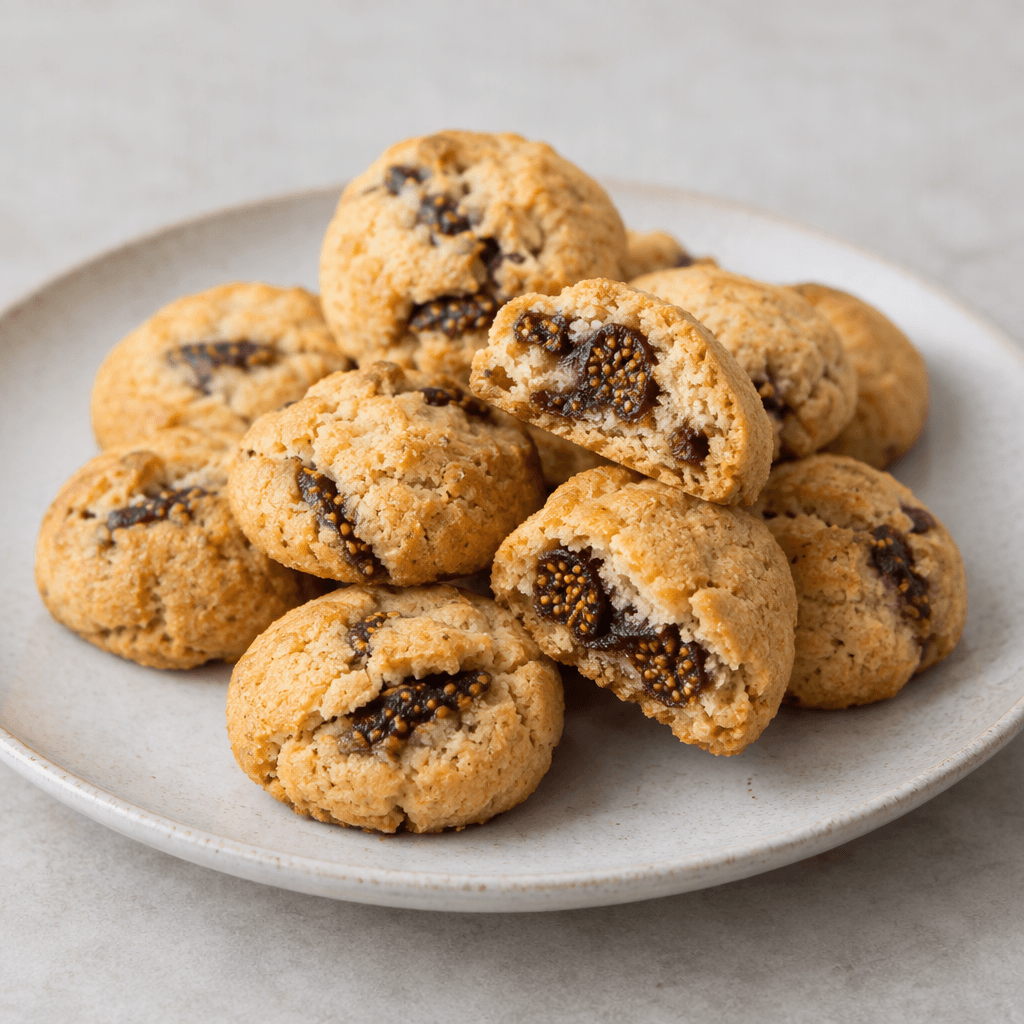
Fig Cookie Calories
Fig-filled cookie, typically made with flour, butter, sugar, and dried figs.
In season: Spring · Summer · Autumn · Winter
CALORIES
GI
POTASSIUM
FIBER
Quick answer
2 piece (medium) of Fig Cookie (40 g) has 156 calories. That works out to 390 calories per 100 g. It contains 28.8 g of carbs, 1.7 g of protein, 4.2 g of fat and 1.5 g of fiber. Its 0.1 mg of Copper covers 6% of the Daily Value. Its glycemic index is 65 (high), so it raises blood sugar quickly.
What is Fig Cookie?
A Fig Cookie is a sweet baked treat made with flour, butter and sugar, with dried figs mixed into the dough or tucked inside as a filling. In Turkey, homemade versions are often shaped into small, golden cookies, with the fruit adding a darker, chewy centre.
The outside is usually crumbly, while the figs bring a soft, jammy texture and concentrated sweetness. Serve one with tea or coffee as an afternoon snack, or put them out for guests. These cookies are mostly a source of carbohydrate rather than protein; a modest portion works well when you want something sweet without making it the centre of a meal.
Fig Cookie Nutrition Facts
Selected: 100 g
390
KCAL / 100G
Carbs
72g
· 26% DV
Protein
4.2g
· 8% DV
Fat
10.5g
· 13% DV
Fiber
3.8g
· 14% DV
DV is the share of the daily value covered, on a 2,000 kcal reference diet.
Calories come from: Carbs 72% · Protein 4% · Fat 24%
Fig Cookie Vitamins & Minerals
Vitamins
B1
0.08mg · 7% DV
B2
0.09mg · 7% DV
B3
0.7mg · 4% DV
B5
0.2mg · 4% DV
Minerals
Sodium
180mg · 8% DV
Phosphorus
50mg · 7% DV
Iron
1mg · 6% DV
Calcium
45mg · 5% DV
How Nutritious Is Fig Cookie?
Nutrient density
Low
How many vitamins, minerals and how much fiber this food carries per calorie. A high score means a lot of nutrition for few calories.
Satiety score
Low
An EatBetter score computed from fiber, protein and calorie density. A high score means staying full longer on the same calories.
Both scores are calculated per 100 g and do not change with the selected portion. The satiety score is EatBetter's own calculation, not a clinical measure.
Fig Cookie Glycemic Index
GLYCEMIC INDEX
GLYCEMIC LOAD
Accounts for portion size — a more realistic measure than GI alone.
How to Burn Off Fig Cookie
To burn the 390 calories in 100 g:
🚶
Walking (5 km/h)
🏃
Running (8 km/h)
🚴
Cycling
🏊
Swimming
Times are calculated with the MET equation for a 70 kg adult. Actual burn varies with your weight, age and pace.
Is Fig Cookie Processed?
NOVA 3
Processed
1. Unprocessed
2. Minimally Processed
3. Processed
4. Ultra-Processed
NOVA classifies foods into 4 groups by industrial processing. NOVA 1 (unprocessed) is the healthiest.
Does Fig Cookie Contain Allergens?
Contains these allergens:
Which Diets Is Fig Cookie Good For?
Vegan
— Not suitable
Vegetarian
✓ Suitable
Gluten-Free
— Not suitable
Dairy-Free
— Not suitable
Mediterranean
— Not suitable
Paleo
— Not suitable
Whole30
— Not suitable
DASH
— Not suitable
Keto
— Not suitable
Low FODMAP
— Not suitable
Fig Cookie Fat Profile
SATURATED
3.5g
MONOUNSATURATED
2.9g
POLYUNSATURATED
1.2g
Omega 6:3 ratio 55:1
Above the ideal 4:1 (55:1).
Compare Fig Cookie
Foods Similar to Fig Cookie
Frequently Asked Questions About Fig Cookie
How do you make fig cookies?
Fig cookies are made by wrapping a fig filling in cookie dough and baking until set and lightly golden. A common homemade dough uses flour, butter, and sugar; dried figs are chopped or cooked into a thick filling so it stays inside the cookie.
Are fig cookies the same as Fig Newtons?
No, fig cookies are a broad homemade cookie style, while Fig Newtons are a specific packaged fig-filled cookie brand. Homemade versions can have a crumbly, buttery dough and a chunky filling, unlike the softer, more uniform texture of many packaged fig bars.
Can you make fig cookies with fresh figs?
Yes, you can make fig cookies with fresh figs, but their extra moisture can make the filling runny. Cook the chopped figs until thick, then cool the filling before assembling the cookies; dried figs are easier to use for a firm center.
How do you stop fig filling from leaking out of fig cookies?
Keep the fig filling thick and cool before adding it to fig cookies. Use a modest amount, leave a clean edge around the dough, and seal the seam firmly; excess moisture or overfilling is the usual reason filling escapes during baking.
Why are my fig cookies dry or crumbly?
Fig cookies often turn dry or crumbly when too much flour is added, the dough is overworked, or the cookies bake too long. Measure flour carefully and stop mixing once the dough comes together; let the cookies cool before judging their final texture.
How long do homemade fig cookies last?
Homemade fig cookies keep well for several days in an airtight container at room temperature, once completely cool. Store them away from heat and moisture; cookies with a particularly moist fresh-fig filling should be refrigerated and eaten sooner.
Do fig cookies need to be refrigerated?
Fig cookies made with a cooked dried-fig filling usually do not need refrigeration for short-term storage; keep them sealed in a cool, dry place. Refrigerate cookies containing a moist fresh-fig filling, since that filling spoils more readily.
Can you freeze fig cookies?
Yes, fig cookies freeze well when fully cooled and packed in an airtight container or freezer bag. Separate layers with parchment to prevent sticking, thaw them at room temperature, and avoid freezing them again after thawing.
Are fig cookies healthy?
Fig cookies can provide some fiber from the figs, but they are still a sweet baked treat made with ingredients such as flour, butter, and sugar. The dried fruit does not make them equivalent to eating whole fresh figs.
Can you make fig cookies without butter?
Yes, you can make fig cookies without butter, but replacing it changes their flavor and crumbly texture. A baking fat substitute can work in a tested cookie recipe; using a liquid oil may make the dough softer and the baked cookies less tender.
Have another question about Fig Cookie?
Ask the AI nutrition coach — calories, portions, alternatives and more, answered in seconds in the app.

Scan calories with your camera
Instant AI nutrition analysis

Nutrition data compiled from USDA FoodData Central and scientific sources.