

Ready & Packaged Foods
All →Vegetables & Legumes
All →Desserts & Confectionery
All →Meat & Protein
All →Grains & Bakery
All →Beverages
All →Milk & Dairy
All →

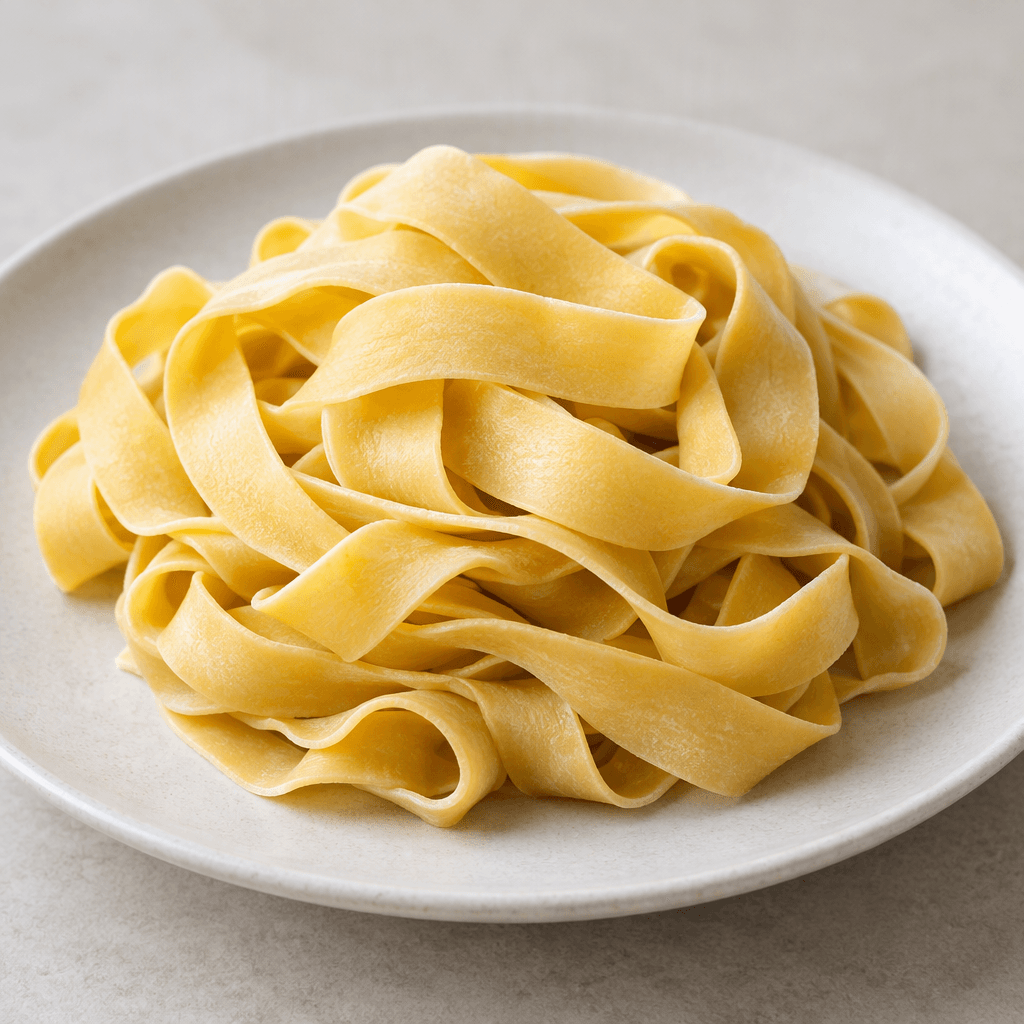
Fettucine Calories
Wide, long pasta; source of carbohydrates
In season: Spring · Summer · Autumn · Winter
CALORIES
GI
POTASSIUM
FIBER
Quick answer
1 cup (medium) of Fettucine (70 g) has 259 calories. That works out to 370 calories per 100 g. It contains 51.8 g of carbs, 9.1 g of protein, 1 g of fat and 2.1 g of fiber. Its 21 µg of Selenium covers 38% of the Daily Value. Its glycemic index is 45 (medium), so it raises blood sugar at a moderate pace.
What is Fettucine?
Fettucine is an Italian pasta made as long, flat ribbons, usually from wheat flour or semolina and water; some versions include eggs. Its broad, smooth strands hold sauce well, making it a familiar choice for dishes with tomato, meat, mushrooms or cream. In Italy it is served hot, freshly cooked and tossed with its sauce, while elsewhere it is also common in home cooking and restaurant pasta dishes.
It is mainly a source of carbohydrates, with some protein. Pair it with vegetables and a tomato-based sauce for a lighter plate, or add beans, chicken or another protein for a more substantial meal.
Fettucine Nutrition Facts
Selected: 100 g
370
KCAL / 100G
Carbs
74g
· 27% DV
Protein
13g
· 26% DV
Fat
1.5g
· 2% DV
Fiber
3g
· 11% DV
DV is the share of the daily value covered, on a 2,000 kcal reference diet.
Calories come from: Carbs 82% · Protein 14% · Fat 4%
Fettucine Vitamins & Minerals
Vitamins
B1
0.4mg · 33% DV
B3
3.2mg · 20% DV
B2
0.2mg · 15% DV
B5
0.5mg · 10% DV
Minerals
Selenium
30µg · 55% DV
Manganese
1mg · 43% DV
Phosphorus
120mg · 17% DV
Magnesium
40mg · 10% DV
How Nutritious Is Fettucine?
Nutrient density
Low
How many vitamins, minerals and how much fiber this food carries per calorie. A high score means a lot of nutrition for few calories.
Satiety score
Medium
An EatBetter score computed from fiber, protein and calorie density. A high score means staying full longer on the same calories.
Both scores are calculated per 100 g and do not change with the selected portion. The satiety score is EatBetter's own calculation, not a clinical measure.
Fettucine Glycemic Index
GLYCEMIC INDEX
GLYCEMIC LOAD
Accounts for portion size — a more realistic measure than GI alone.
How to Burn Off Fettucine
To burn the 370 calories in 100 g:
🚶
Walking (5 km/h)
🏃
Running (8 km/h)
🚴
Cycling
🏊
Swimming
Times are calculated with the MET equation for a 70 kg adult. Actual burn varies with your weight, age and pace.
Is Fettucine Processed?
NOVA 3
Processed
1. Unprocessed
2. Minimally Processed
3. Processed
4. Ultra-Processed
NOVA classifies foods into 4 groups by industrial processing. NOVA 1 (unprocessed) is the healthiest.
Does Fettucine Contain Allergens?
Contains these allergens:
Which Diets Is Fettucine Good For?
Vegan
— Not suitable
Vegetarian
✓ Suitable
Gluten-Free
— Not suitable
Dairy-Free
— Not suitable
Mediterranean
✓ Suitable
Paleo
— Not suitable
Whole30
— Not suitable
DASH
— Not suitable
Keto
— Not suitable
Low FODMAP
— Not suitable
Fettucine Fat Profile
SATURATED
0.3g
MONOUNSATURATED
0.2g
POLYUNSATURATED
0.4g
Omega 6:3 ratio 20:1
Above the ideal 4:1 (20:1).
Compare Fettucine
Foods Similar to Fettucine
Frequently Asked Questions About Fettucine
What is Fettucine?
Fettucine is a long, flat ribbon pasta from Italian cuisine. Its broad surface holds rich sauces well, which is why it is often served with creamy sauces, meat ragù, or mushrooms.
What is the difference between Fettucine Alfredo and regular Fettucine?
Fettucine is the pasta shape; Fettucine Alfredo is a prepared dish made by tossing it with a rich butter-and-Parmesan sauce. Cream and garlic appear in many modern versions, though they are not essential to the simplest traditional style.
How do you cook Fettucine?
Boil Fettucine in plenty of salted water, stirring occasionally, and follow the package directions for timing. Save a little cooking water before draining; tossing it with the sauce and pasta water helps the sauce coat the ribbons.
What sauce goes best with Fettucine?
Creamy Alfredo-style sauce, mushroom sauce, and meat ragù are classic matches for Fettucine. Its wide ribbons hold thick sauces particularly well, while lighter tomato or herb sauces also work if you prefer a less rich dish.
What is the difference between Fettucine and tagliatelle?
Fettucine and tagliatelle are both long, flat ribbon pastas, and their names and widths can overlap depending on the region or maker. Tagliatelle is especially associated with ragù in Italian cooking.
Can you use Fettucine for carbonara?
Yes, Fettucine works in carbonara, although spaghetti is the more familiar choice. Toss the hot pasta with egg, hard cheese, cured pork, and black pepper off the heat so the eggs turn silky rather than scramble.
Is fresh Fettucine different from dried Fettucine?
Yes. Fresh Fettucine is softer and cooks much faster, while dried Fettucine has a firmer bite and keeps longer in the pantry. Their texture differs, but either can be served with suitable sauces.
Can you freeze cooked Fettucine?
Yes, cooked Fettucine can be frozen, preferably without sauce or with a sauce that freezes well. Cool it promptly, store it airtight, and thaw it in the refrigerator before reheating with a splash of water or sauce.
How long does cooked Fettucine last in the fridge?
Cooked Fettucine keeps for about three to four days in the refrigerator when stored promptly in a covered, airtight container. Reheat it until steaming hot, adding a little water if the pasta has dried out.
Can you substitute Fettucine for linguine?
Yes, you can substitute Fettucine for linguine in most recipes, but the wider ribbons hold thicker sauces more effectively. For delicate seafood or oil-based sauces, linguine may give a more balanced pasta-to-sauce texture.
Have another question about Fettucine?
Ask the AI nutrition coach — calories, portions, alternatives and more, answered in seconds in the app.

Scan calories with your camera
Instant AI nutrition analysis

Nutrition data compiled from USDA FoodData Central and scientific sources.