

Ready & Packaged Foods
All →Vegetables & Legumes
All →Desserts & Confectionery
All →Meat & Protein
All →Grains & Bakery
All →Beverages
All →Milk & Dairy
All →

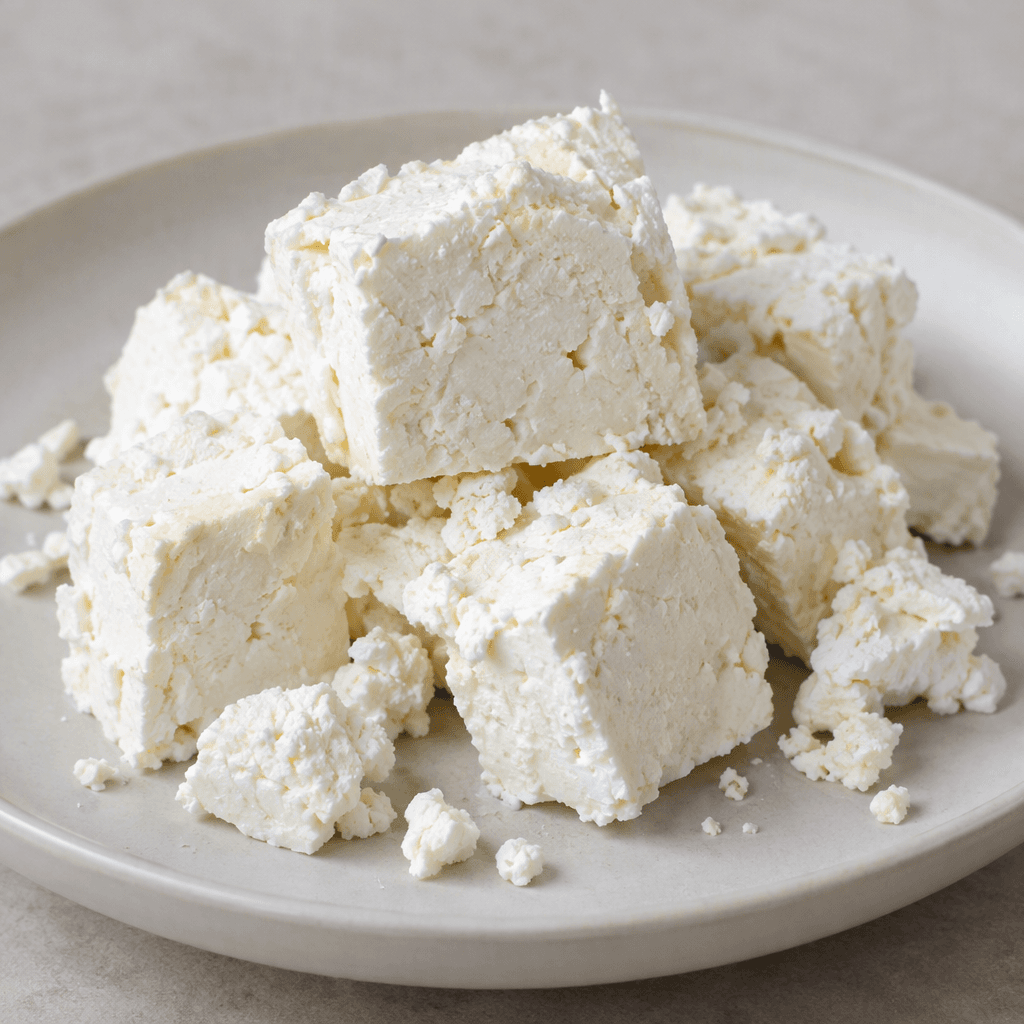
Feta Calories
Greek cheese, salty, high calcium
In season: Spring · Summer · Autumn · Winter
CALORIES
GI
POTASSIUM
FIBER
Quick answer
1 slice (medium) of Feta (40 g) has 106 calories. That works out to 264 calories per 100 g. It contains 1.6 g of carbs, 5.7 g of protein, 8.5 g of fat and 0 g of fiber. Its 0.7 µg of B12 covers 28% of the Daily Value. Its glycemic index is 0 (low), so it raises blood sugar slowly.
What is Feta?
Feta is a Greek brined cheese, traditionally made from sheep’s milk or a mixture of sheep’s and goat’s milk. It is aged in brine, which gives it its characteristic tang and crumbly texture. In Greece, it is served at the table, folded into pies, or scattered over salads; it is also familiar in Mediterranean cooking worldwide.
Its salty, pleasantly sharp flavour works well with tomatoes, cucumber, olives and herbs, and it softens without disappearing when baked. Feta provides protein and calcium, while also being relatively rich in fat: it has 21.3 g per 100 g. For a lighter meal, crumble a modest amount over a generous salad or roasted vegetables, and go easy on other salty ingredients.
Feta Nutrition Facts
Selected: 100 g
264
KCAL / 100G
Carbs
4.1g
· 1% DV
Protein
14.2g
· 28% DV
Fat
21.3g
· 27% DV
Fiber
0g
· 0% DV
DV is the share of the daily value covered, on a 2,000 kcal reference diet.
Calories come from: Carbs 6% · Protein 21% · Fat 73%
Feta Vitamins & Minerals
Vitamins
B12
1.7µg · 71% DV
B2
0.56mg · 43% DV
Vitamin A
260µg · 29% DV
B5
1mg · 20% DV
Minerals
Calcium
493mg · 49% DV
Phosphorus
337mg · 48% DV
Sodium
917mg · 40% DV
Zinc
3mg · 27% DV
How Nutritious Is Feta?
Nutrient density
High
How many vitamins, minerals and how much fiber this food carries per calorie. A high score means a lot of nutrition for few calories.
Satiety score
Medium
An EatBetter score computed from fiber, protein and calorie density. A high score means staying full longer on the same calories.
Both scores are calculated per 100 g and do not change with the selected portion. The satiety score is EatBetter's own calculation, not a clinical measure.
Feta Glycemic Index
GLYCEMIC INDEX
GLYCEMIC LOAD
Accounts for portion size — a more realistic measure than GI alone.
How to Burn Off Feta
To burn the 264 calories in 100 g:
🚶
Walking (5 km/h)
🏃
Running (8 km/h)
🚴
Cycling
🏊
Swimming
Times are calculated with the MET equation for a 70 kg adult. Actual burn varies with your weight, age and pace.
Is Feta Processed?
NOVA 2
Minimally Processed
1. Unprocessed
2. Minimally Processed
3. Processed
4. Ultra-Processed
NOVA classifies foods into 4 groups by industrial processing. NOVA 1 (unprocessed) is the healthiest.
Does Feta Contain Allergens?
Contains these allergens:
Which Diets Is Feta Good For?
Vegan
— Not suitable
Vegetarian
✓ Suitable
Gluten-Free
✓ Suitable
Dairy-Free
— Not suitable
Mediterranean
✓ Suitable
Paleo
— Not suitable
Whole30
— Not suitable
DASH
— Not suitable
Keto
— Not suitable
Low FODMAP
— Not suitable
Feta Fat Profile
SATURATED
13.3g
MONOUNSATURATED
5.2g
POLYUNSATURATED
0.6g
Omega 6:3 ratio 2.7:1
Below the ideal 4:1 — a good omega balance.
Compare Feta
Foods Similar to Feta
Frequently Asked Questions About Feta
What is feta?
Feta is a Greek brined cheese with a white, crumbly texture and a tangy, salty taste. It is traditionally made from sheep’s milk or a mixture of sheep’s and goat’s milk.
What does feta taste like?
Feta tastes salty, tangy, and slightly sour, with a rich, savory finish. Its flavor can be stronger when it is made mainly from sheep’s milk, and milder when mixed with goat’s milk.
What is feta made from?
Traditional Greek feta is made from sheep’s milk, either alone or blended with goat’s milk. It is set, salted, and aged in brine, which gives feta its distinctive flavor and crumbly texture.
How is feta different from goat cheese?
Feta is not necessarily goat cheese: traditional feta is made mostly from sheep’s milk, sometimes with goat’s milk added. Goat cheese can be made entirely from goat’s milk and comes in many styles beyond feta.
How do you use feta?
Crumble feta over Greek salad, roasted vegetables, eggs, or pasta, or bake it with tomatoes for a warm topping. Its salty flavor pairs especially well with olives, cucumber, watermelon, and fresh herbs.
How do you store feta after opening?
Keep opened feta refrigerated in an airtight container, submerged in its brine. If there is not enough brine to cover it, add lightly salted water; use it within about a week for the best quality.
Can you freeze feta?
Yes, feta can be frozen, but thawing makes its texture drier and more crumbly. Freeze it in a sealed container, then use the thawed cheese in cooked dishes such as pasta, pies, or casseroles.
Does feta melt?
Feta softens when heated but does not melt into a smooth, stretchy sauce like mozzarella. It tends to hold its shape or crumble, so it works well baked on vegetables or stirred into hot dishes.
What can I use instead of feta?
Use brined white cheese or a crumbly goat cheese as a feta substitute. White cheese is often milder, so taste the dish before adding extra salt; goat cheese can bring a tangier flavor.
How can you tell if feta has gone bad?
Discard feta if it develops mold, a slimy surface, unusual discoloration, or a strong unpleasant odor. A mildly tangy smell is normal for brined feta, but a sharp, foul odor is not.
Have another question about Feta?
Ask the AI nutrition coach — calories, portions, alternatives and more, answered in seconds in the app.

Scan calories with your camera
Instant AI nutrition analysis

Nutrition data compiled from USDA FoodData Central and scientific sources.