

Ready & Packaged Foods
All →Vegetables & Legumes
All →Desserts & Confectionery
All →Meat & Protein
All →Grains & Bakery
All →Beverages
All →Milk & Dairy
All →

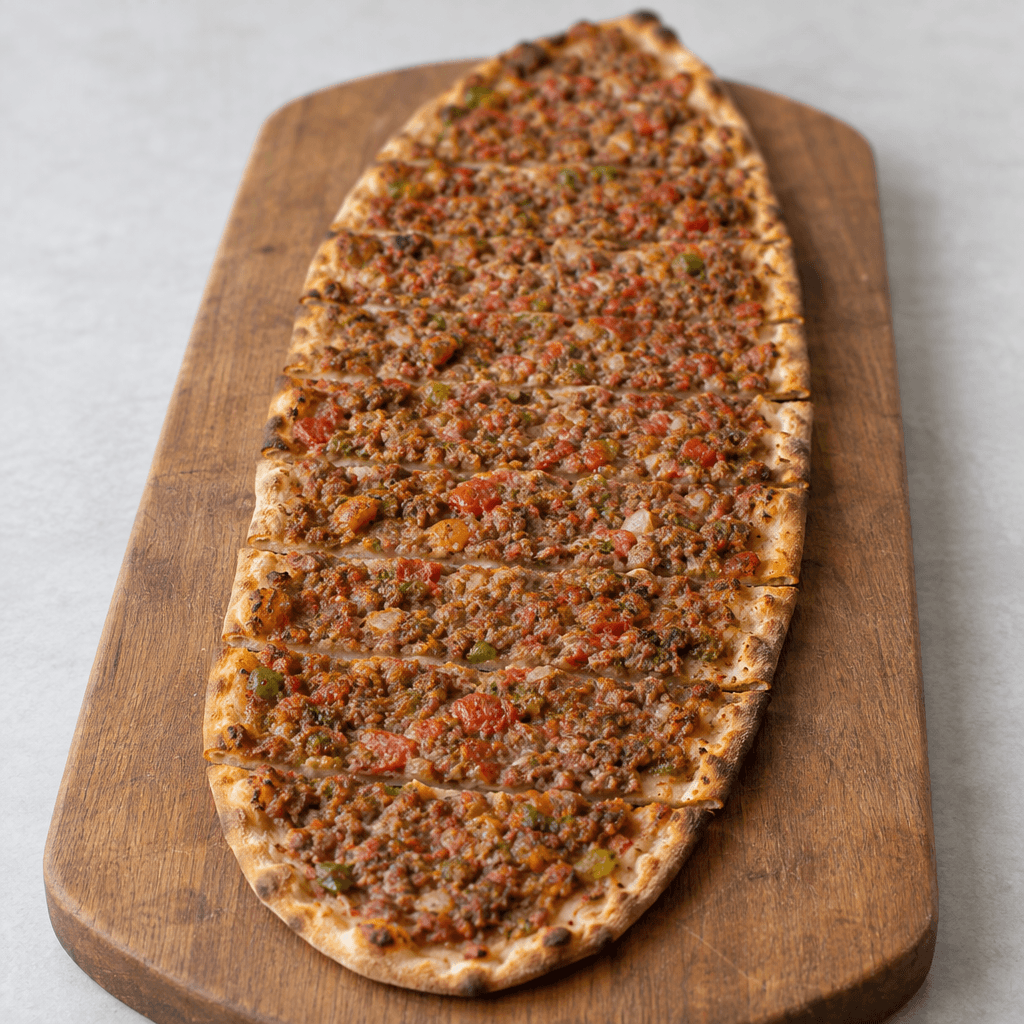
Etliekmek Calories
Traditional Turkish flatbread with minced meat, specialty of Konya
In season: Spring · Summer · Autumn · Winter
CALORIES
GI
POTASSIUM
FIBER
Quick answer
1 piece (medium) of Etliekmek (200 g) has 440 calories. That works out to 220 calories per 100 g. It contains 54 g of carbs, 21 g of protein, 16 g of fat and 4.2 g of fiber. Its 0.9 µg of B12 covers 38% of the Daily Value. Its glycemic index is 65 (medium), so it raises blood sugar at a moderate pace.
What is Etliekmek?
Etliekmek is a long, thin Turkish flatbread associated with Konya. A finely minced meat mixture—often with tomato, green pepper and onion—is spread over the dough before it is baked in a very hot oven. The edges turn lightly crisp while the topping stays savoury and tender.
It is usually cut into short pieces and served hot, often with ayran, salad or lemon. In Turkey it makes an easy shared meal; elsewhere, it works well as a casual lunch or dinner with a fresh side salad. The bread provides most of its carbohydrates, while the meat adds protein: a 100 g portion has 10.5 g of protein. For a lighter plate, pair it with vegetables rather than extra bread.
Etliekmek Nutrition Facts
Selected: 100 g
220
KCAL / 100G
Carbs
27g
· 10% DV
Protein
10.5g
· 21% DV
Fat
8g
· 10% DV
Fiber
2.1g
· 8% DV
DV is the share of the daily value covered, on a 2,000 kcal reference diet.
Calories come from: Carbs 49% · Protein 19% · Fat 32%
Etliekmek Vitamins & Minerals
Vitamins
B12
0.45µg · 19% DV
B1
0.18mg · 15% DV
B3
2.1mg · 13% DV
B5
0.55mg · 11% DV
Minerals
Sodium
330mg · 14% DV
Selenium
7.5µg · 14% DV
Phosphorus
92mg · 13% DV
Zinc
1mg · 9% DV
How Nutritious Is Etliekmek?
Nutrient density
Medium
How many vitamins, minerals and how much fiber this food carries per calorie. A high score means a lot of nutrition for few calories.
Satiety score
Medium
An EatBetter score computed from fiber, protein and calorie density. A high score means staying full longer on the same calories.
Both scores are calculated per 100 g and do not change with the selected portion. The satiety score is EatBetter's own calculation, not a clinical measure.
Etliekmek Glycemic Index
GLYCEMIC INDEX
GLYCEMIC LOAD
Accounts for portion size — a more realistic measure than GI alone.
How to Burn Off Etliekmek
To burn the 220 calories in 100 g:
🚶
Walking (5 km/h)
🏃
Running (8 km/h)
🚴
Cycling
🏊
Swimming
Times are calculated with the MET equation for a 70 kg adult. Actual burn varies with your weight, age and pace.
Is Etliekmek Processed?
NOVA 3
Processed
1. Unprocessed
2. Minimally Processed
3. Processed
4. Ultra-Processed
NOVA classifies foods into 4 groups by industrial processing. NOVA 1 (unprocessed) is the healthiest.
Does Etliekmek Contain Allergens?
Contains these allergens:
Which Diets Is Etliekmek Good For?
Vegan
— Not suitable
Vegetarian
— Not suitable
Gluten-Free
— Not suitable
Dairy-Free
— Not suitable
Mediterranean
✓ Suitable
Paleo
— Not suitable
Whole30
— Not suitable
DASH
— Not suitable
Keto
— Not suitable
Low FODMAP
— Not suitable
Etliekmek Fat Profile
SATURATED
2.6g
MONOUNSATURATED
2.8g
POLYUNSATURATED
1.1g
Omega 6:3 ratio 7:1
Above the ideal 4:1 (7:1).
Compare Etliekmek
Foods Similar to Etliekmek
Frequently Asked Questions About Etliekmek
What is etliekmek?
Etliekmek is a long, thin Turkish flatbread topped with a finely minced meat mixture and baked. The Konya specialty commonly includes minced meat, tomato, pepper and onion, and is usually cut into short pieces before serving.
Where does etliekmek come from?
Etliekmek is especially associated with Konya, a city in central Türkiye. Konya-style etliekmek is traditionally baked in a very hot oven, and the dish is a well-known local specialty rather than simply a generic meat-topped bread.
How is etliekmek different from lahmacun?
Etliekmek is typically long and narrow, while lahmacun is usually round. Their dough and topping proportions can differ too: etliekmek is served as a bread-like Konya specialty, whereas lahmacun is commonly rolled or folded around its toppings.
What goes on top of etliekmek?
Etliekmek is topped with finely minced meat, commonly mixed with tomato, green pepper and onion. The ingredients are spread in a thin layer over the dough before baking; recipes and seasoning can vary between bakeries.
How is traditional etliekmek made?
Traditional etliekmek is made by stretching dough into a long, thin shape, spreading raw minced-meat topping over it, and baking it in a very hot oven. A hot oven helps cook the topping while browning the edges of the dough.
How is etliekmek usually served?
Etliekmek is usually served hot, cut into manageable pieces. It can be eaten on its own or alongside ayran, salad or roasted peppers; keeping the toppings visible rather than wrapping the bread is typical.
Can you make etliekmek at home?
Yes, you can make etliekmek at home. Stretch the dough thinly, spread the meat mixture evenly without piling it up, and preheat the oven thoroughly; a home oven may not reproduce the intense heat of a traditional bakery oven.
How should leftover etliekmek be stored?
Store leftover etliekmek in a covered container in the refrigerator once it has cooled. Eat it within a few days, and do not leave the meat-topped bread at room temperature for an extended period.
What is the best way to reheat etliekmek?
Reheat etliekmek in an oven or a covered pan until the topping is hot throughout. These methods help the bread stay firmer than microwaving; check that the meat is thoroughly heated before eating.
Is etliekmek a healthy meal?
Etliekmek can be part of a balanced meal, but it combines bread with a meat topping and may be filling. Pairing a moderate portion with vegetables or salad adds variety without turning the meal into more bread and meat.
Have another question about Etliekmek?
Ask the AI nutrition coach — calories, portions, alternatives and more, answered in seconds in the app.

Scan calories with your camera
Instant AI nutrition analysis

Nutrition data compiled from USDA FoodData Central and scientific sources.