

Ready & Packaged Foods
All →Vegetables & Legumes
All →Desserts & Confectionery
All →Meat & Protein
All →Grains & Bakery
All →Beverages
All →Milk & Dairy
All →

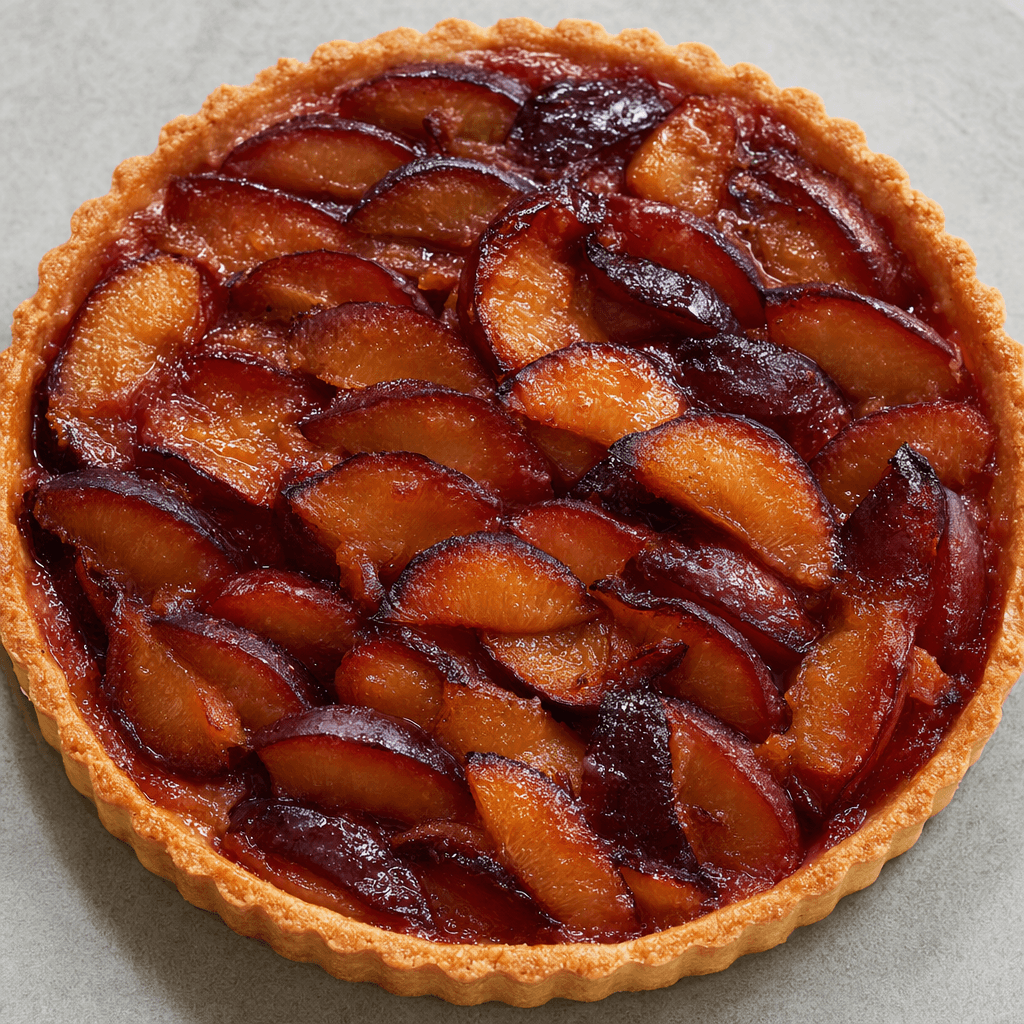
Plum tart Calories
Baked sweet pastry with plums
In season: Summer · Autumn
CALORIES · 100 G
GI
POTASSIUM · 100 G
FIBER · 100 G
Quick answer
100 g of Plum tart has 236 calories. It contains 34.1 g of carbs, 3.2 g of protein, 10.1 g of fat and 1.6 g of fiber. Its 0.2 mg of B1 covers 18% of the Daily Value. Its glycemic index is 58 (medium), so it raises blood sugar at a moderate pace.
Plum tart Nutrition Facts
Selected: 100 g
236
KCAL / 100G
Carbs
34.1g
· 12% DV
Protein
3.2g
· 6% DV
Fat
10.1g
· 13% DV
Fiber
1.6g
· 6% DV
DV is the share of the daily value covered, on a 2,000 kcal reference diet.
Calories come from: Carbs 57% · Protein 5% · Fat 38%
Plum tart nutrition facts table · 100 g
| Nutrient | Amount | % DV |
|---|---|---|
| Calories | 236 kcal | |
| Total fat | 10.1 g | 13% |
| Saturated fat | 5.12 g | 26% |
| Trans fat | 0.18 g | |
| Sodium | 178 mg | 8% |
| Total carbohydrate | 34.1 g | 12% |
| Fiber | 1.6 g | 6% |
| Protein | 3.2 g | 6% |
Calories: Calories measure energy. Average daily need is 2,000 kcal. Excess calories are stored as fat, too few cause weight loss.
Carbs: Your body's primary energy source. The brain runs exclusively on carbs. Daily need: 275g.
Protein: Essential for muscle repair and cell growth. Daily need: 50g. Keeps you full and boosts metabolism.
Fat: Needed for hormone production and vitamin absorption. Daily need: 78g. Limit saturated fats, choose unsaturated.
Fiber: Critical for digestive health and satiety. Daily need: 28g. Stabilizes blood sugar, lowers cholesterol.

Log this food in EatBetter
100,000+ people use it
- Get your daily calorie target
- Snap your meal, log it in seconds
- See every vitamin and mineral

📸 Scan the code to get the app free.

How Many Calories in 1 Slice of Plum tart?
| Serving | Amount | Calories |
|---|---|---|
| 1 slice (medium) | 100 g | 236 kcal |
| 1 piece (small) | 45 g | 106 kcal |
| 1 slice (thin) | 60 g | 142 kcal |
| 1 piece (medium) | 85 g | 201 kcal |
| 100 g | 100 g | 236 kcal |
| 1 serving (medium) | 130 g | 307 kcal |
| 1 slice (thick) | 145 g | 342 kcal |
| 1 piece (large) | 160 g | 378 kcal |
| 1 serving (large) | 220 g | 519 kcal |
Calculated from 236 calories per 100 g.
Frequently Asked Questions About Plum tart
What is plum tart made of?
Plum tart is made with a pastry crust and plums, often arranged cut-side up over the base. Recipes may add sugar, spices, or a filling such as almond cream, but the fruit and pastry are its defining parts.
How do you make plum tart?
Make plum tart by fitting pastry into a tart pan, arranging pitted plums on top, and baking until the crust is golden and the fruit is tender. Let it cool before slicing so the filling sets and the base stays intact.
Should plums be peeled for plum tart?
No, plums usually do not need to be peeled for plum tart. Their skins help the fruit hold its shape as it bakes and add color; simply wash, dry, halve, and remove the pits before arranging them on the pastry.
Can you use canned plums for plum tart?
Yes, canned plums can work in plum tart, but drain them very well first. Their softer texture and packing liquid can make the pastry soggy, so pat the fruit dry and expect it to hold its shape less firmly than fresh plums.
Why does plum tart turn out watery?
Plum tart turns watery when the fruit releases more juice than the pastry can absorb. Use firm, ripe plums, dry them after washing, and avoid crowding the tart; a thin layer of ground almonds can also absorb some fruit juice.
What is the difference between plum tart and plum pie?
Plum tart is usually baked in a shallow pan with an open top, while plum pie is often deeper and may have pastry covering the fruit. The names can overlap, but the pan depth and pastry design are the clearest differences.
Can you make plum tart ahead of time?
Yes, you can bake plum tart a day ahead and keep it covered in the refrigerator. The crust may soften as the fruit sits, so for the crispest texture, bake it on the day you plan to serve it.
How do you reheat plum tart?
Reheat plum tart in a low oven until warmed through to help restore some crispness to the pastry. A microwave is quicker but tends to soften the crust, so use it only when texture matters less than speed.
What spices go well in plum tart?
Cinnamon, cardamom, and a little ginger pair well with the sweet-tart flavor of plums in plum tart. Use a light hand so the spices complement the fruit rather than overpowering it.
Can plum tart be made without a tart pan?
Yes, plum tart can be made without a tart pan by folding the edges of pastry around the fruit on a flat baking sheet. This free-form version is often called a galette and gives the crust a more rustic shape.
Plum tart Vitamins & Minerals
Vitamins
B1
0.21mg · 18% DV
Biotin
3.1µg · 10% DV
B2
0.12mg · 9% DV
B3
1.35mg · 8% DV
Minerals
Selenium
8.4µg · 15% DV
Manganese
0.25mg · 11% DV
Copper
0.09mg · 10% DV
Phosphorus
63mg · 9% DV
Sodium
178mg · 8% DV
Potassium ⭐
137mg · 4% DV
Plum tart Glycemic Index
GLYCEMIC INDEX
GLYCEMIC LOAD
Accounts for portion size — a more realistic measure than GI alone.
How to Burn Off Plum tart
To burn the 236 calories in 100 g:
🚶
Walking (5 km/h)
🏃
Running (8 km/h)
🚴
Cycling
🏊
Swimming
Times are calculated with the MET equation for a 70 kg adult. Actual burn varies with your weight, age and pace.
What is Plum tart?
Plum tart pairs a pastry base with plums, baked until the fruit softens and the crust turns golden. Recipes vary: the plums may be arranged over an unbaked base or added to a partly baked shell, and some versions use a little sugar to balance the fruit’s tartness. The result is sweet and buttery, with juicy, tender fruit against a crisp edge and a softer centre.
In places where it is part of home baking, it is often served in slices with coffee or tea, as a dessert or an afternoon treat. It is mainly a pastry-based source of carbohydrates and fat, with 34.1 g of carbohydrate per 100 g. For a less rich serving, skip whipped cream and pair a slice with plain yogurt instead.
How Nutritious Is Plum tart?
Nutrient density
Low
How many vitamins, minerals and how much fiber this food carries per calorie. A high score means a lot of nutrition for few calories.
Satiety score
Low
An EatBetter score computed from fiber, protein and calorie density. A high score means staying full longer on the same calories.
Both scores are calculated per 100 g and do not change with the selected portion. The satiety score is EatBetter's own calculation, not a clinical measure.
Is Plum tart Processed?
NOVA 3
Processed
1. Unprocessed
2. Minimally Processed
3. Processed
4. Ultra-Processed
NOVA classifies foods into 4 groups by industrial processing. NOVA 1 (unprocessed) is the healthiest.
Does Plum tart Contain Allergens?
Contains these allergens:
Which Diets Is Plum tart Good For?
Vegan
— Not suitable
Vegetarian
✓ Suitable
Gluten-Free
— Not suitable
Dairy-Free
— Not suitable
Mediterranean
— Not suitable
Paleo
— Not suitable
Whole30
— Not suitable
DASH
— Not suitable
Keto
— Not suitable
Low FODMAP
— Not suitable
Plum tart Fat Profile
SATURATED
5.12g
MONOUNSATURATED
2.61g
POLYUNSATURATED
1.48g
Omega 6:3 ratio 19.7:1
Above the ideal 4:1 (19.7:1).
Compare Plum tart
Foods Similar to Plum tart
Have another question about Plum tart?
Ask the AI nutrition coach — calories, portions, alternatives and more, answered in seconds in the app.

Scan calories with your camera
Instant AI nutrition analysis

Nutrition data compiled from USDA FoodData Central and scientific sources.