

Ready & Packaged Foods
All →Vegetables & Legumes
All →Desserts & Confectionery
All →Meat & Protein
All →Grains & Bakery
All →Beverages
All →Milk & Dairy
All →

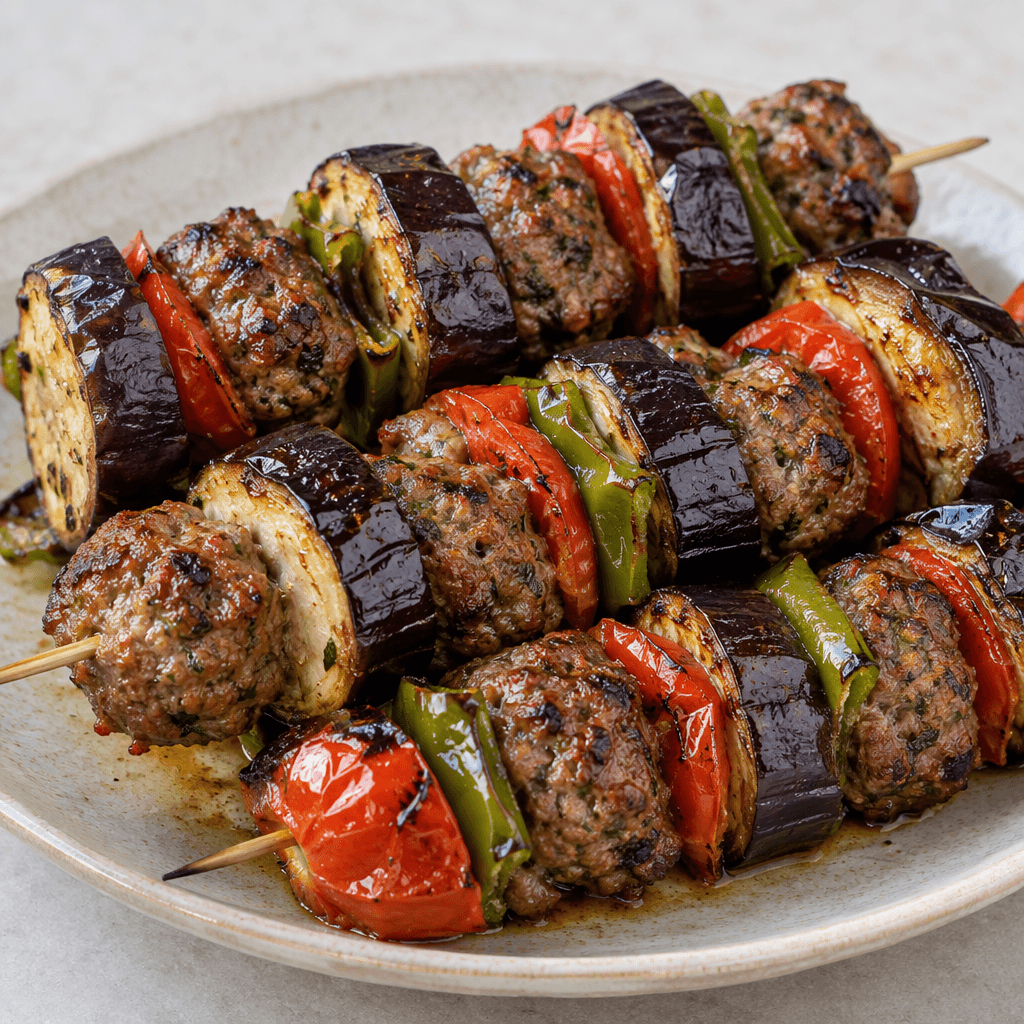
Eggplant Kebab Calories
Traditional kebab made with eggplant, ground meat, and spices.
In season: Summer · Autumn
CALORIES
GI
POTASSIUM
FIBER
Quick answer
1 piece (medium) of Eggplant Kebab (180 g) has 216 calories. That works out to 120 calories per 100 g. It contains 12.6 g of carbs, 13.5 g of protein, 11.7 g of fat and 4.5 g of fiber. Its 1.1 µg of B12 covers 45% of the Daily Value. Its glycemic index is 35 (low), so it raises blood sugar slowly.
What is Eggplant Kebab?
Eggplant Kebab is a Turkish dish of eggplant slices alternated with seasoned ground meat on a skewer, then grilled or roasted. It is especially associated with southeastern Turkey, where recipes vary by town and household; tomato and green pepper may be threaded onto the skewer or cooked alongside it.
The eggplant turns soft and smoky, soaking up the meat’s juices, while the exposed edges brown over the heat. It is commonly served as a main meal with rice or flatbread and a fresh salad; grilled peppers and yogurt are natural companions. With vegetables and meat together, it makes a hearty, substantial plate. For a lighter serving, pair it with extra salad and choose grilling or roasting without added oil.
Eggplant Kebab Nutrition Facts
Selected: 100 g
120
KCAL / 100G
Carbs
7g
· 3% DV
Protein
7.5g
· 15% DV
Fat
6.5g
· 8% DV
Fiber
2.5g
· 9% DV
DV is the share of the daily value covered, on a 2,000 kcal reference diet.
Calories come from: Carbs 24% · Protein 26% · Fat 50%
Eggplant Kebab Vitamins & Minerals
Vitamins
B12
0.6µg · 25% DV
B3
1.8mg · 11% DV
B6
0.18mg · 11% DV
B5
0.5mg · 10% DV
Minerals
Phosphorus
95mg · 14% DV
Sodium
220mg · 10% DV
Zinc
1mg · 9% DV
Selenium
5µg · 9% DV
How Nutritious Is Eggplant Kebab?
Nutrient density
Medium
How many vitamins, minerals and how much fiber this food carries per calorie. A high score means a lot of nutrition for few calories.
Satiety score
Medium
An EatBetter score computed from fiber, protein and calorie density. A high score means staying full longer on the same calories.
Both scores are calculated per 100 g and do not change with the selected portion. The satiety score is EatBetter's own calculation, not a clinical measure.
Eggplant Kebab Glycemic Index
GLYCEMIC INDEX
GLYCEMIC LOAD
Accounts for portion size — a more realistic measure than GI alone.
How to Burn Off Eggplant Kebab
To burn the 120 calories in 100 g:
🚶
Walking (5 km/h)
🏃
Running (8 km/h)
🚴
Cycling
🏊
Swimming
Times are calculated with the MET equation for a 70 kg adult. Actual burn varies with your weight, age and pace.
Is Eggplant Kebab Processed?
NOVA 2
Minimally Processed
1. Unprocessed
2. Minimally Processed
3. Processed
4. Ultra-Processed
NOVA classifies foods into 4 groups by industrial processing. NOVA 1 (unprocessed) is the healthiest.
Does Eggplant Kebab Contain Allergens?
No known major allergens
Which Diets Is Eggplant Kebab Good For?
Vegan
— Not suitable
Vegetarian
— Not suitable
Gluten-Free
— Not suitable
Dairy-Free
— Not suitable
Mediterranean
✓ Suitable
Paleo
— Not suitable
Whole30
— Not suitable
DASH
— Not suitable
Keto
— Not suitable
Low FODMAP
— Not suitable
Eggplant Kebab Fat Profile
SATURATED
2.2g
MONOUNSATURATED
2.5g
POLYUNSATURATED
0.3g
Omega 6:3 ratio 5.5:1
Above the ideal 4:1 (5.5:1).
Compare Eggplant Kebab
Foods Similar to Eggplant Kebab
Frequently Asked Questions About Eggplant Kebab
How do you make Eggplant Kebab?
Eggplant Kebab is made by alternating eggplant slices with seasoned ground meat, then grilling or roasting them until the eggplant is tender and the meat is cooked through. Keep the pieces similar in size so they cook evenly.
What meat is used in Eggplant Kebab?
Eggplant Kebab is commonly made with ground lamb, or a lamb-and-beef mixture. Meat with some fat tends to stay juicier over a grill; very lean mince can turn dry before the eggplant is tender.
Where does Eggplant Kebab come from?
Eggplant Kebab is strongly associated with Gaziantep in southeastern Turkey, where it is a well-known regional kebab. Recipes vary between households, including how the eggplant is cut and which meat and spices are used.
Can you cook Eggplant Kebab in the oven?
Yes, Eggplant Kebab can be cooked in an oven instead of on a grill. Arrange the skewered ingredients in a roasting pan and cook until the eggplant is soft and the meat is fully cooked; tomatoes and peppers can roast alongside.
Do you peel eggplant for Eggplant Kebab?
No, Eggplant Kebab is usually made with the skin on. The skin helps the eggplant slices hold their shape on the skewer, so wash the eggplant, trim the stem, and cut it into the thickness your recipe calls for.
What do you serve with Eggplant Kebab?
Eggplant Kebab is often served with grilled tomatoes and green peppers, flatbread, and a fresh salad or onion salad. The bread is useful for soaking up the juices from the meat and eggplant.
How do you keep Eggplant Kebab from falling off the skewer?
To keep Eggplant Kebab on the skewer, shape the meat firmly and alternate it closely with sturdy eggplant slices. Avoid very thin slices and turn the skewers gently rather than pulling or twisting the ingredients over the heat.
Can you prepare Eggplant Kebab ahead of time?
Yes, you can assemble Eggplant Kebab ahead and keep it covered in the refrigerator until cooking. Keep the raw meat chilled, and cook the kebab thoroughly; avoid leaving assembled skewers at room temperature while you prepare other dishes.
Should you salt eggplant before making Eggplant Kebab?
Usually, you do not need to salt eggplant before making Eggplant Kebab because modern eggplants are rarely bitter. If yours tastes bitter, salt the cut pieces briefly, then pat them dry before threading them onto the skewers.
How do you store leftover Eggplant Kebab?
Store leftover Eggplant Kebab in a covered container in the refrigerator once it has cooled, and eat it within a few days. Reheat it until hot throughout; leaving cooked meat at room temperature for an extended time is unsafe.
Have another question about Eggplant Kebab?
Ask the AI nutrition coach — calories, portions, alternatives and more, answered in seconds in the app.

Scan calories with your camera
Instant AI nutrition analysis

Nutrition data compiled from USDA FoodData Central and scientific sources.