

Ready & Packaged Foods
All →Vegetables & Legumes
All →Desserts & Confectionery
All →Meat & Protein
All →Grains & Bakery
All →Beverages
All →Milk & Dairy
All →

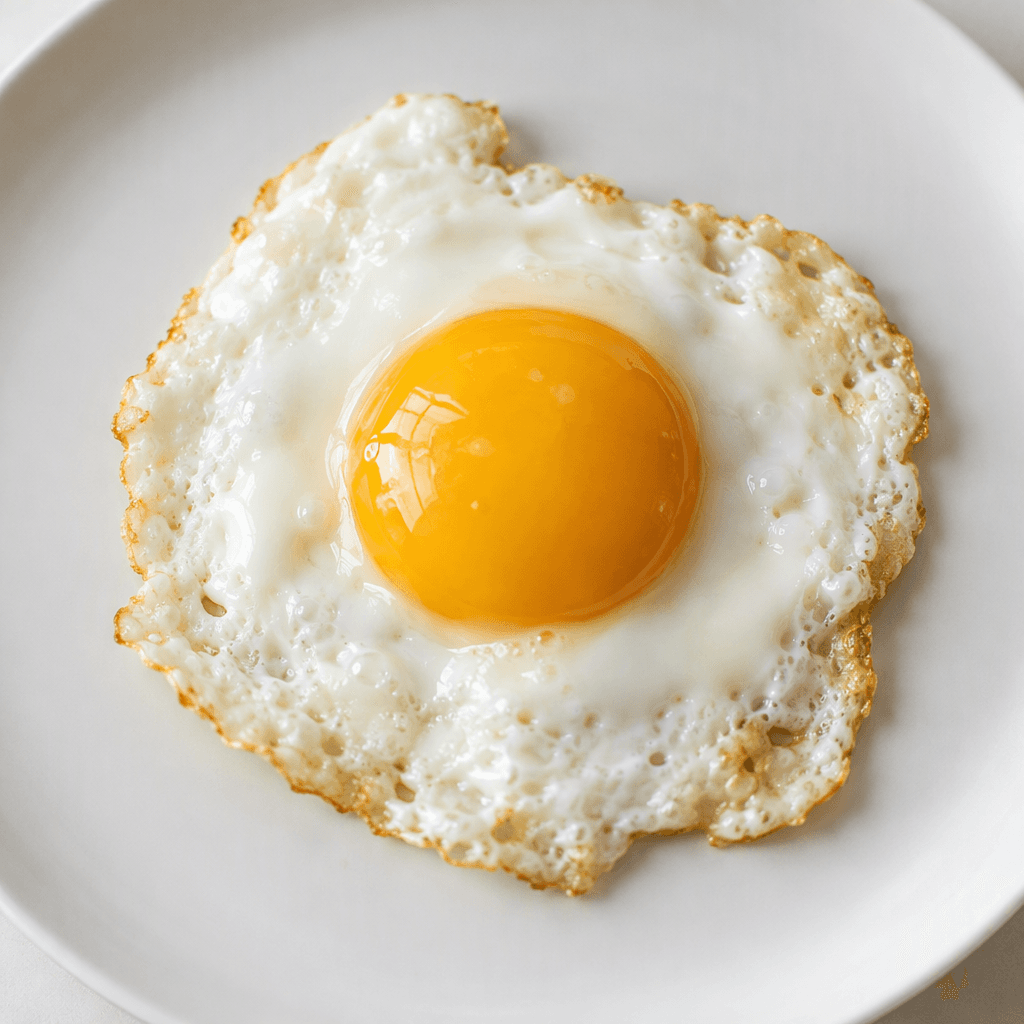
Egg (pan-cooked, low oil) Calories
High-quality protein, vitamin B12, low-oil cooking
In season: Spring · Summer · Autumn · Winter
CALORIES
GI
POTASSIUM
FIBER
Quick answer
1 piece (medium) of Egg (pan-cooked, low oil) (55 g) has 80 calories. That works out to 145 calories per 100 g. It contains 0.6 g of carbs, 6.9 g of protein, 5.3 g of fat and 0 g of fiber. Its 11 µg of Biotin covers 37% of the Daily Value. Its glycemic index is 0 (low), so it raises blood sugar slowly.
What is Egg (pan-cooked, low oil)?
Egg (pan-cooked, low oil) is prepared by cracking an egg into a lightly oiled pan and cooking it until the white is set. The yolk may be left soft and glossy, or cooked through to suit your preference. It is a simple home-cooked dish found in many food traditions rather than one tied to a single place.
Serve it on toast or alongside vegetables for breakfast, brunch, or a quick meal; a runny yolk is especially good for dipping bread. It provides high-quality protein, with about 12.5 g per 100 g, and very little carbohydrate. A non-stick pan helps keep the added oil modest, while greens, tomatoes, or wholegrain toast make an easy pairing.
Egg (pan-cooked, low oil) Nutrition Facts
Selected: 100 g
145
KCAL / 100G
Carbs
1.1g
· 0% DV
Protein
12.5g
· 25% DV
Fat
9.7g
· 12% DV
Fiber
0g
· 0% DV
DV is the share of the daily value covered, on a 2,000 kcal reference diet.
Calories come from: Carbs 3% · Protein 35% · Fat 62%
Egg (pan-cooked, low oil) Vitamins & Minerals
Vitamins
Biotin
20µg · 67% DV
B12
1.2µg · 50% DV
B2
0.45mg · 35% DV
B5
1.3mg · 26% DV
Minerals
Selenium
30µg · 55% DV
Phosphorus
170mg · 24% DV
Iodine
35µg · 23% DV
Zinc
1mg · 9% DV
How Nutritious Is Egg (pan-cooked, low oil)?
Nutrient density
High
How many vitamins, minerals and how much fiber this food carries per calorie. A high score means a lot of nutrition for few calories.
Satiety score
Medium
An EatBetter score computed from fiber, protein and calorie density. A high score means staying full longer on the same calories.
Both scores are calculated per 100 g and do not change with the selected portion. The satiety score is EatBetter's own calculation, not a clinical measure.
Egg (pan-cooked, low oil) Glycemic Index
GLYCEMIC INDEX
GLYCEMIC LOAD
Accounts for portion size — a more realistic measure than GI alone.
How to Burn Off Egg (pan-cooked, low oil)
To burn the 145 calories in 100 g:
🚶
Walking (5 km/h)
🏃
Running (8 km/h)
🚴
Cycling
🏊
Swimming
Times are calculated with the MET equation for a 70 kg adult. Actual burn varies with your weight, age and pace.
Is Egg (pan-cooked, low oil) Processed?
NOVA 2
Minimally Processed
1. Unprocessed
2. Minimally Processed
3. Processed
4. Ultra-Processed
NOVA classifies foods into 4 groups by industrial processing. NOVA 1 (unprocessed) is the healthiest.
Does Egg (pan-cooked, low oil) Contain Allergens?
Contains these allergens:
Which Diets Is Egg (pan-cooked, low oil) Good For?
Vegan
— Not suitable
Vegetarian
— Not suitable
Gluten-Free
✓ Suitable
Dairy-Free
— Not suitable
Mediterranean
✓ Suitable
Paleo
✓ Suitable
Whole30
— Not suitable
DASH
— Not suitable
Keto
✓ Suitable
Low FODMAP
— Not suitable
Egg (pan-cooked, low oil) Fat Profile
SATURATED
2.7g
MONOUNSATURATED
3.7g
POLYUNSATURATED
1.3g
Omega 6:3 ratio 15:1
Above the ideal 4:1 (15:1).
Compare Egg (pan-cooked, low oil)
Foods Similar to Egg (pan-cooked, low oil)
Frequently Asked Questions About Egg (pan-cooked, low oil)
How do you cook a pan-cooked low-oil egg?
Heat a nonstick pan over medium-low heat, add a thin film of oil, and crack in the egg. Cook until the white is opaque and set; leave it uncovered if you want the yolk to stay runny.
How do you stop a pan-cooked low-oil egg from sticking?
Warm the pan before adding a thin coating of oil, and use a well-seasoned or nonstick pan. Keep the heat moderate and avoid moving the egg until the white has begun to set.
Do you flip a pan-cooked low-oil egg?
No, you do not have to flip a pan-cooked low-oil egg. Cook it sunny-side up until the white sets, or turn it carefully with a spatula if you want the yolk more thoroughly cooked.
How can you keep the yolk runny in a pan-cooked low-oil egg?
Cook the egg over medium-low heat and stop when the white is opaque and set but the yolk still looks glossy. A lid can cook the top of the white faster, but leaving it off helps preserve a runny yolk.
Why does the yolk break in a pan-cooked low-oil egg?
The yolk can break if its membrane is weak or gets damaged while cracking the egg. Crack it into a small bowl first, then gently slide it into the pan to keep the yolk intact.
How long does a pan-cooked low-oil egg take to cook?
A pan-cooked low-oil egg usually cooks within a few minutes, depending on the heat and how firm you like the yolk. Look for an opaque, set white; cook longer if you want a firm yolk.
Can you store a pan-cooked low-oil egg in the fridge?
Yes, refrigerate a pan-cooked low-oil egg promptly in a covered container and eat it soon. Do not leave it sitting at room temperature for an extended period, and discard it if its smell or appearance changes.
Can you reheat a pan-cooked low-oil egg?
Yes, you can reheat a pan-cooked low-oil egg, though the white may turn rubbery and the yolk may dry out. Reheat a properly refrigerated egg gently in a pan until it is hot throughout.
Is a runny-yolk pan-cooked low-oil egg safe during pregnancy?
During pregnancy, choose a pan-cooked low-oil egg with both the white and yolk fully cooked; runny eggs can carry a foodborne infection risk. Ask your healthcare professional for advice specific to your circumstances.
Can you make a pan-cooked low-oil egg without butter?
Yes, use a small amount of a neutral cooking oil instead of butter, or use a reliable nonstick pan to minimize the oil. The pan still needs enough lubrication to release the egg cleanly.
Have another question about Egg (pan-cooked, low oil)?
Ask the AI nutrition coach — calories, portions, alternatives and more, answered in seconds in the app.

Scan calories with your camera
Instant AI nutrition analysis

Nutrition data compiled from USDA FoodData Central and scientific sources.