

Ready & Packaged Foods
All →Vegetables & Legumes
All →Desserts & Confectionery
All →Meat & Protein
All →Grains & Bakery
All →Beverages
All →Milk & Dairy
All →

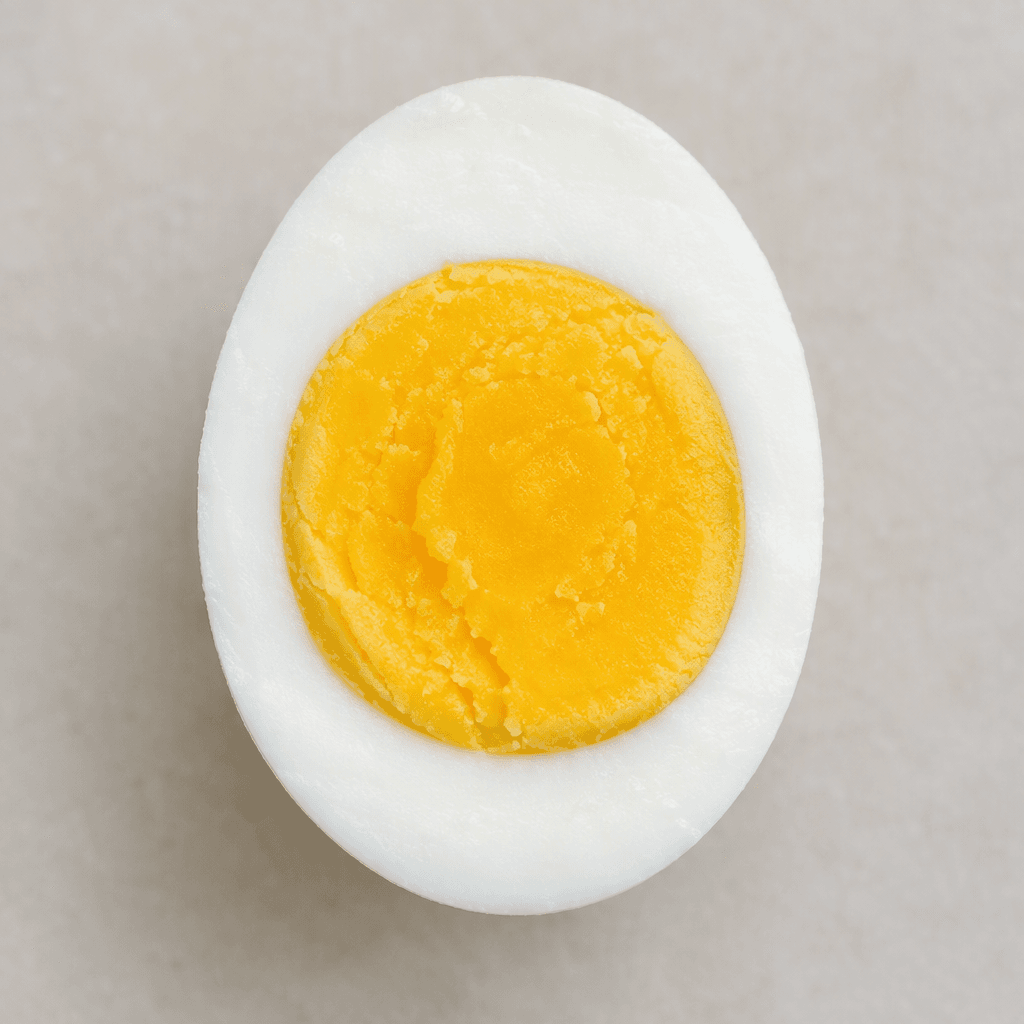
Egg (half) Calories
Protein source, vitamin B12, vitamin D, healthy fats
In season: Spring · Summer · Autumn · Winter
CALORIES
GI
POTASSIUM
FIBER
Quick answer
½ piece (half) of Egg (half) (25 g) has 36 calories. That works out to 143 calories per 100 g. It contains 0.3 g of carbs, 3.3 g of protein, 2.5 g of fat and 0 g of fiber. Its 5 µg of Biotin covers 17% of the Daily Value. Its glycemic index is 0 (low), so it raises blood sugar slowly.
What is Egg (half)?
A half egg is one portion of a chicken egg, cut in half; the pictured version is cooked until the white and yolk are firm, as with a hard-boiled egg. Eggs are a familiar staple in many cuisines, served at breakfast, sliced into salads or sandwiches, and used in snacks and appetisers. In Turkey, a boiled egg may appear at the breakfast table or make a quick, convenient choice for sahur.
The white is tender and mild, while the yolk is richer and slightly creamy. Eggs provide protein along with fats and vitamin B12. This smaller portion suits a light meal or snack; pair it with fresh vegetables, or add wholegrain bread when you want something more filling.
Egg (half) Nutrition Facts
Selected: 100 g
143
KCAL / 100G
Carbs
1.1g
· 0% DV
Protein
13g
· 26% DV
Fat
9.9g
· 13% DV
Fiber
0g
· 0% DV
DV is the share of the daily value covered, on a 2,000 kcal reference diet.
Calories come from: Carbs 3% · Protein 36% · Fat 61%
Egg (half) Vitamins & Minerals
Vitamins
Biotin
20µg · 67% DV
B12
1.1µg · 46% DV
B2
0.5mg · 38% DV
B5
1.4mg · 28% DV
Minerals
Selenium
30µg · 55% DV
Iodine
47µg · 31% DV
Phosphorus
190mg · 27% DV
Zinc
1mg · 9% DV
How Nutritious Is Egg (half)?
Nutrient density
Very high
How many vitamins, minerals and how much fiber this food carries per calorie. A high score means a lot of nutrition for few calories.
Satiety score
Medium
An EatBetter score computed from fiber, protein and calorie density. A high score means staying full longer on the same calories.
Both scores are calculated per 100 g and do not change with the selected portion. The satiety score is EatBetter's own calculation, not a clinical measure.
Egg (half) Glycemic Index
GLYCEMIC INDEX
GLYCEMIC LOAD
Accounts for portion size — a more realistic measure than GI alone.
How to Burn Off Egg (half)
To burn the 143 calories in 100 g:
🚶
Walking (5 km/h)
🏃
Running (8 km/h)
🚴
Cycling
🏊
Swimming
Times are calculated with the MET equation for a 70 kg adult. Actual burn varies with your weight, age and pace.
Is Egg (half) Processed?
NOVA 1
Unprocessed
1. Unprocessed
2. Minimally Processed
3. Processed
4. Ultra-Processed
NOVA classifies foods into 4 groups by industrial processing. NOVA 1 (unprocessed) is the healthiest.
Does Egg (half) Contain Allergens?
Contains these allergens:
Which Diets Is Egg (half) Good For?
Vegan
— Not suitable
Vegetarian
✓ Suitable
Gluten-Free
✓ Suitable
Dairy-Free
— Not suitable
Mediterranean
✓ Suitable
Paleo
✓ Suitable
Whole30
— Not suitable
DASH
— Not suitable
Keto
✓ Suitable
Low FODMAP
— Not suitable
Egg (half) Fat Profile
SATURATED
3.1g
MONOUNSATURATED
3.6g
POLYUNSATURATED
1.4g
Omega 6:3 ratio 26:1
Above the ideal 4:1 (26:1).
Compare Egg (half)
Foods Similar to Egg (half)
Frequently Asked Questions About Egg (half)
How long should you boil an egg for a firm yolk in a half egg?
For a firm yolk in a half egg, boil the whole egg in its shell for about 9–12 minutes once the water is boiling. Cool it promptly in cold water to stop cooking; this also helps prevent the gray-green ring around the yolk.
Can you eat a half egg cold?
Yes, a properly refrigerated hard-boiled egg half can be eaten cold. It works well in salads, sandwiches, or as a snack; keep it chilled until serving and avoid eating it if it has been left at room temperature for too long.
How do you cut a half egg neatly without crumbling the yolk?
Use a sharp, thin knife and wipe the blade between cuts to keep a half egg neat. For especially clean edges, chill the peeled hard-boiled egg first; a dull blade tends to press the white and break the yolk rather than slice through it.
How long can a hard-boiled egg half stay out of the fridge?
A hard-boiled egg half should not sit at room temperature for more than two hours, or one hour in very hot conditions. Put it back in the refrigerator promptly; leaving cut egg out for an extended period raises the risk of bacterial growth.
Can you freeze a hard-boiled egg half?
Freezing a hard-boiled egg half is not recommended because the white becomes tough and watery after thawing. If you need to freeze cooked egg, the yolk holds its texture better on its own, but a refrigerated half is usually better eaten fresh.
Why does the yolk in a half egg look dry and chalky?
A dry, chalky yolk in a half egg usually means the egg was cooked too long. Use a timer and cool the egg in cold water as soon as it is done; this limits carryover cooking and keeps the yolk more tender.
Can you microwave a hard-boiled egg half?
It is safer not to microwave a hard-boiled egg half. Steam can build up inside the egg and cause it to burst during or after heating; eat it cold, or chop it into a hot dish and let the dish warm it through.
How do you store a leftover half egg?
Store a leftover half egg in a covered container in the refrigerator, ideally with the cut side protected from air. Eat it within about two days for best quality; covering it also helps keep the yolk from drying out and absorbing other food odors.
Why does a half egg smell sulfurous after boiling?
A mild sulfur smell from a boiled half egg can come from the sulfur compounds naturally present in egg white, especially after overcooking. Cool the egg promptly and store it covered; discard it if the odor is unusually strong or otherwise unpleasant.
What can you make with one half egg?
One half egg can be chopped into a small salad, tucked into a sandwich, or used as a topping for soup or toast. Add it near serving time so the yolk stays intact and the egg does not become overcooked in a hot dish.
Have another question about Egg (half)?
Ask the AI nutrition coach — calories, portions, alternatives and more, answered in seconds in the app.

Scan calories with your camera
Instant AI nutrition analysis

Nutrition data compiled from USDA FoodData Central and scientific sources.