

Ready & Packaged Foods
All →Vegetables & Legumes
All →Desserts & Confectionery
All →Meat & Protein
All →Grains & Bakery
All →Beverages
All →Milk & Dairy
All →

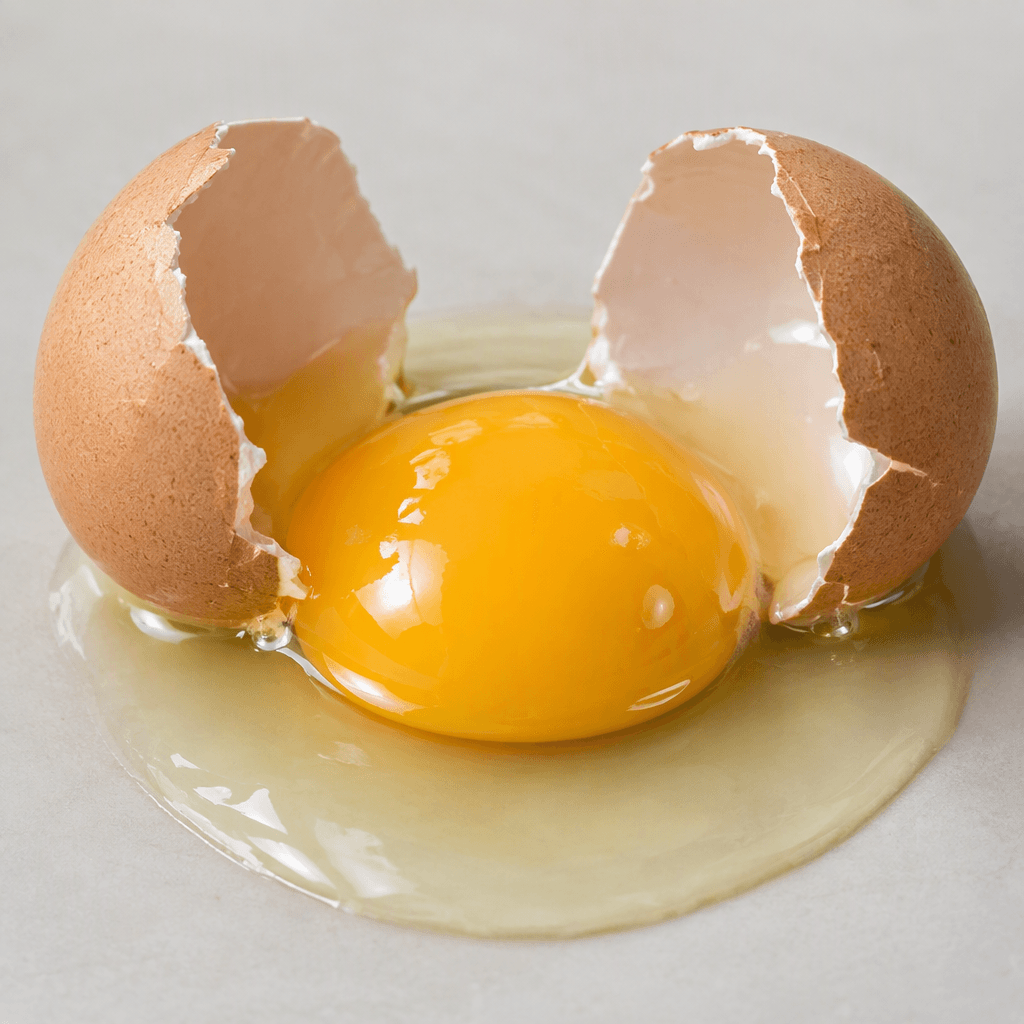
Egg (cracked) Calories
High-quality protein, vitamin B12, choline, vitamin D
In season: Spring · Summer · Autumn · Winter
CALORIES
GI
POTASSIUM
FIBER
Quick answer
1 piece (medium) of Egg (cracked) (50 g) has 72 calories. That works out to 143 calories per 100 g. It contains 0.6 g of carbs, 6.5 g of protein, 5 g of fat and 0 g of fiber. Its 10 µg of Biotin covers 33% of the Daily Value. Its glycemic index is 0 (low), so it raises blood sugar slowly.
What is Egg (cracked)?
A cracked egg is a fresh egg removed from its shell, with the white and yolk ready to cook together or separately. It is a basic ingredient in kitchens worldwide: it can be fried or scrambled for breakfast, boiled for a quick meal, or mixed into batters and baking. Before cooking, the white is translucent and loose while the yolk is glossy and rounded; heat sets the white and firms the yolk to varying degrees.
Eggs provide high-quality protein along with nutrients such as vitamin B12 and choline; 100 grams contains 13 grams of protein. For a lighter meal, poach or boil one rather than frying it in much oil, and serve with vegetables or whole-grain toast.
Egg (cracked) Nutrition Facts
Selected: 100 g
143
KCAL / 100G
Carbs
1.1g
· 0% DV
Protein
13g
· 26% DV
Fat
9.9g
· 13% DV
Fiber
0g
· 0% DV
DV is the share of the daily value covered, on a 2,000 kcal reference diet.
Calories come from: Carbs 3% · Protein 36% · Fat 61%
Egg (cracked) Vitamins & Minerals
Vitamins
Biotin
20µg · 67% DV
B12
1.1µg · 46% DV
B2
0.5mg · 38% DV
B5
1.4mg · 28% DV
Minerals
Selenium
30µg · 55% DV
Iodine
47µg · 31% DV
Phosphorus
190mg · 27% DV
Iron
2mg · 11% DV
How Nutritious Is Egg (cracked)?
Nutrient density
Very high
How many vitamins, minerals and how much fiber this food carries per calorie. A high score means a lot of nutrition for few calories.
Satiety score
Medium
An EatBetter score computed from fiber, protein and calorie density. A high score means staying full longer on the same calories.
Both scores are calculated per 100 g and do not change with the selected portion. The satiety score is EatBetter's own calculation, not a clinical measure.
Egg (cracked) Glycemic Index
GLYCEMIC INDEX
GLYCEMIC LOAD
Accounts for portion size — a more realistic measure than GI alone.
How to Burn Off Egg (cracked)
To burn the 143 calories in 100 g:
🚶
Walking (5 km/h)
🏃
Running (8 km/h)
🚴
Cycling
🏊
Swimming
Times are calculated with the MET equation for a 70 kg adult. Actual burn varies with your weight, age and pace.
Is Egg (cracked) Processed?
NOVA 2
Minimally Processed
1. Unprocessed
2. Minimally Processed
3. Processed
4. Ultra-Processed
NOVA classifies foods into 4 groups by industrial processing. NOVA 1 (unprocessed) is the healthiest.
Does Egg (cracked) Contain Allergens?
Contains these allergens:
Which Diets Is Egg (cracked) Good For?
Vegan
— Not suitable
Vegetarian
✓ Suitable
Gluten-Free
✓ Suitable
Dairy-Free
— Not suitable
Mediterranean
✓ Suitable
Paleo
— Not suitable
Whole30
— Not suitable
DASH
— Not suitable
Keto
✓ Suitable
Low FODMAP
— Not suitable
Egg (cracked) Fat Profile
SATURATED
3.1g
MONOUNSATURATED
3.7g
POLYUNSATURATED
1.4g
Omega 6:3 ratio 26:1
Above the ideal 4:1 (26:1).
Compare Egg (cracked)
Foods Similar to Egg (cracked)
Frequently Asked Questions About Egg (cracked)
How long can a cracked egg stay in the fridge?
Keep a cracked raw egg in a clean, covered container in the refrigerator and use it within 2 days. Discard it if it has been at room temperature for more than 2 hours, and keep it separate from ready-to-eat foods.
Can you eat a raw egg?
You can, but raw eggs may contain Salmonella even when they look and smell normal. Cooking the white and yolk until firm reduces the risk; use pasteurized eggs in recipes that call for raw or lightly cooked egg.
Can you freeze a cracked egg?
Yes, freeze the egg without its shell. Lightly beat it, transfer it to a covered freezer-safe container, and cook it thoroughly after thawing in the refrigerator. Freezing can change its texture, so it is less suitable for preparations such as boiled eggs.
How can you tell if an egg is fresh?
Place the egg in a bowl of water: a fresh one usually lies flat on the bottom, while an older one may stand upright. Floating indicates age, not a definitive safety test; discard an egg with an off smell or unusual appearance.
Why does an egg yolk break when you crack an egg?
A yolk can break if the shell’s sharp edge punctures it or if the egg is older and its yolk membrane has weakened. Crack eggs on a flat surface into a small bowl first; this also makes it easier to spot shell fragments.
Is cloudy egg white a sign that an egg has gone bad?
No, a cloudy raw egg white is often a sign of freshness, caused by carbon dioxide dissolved in the white. A bad smell, unusual discoloration, or an abnormal texture is a better reason to discard an egg.
Should you wash an egg before cracking it?
Do not wash eggs before storing them, because washing can damage their natural protective coating. If the shell is dirty, clean it just before cracking, then wash your hands and any surfaces that touched the raw egg.
What is the difference between brown and white eggs?
The shell color usually reflects the breed of the hen, not the egg’s nutritional value or flavor. Choose eggs based on freshness, careful storage, and intact shells rather than assuming brown or white eggs are healthier.
How do you boil an egg so the yolk is soft or hard?
Cover the egg with water in a saucepan and bring it to a boil, then lower the heat and continue cooking. Cook it for less time for a softer yolk and longer for a firm yolk; cool it in cold water to make peeling easier.
How do you get eggshell out of a cracked egg?
Use a larger piece of clean eggshell or clean fingers to lift the fragment out. Cracking the egg into a separate small bowl first makes shell pieces easier to see and keeps them out of the rest of your recipe.
Have another question about Egg (cracked)?
Ask the AI nutrition coach — calories, portions, alternatives and more, answered in seconds in the app.

Scan calories with your camera
Instant AI nutrition analysis

Nutrition data compiled from USDA FoodData Central and scientific sources.