

Ready & Packaged Foods
All →Vegetables & Legumes
All →Desserts & Confectionery
All →Meat & Protein
All →Grains & Bakery
All →Beverages
All →Milk & Dairy
All →

Dutch Waffle Calories
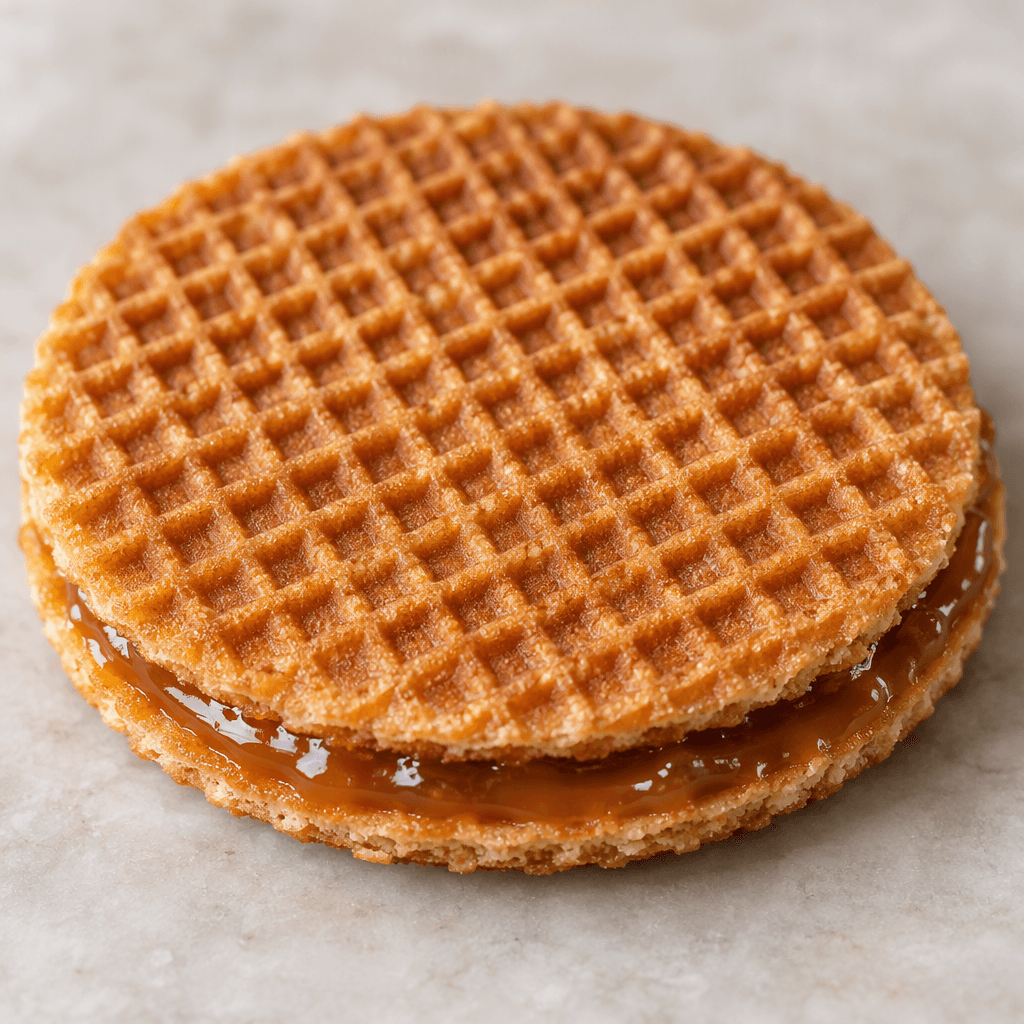
Thin, crisp waffle, often filled with caramel
In season: Autumn · Winter
CALORIES
GI
POTASSIUM
FIBER
Quick answer
1 piece (medium) of Dutch Waffle (35 g) has 151 calories. That works out to 430 calories per 100 g. It contains 24.8 g of carbs, 1.6 g of protein, 5.3 g of fat and 0.5 g of fiber. Its glycemic index is 70 (high), so it raises blood sugar quickly.
What is Dutch Waffle?
A Dutch waffle is a thin, round waffle made from two crisp layers with a glossy caramel-like syrup filling between them. It is closely associated with the Dutch stroopwafel, unlike the thicker, softer waffles often served as a breakfast base. The outer layers have a delicate grid and a light crunch, while the middle is sweet and chewy.
In the Netherlands, it is commonly enjoyed with coffee or tea; English-speaking readers can serve it the same way as a small treat or alongside dessert. It is mainly a source of carbohydrates and fat, with little fibre, so its sweetness is satisfying in a modest portion. Pair it with unsweetened tea or coffee to balance the caramel flavour.
Dutch Waffle Nutrition Facts
Selected: 100 g
430
KCAL / 100G
Carbs
71g
· 26% DV
Protein
4.5g
· 9% DV
Fat
15g
· 19% DV
Fiber
1.5g
· 5% DV
DV is the share of the daily value covered, on a 2,000 kcal reference diet.
Calories come from: Carbs 65% · Protein 4% · Fat 31%
Dutch Waffle Vitamins & Minerals
Vitamins
B1
0.12mg · 10% DV
B2
0.13mg · 10% DV
B3
1.1mg · 7% DV
Biotin
2µg · 7% DV
Minerals
Sodium
250mg · 11% DV
Selenium
6µg · 11% DV
Phosphorus
70mg · 10% DV
Calcium
60mg · 6% DV
How Nutritious Is Dutch Waffle?
Nutrient density
Low
How many vitamins, minerals and how much fiber this food carries per calorie. A high score means a lot of nutrition for few calories.
Satiety score
Low
An EatBetter score computed from fiber, protein and calorie density. A high score means staying full longer on the same calories.
Both scores are calculated per 100 g and do not change with the selected portion. The satiety score is EatBetter's own calculation, not a clinical measure.
Dutch Waffle Glycemic Index
GLYCEMIC INDEX
GLYCEMIC LOAD
Accounts for portion size — a more realistic measure than GI alone.
How to Burn Off Dutch Waffle
To burn the 430 calories in 100 g:
🚶
Walking (5 km/h)
🏃
Running (8 km/h)
🚴
Cycling
🏊
Swimming
Times are calculated with the MET equation for a 70 kg adult. Actual burn varies with your weight, age and pace.
Is Dutch Waffle Processed?
NOVA 3
Processed
1. Unprocessed
2. Minimally Processed
3. Processed
4. Ultra-Processed
NOVA classifies foods into 4 groups by industrial processing. NOVA 1 (unprocessed) is the healthiest.
Does Dutch Waffle Contain Allergens?
Contains these allergens:
Which Diets Is Dutch Waffle Good For?
Vegan
— Not suitable
Vegetarian
— Not suitable
Gluten-Free
— Not suitable
Dairy-Free
— Not suitable
Mediterranean
— Not suitable
Paleo
— Not suitable
Whole30
— Not suitable
DASH
— Not suitable
Keto
— Not suitable
Low FODMAP
— Not suitable
Dutch Waffle Fat Profile
SATURATED
7.5g
MONOUNSATURATED
4.5g
POLYUNSATURATED
2.3g
Omega 6:3 ratio 55:1
Above the ideal 4:1 (55:1).
Compare Dutch Waffle
Foods Similar to Dutch Waffle
Frequently Asked Questions About Dutch Waffle
What is a Dutch waffle?
A Dutch waffle is a thin, round sandwich of two crisp waffle layers with a sweet caramel-syrup filling. It is commonly served as a snack with coffee or tea, and is also known by its Dutch name, stroopwafel.
Is a Dutch waffle the same as a stroopwafel?
Yes, Dutch waffle is a common English name for a stroopwafel. The traditional version has two thin, baked waffle layers joined with a syrupy caramel filling, rather than the thick, fluffy shape associated with some other waffles.
How do you eat a Dutch waffle?
You can eat a Dutch waffle as it is, or enjoy it with coffee or tea. For a softer filling, place the waffle over a hot mug for a short time so the rising steam warms the caramel.
Why do people put a Dutch waffle on top of a hot drink?
People rest a Dutch waffle over a hot drink to soften its caramel filling with steam. Leave it there briefly, then eat it while the center is warm; keeping it over the mug too long can soften the crisp waffle layers.
What is the filling in a Dutch waffle made of?
The classic Dutch waffle filling is a thick, sweet syrup made with caramelized sugar, often combined with butter and cinnamon. Recipes and packaged versions vary, so the flavor and exact ingredients are not identical in every Dutch waffle.
Where did the Dutch waffle originate?
The Dutch waffle, or stroopwafel, originated in the Netherlands and is particularly associated with Gouda. Its familiar form pairs thin waffle rounds with a syrup filling, making it different from thicker waffles served with toppings.
How is a Dutch waffle made?
A Dutch waffle is made by baking thin rounds of dough in a waffle iron, splitting or pairing the rounds, and spreading syrup between them. Traditionally, the rounds are cut while warm so the caramel filling can hold the two layers together.
How is a Dutch waffle different from a Belgian waffle?
A Dutch waffle is thin and crisp, with caramel syrup sandwiched between two layers. Belgian waffles are typically thicker and airier, with deeper pockets, and are often served topped with fruit, cream, or syrup rather than filled inside.
How should you store a Dutch waffle?
Store a Dutch waffle in a tightly sealed container in a cool, dry place to keep moisture from softening its crisp layers. Once a package is open, close it securely and avoid leaving the waffles exposed to air.
Can you freeze Dutch waffles?
Yes, you can freeze Dutch waffles. Separate them with pieces of baking paper, place them in an airtight freezer container, and thaw them at room temperature before eating; a brief gentle warming can soften the filling again.
Have another question about Dutch Waffle?
Ask the AI nutrition coach — calories, portions, alternatives and more, answered in seconds in the app.

Scan calories with your camera
Instant AI nutrition analysis

Nutrition data compiled from USDA FoodData Central and scientific sources.