

Ready & Packaged Foods
All →Vegetables & Legumes
All →Desserts & Confectionery
All →Meat & Protein
All →Grains & Bakery
All →Beverages
All →Milk & Dairy
All →

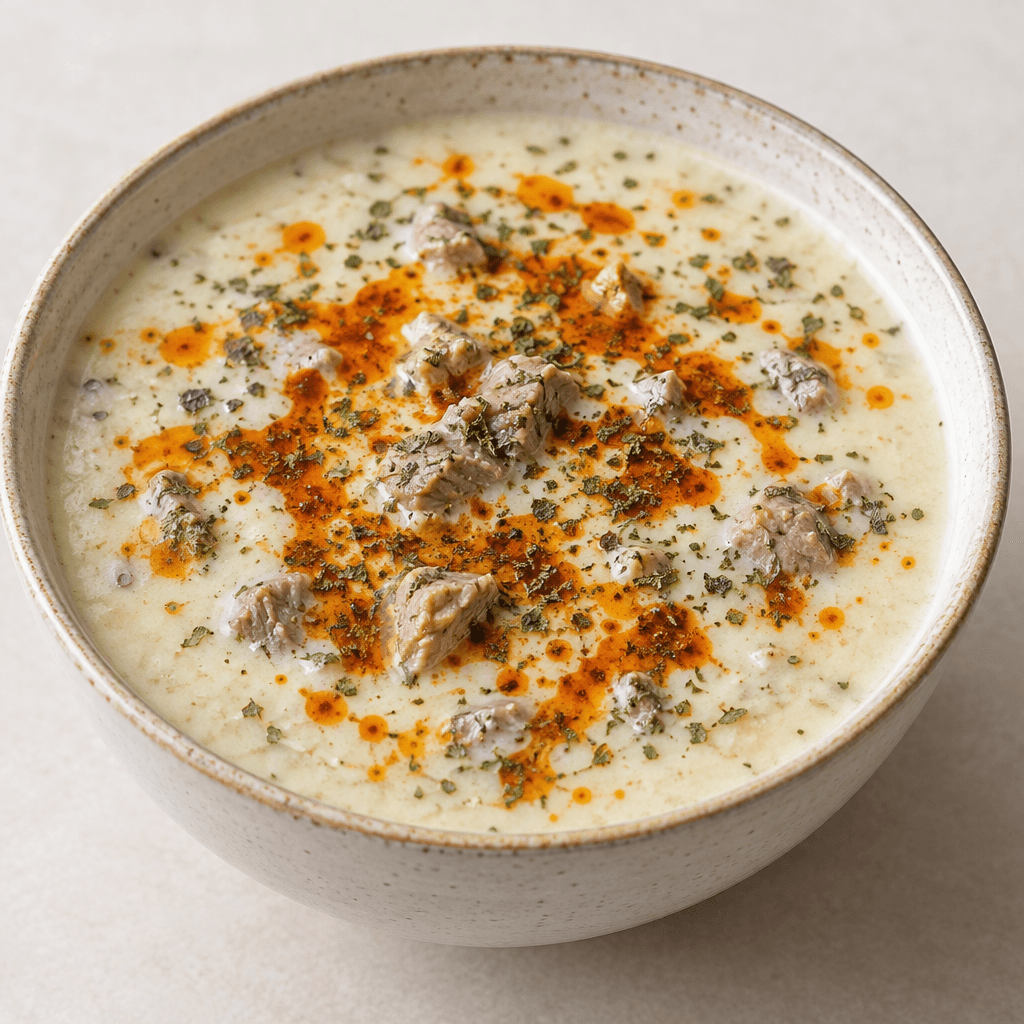
Düğün Çorbası (Turkish Wedding Soup) Calories
Traditional Turkish soup made with lamb, flour, egg-lemon sauce
In season: Winter · Autumn
CALORIES
GI
POTASSIUM
FIBER
Quick answer
1 cup (medium) of Düğün Çorbası (Turkish Wedding Soup) (220 g) has 143 calories. That works out to 65 calories per 100 g. It contains 10.6 g of carbs, 9.2 g of protein, 7 g of fat and 0.7 g of fiber. Its 704 mg of Sodium covers 31% of the Daily Value. Its glycemic index is 45 (low), so it raises blood sugar slowly.
What is Düğün Çorbası (Turkish Wedding Soup)?
Düğün Çorbası, or Turkish wedding soup, is a traditional Turkish lamb soup. Tender pieces of lamb simmer in broth, which is thickened with flour and enriched with an egg-and-lemon dressing for a gently creamy, slightly tangy finish. It is associated with celebratory wedding meals, though it is also cooked at home.
In Turkey it is usually served hot as a first course, often finished with paprika butter and dried mint; bread makes a natural accompaniment. The lamb contributes protein, while the flour-thickened broth makes the soup more substantial than a clear stock. For a lighter meal, use less butter on top and serve it with a crisp salad.
Düğün Çorbası (Turkish Wedding Soup) Nutrition Facts
Selected: 100 g
65
KCAL / 100G
Carbs
4.8g
· 2% DV
Protein
4.2g
· 8% DV
Fat
3.2g
· 4% DV
Fiber
0.3g
· 1% DV
DV is the share of the daily value covered, on a 2,000 kcal reference diet.
Calories come from: Carbs 30% · Protein 26% · Fat 44%
Düğün Çorbası (Turkish Wedding Soup) Vitamins & Minerals
Vitamins
B12
0.18µg · 8% DV
B5
0.32mg · 6% DV
B2
0.07mg · 5% DV
B3
0.85mg · 5% DV
Minerals
Sodium
320mg · 14% DV
Zinc
1mg · 9% DV
Iron
1mg · 6% DV
Selenium
3.5µg · 6% DV
How Nutritious Is Düğün Çorbası (Turkish Wedding Soup)?
Nutrient density
Medium
How many vitamins, minerals and how much fiber this food carries per calorie. A high score means a lot of nutrition for few calories.
Satiety score
Medium
An EatBetter score computed from fiber, protein and calorie density. A high score means staying full longer on the same calories.
Both scores are calculated per 100 g and do not change with the selected portion. The satiety score is EatBetter's own calculation, not a clinical measure.
Düğün Çorbası (Turkish Wedding Soup) Glycemic Index
GLYCEMIC INDEX
GLYCEMIC LOAD
Accounts for portion size — a more realistic measure than GI alone.
How to Burn Off Düğün Çorbası (Turkish Wedding Soup)
To burn the 65 calories in 100 g:
🚶
Walking (5 km/h)
🏃
Running (8 km/h)
🚴
Cycling
🏊
Swimming
Times are calculated with the MET equation for a 70 kg adult. Actual burn varies with your weight, age and pace.
Is Düğün Çorbası (Turkish Wedding Soup) Processed?
NOVA 2
Minimally Processed
1. Unprocessed
2. Minimally Processed
3. Processed
4. Ultra-Processed
NOVA classifies foods into 4 groups by industrial processing. NOVA 1 (unprocessed) is the healthiest.
Does Düğün Çorbası (Turkish Wedding Soup) Contain Allergens?
Contains these allergens:
Which Diets Is Düğün Çorbası (Turkish Wedding Soup) Good For?
Vegan
— Not suitable
Vegetarian
— Not suitable
Gluten-Free
— Not suitable
Dairy-Free
— Not suitable
Mediterranean
✓ Suitable
Paleo
— Not suitable
Whole30
— Not suitable
DASH
— Not suitable
Keto
— Not suitable
Low FODMAP
— Not suitable
Düğün Çorbası (Turkish Wedding Soup) Fat Profile
SATURATED
1.1g
MONOUNSATURATED
1.2g
POLYUNSATURATED
0.25g
Omega 6:3 ratio 2.7:1
Below the ideal 4:1 — a good omega balance.
Compare Düğün Çorbası (Turkish Wedding Soup)
Foods Similar to Düğün Çorbası (Turkish Wedding Soup)
Frequently Asked Questions About Düğün Çorbası (Turkish Wedding Soup)
What is Turkish wedding soup?
Turkish wedding soup is a traditional lamb soup thickened with flour and finished with an egg-and-lemon mixture. It is commonly topped with butter warmed with red pepper, and is served at celebrations as well as at home.
How do you make Turkish wedding soup?
To make Turkish wedding soup, simmer lamb until tender, shred or chop it, and return it to the cooking broth. Thicken the broth with flour, then stir in tempered egg and lemon; finish with a paprika-butter drizzle.
What meat goes into Turkish wedding soup?
Turkish wedding soup is traditionally made with lamb, often cooked on the bone to enrich the broth. Boneless lamb also works for a home version; cook it until tender so it can be easily broken into small pieces.
How do you keep the egg and lemon sauce from curdling in Turkish wedding soup?
Temper the egg-and-lemon mixture by whisking in hot soup a little at a time before adding it slowly to the pot. Stir continuously and avoid a hard boil afterward, which can make the egg separate and leave the soup grainy.
Where does Turkish wedding soup come from?
Turkish wedding soup is part of Turkish cooking and is served at wedding feasts in different parts of the country. Recipes vary among regions and families, but lamb broth and an egg-and-lemon finish are common features.
Why is Turkish wedding soup served at weddings?
Turkish wedding soup is associated with wedding feasts because it is a nourishing, shareable dish that can be prepared for a crowd. Its name reflects that celebratory tradition, although it is also cooked and eaten as an everyday soup.
Can you make Turkish wedding soup with chicken instead of lamb?
Yes, chicken can replace lamb, but the result is a variation rather than the classic lamb-based Turkish wedding soup. Use well-seasoned chicken broth and add cooked, shredded chicken; keep the egg-and-lemon tempering step gentle to prevent curdling.
What is the red butter topping on Turkish wedding soup?
The red topping is usually butter warmed with paprika or red pepper flakes, sometimes with dried mint. Spoon it over the soup just before serving so its aroma and color remain distinct from the creamy lamb broth.
Can Turkish wedding soup be made ahead?
Yes, you can cook the lamb and broth ahead, then add the flour thickener and egg-lemon mixture closer to serving. Reheat gently and stir often; boiling the finished soup can cause the sauce to separate.
How long does Turkish wedding soup keep in the refrigerator?
Store leftover Turkish wedding soup covered in the refrigerator and eat it within a few days. Reheat only the portion you need over low heat, stirring frequently, because repeated boiling can affect the texture of its egg-based finish.
Have another question about Düğün Çorbası (Turkish Wedding Soup)?
Ask the AI nutrition coach — calories, portions, alternatives and more, answered in seconds in the app.

Scan calories with your camera
Instant AI nutrition analysis

Nutrition data compiled from USDA FoodData Central and scientific sources.