

Ready & Packaged Foods
All →Vegetables & Legumes
All →Desserts & Confectionery
All →Meat & Protein
All →Grains & Bakery
All →Beverages
All →Milk & Dairy
All →

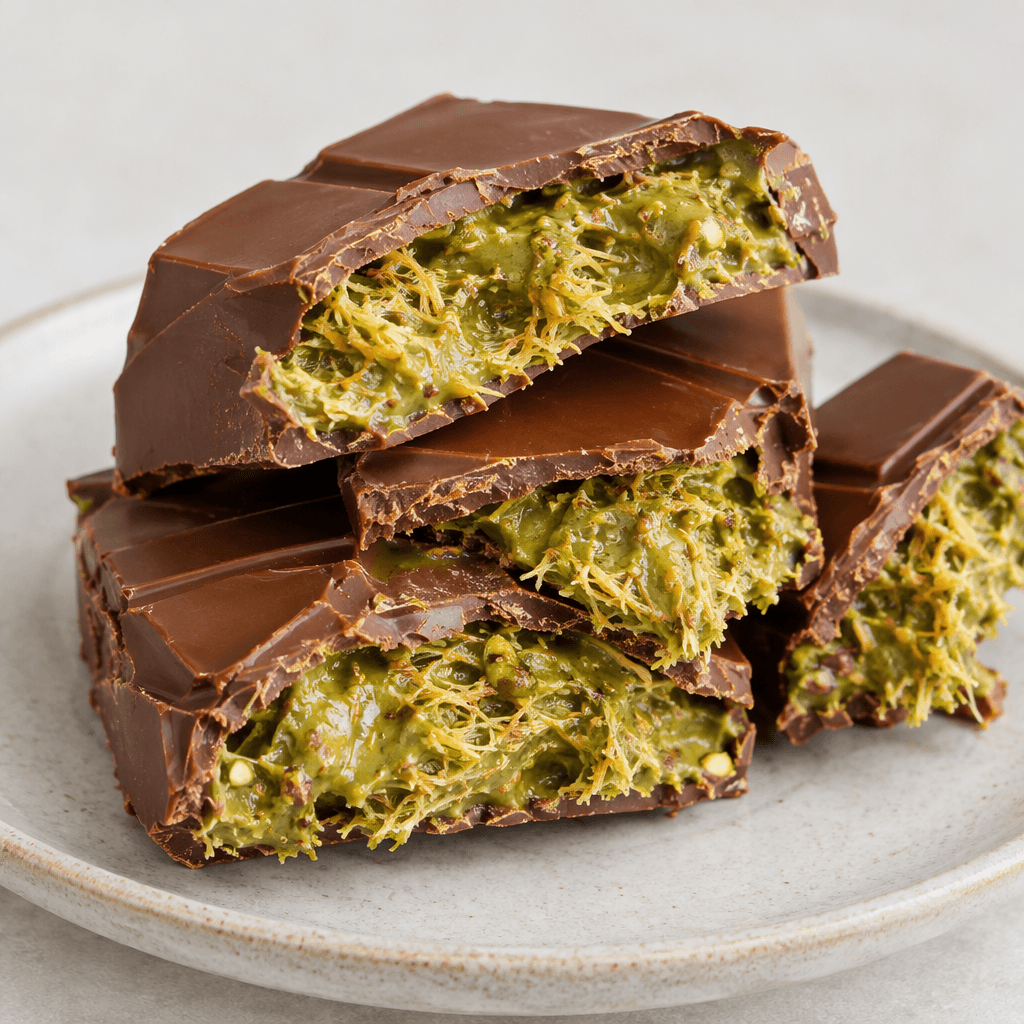
Dubai Chocolate Calories
Luxury, rich cocoa, high sugar and fat content
In season: Spring · Summer · Autumn · Winter
CALORIES
GI
POTASSIUM
FIBER
Quick answer
1 piece (medium) of Dubai Chocolate (30 g) has 162 calories. That works out to 540 calories per 100 g. It contains 15.6 g of carbs, 1.9 g of protein, 10.2 g of fat and 1.7 g of fiber. Its 0.2 mg of Copper covers 27% of the Daily Value. Its glycemic index is 40 (medium), so it raises blood sugar at a moderate pace.
What is Dubai Chocolate?
Dubai Chocolate is a thick chocolate bar filled with pistachio cream and crisp strands of shredded pastry, usually kataifi. Associated with Dubai, it brings together a glossy chocolate shell, a vivid green filling and a crunchy centre; recipes may use different kinds of chocolate.
Its flavour is rich and sweet, with the contrast of smooth pistachio and crisp pastry. In the UAE and elsewhere, people often break it into chunks to enjoy as a dessert or treat with coffee or tea. It is energy-dense and high in sugar and fat, so a small piece can feel satisfying. Share a bar or serve a piece with unsweetened coffee for a less-sweet pairing.
Dubai Chocolate Nutrition Facts
Selected: 100 g
540
KCAL / 100G
Carbs
52g
· 19% DV
Protein
6.2g
· 12% DV
Fat
34g
· 44% DV
Fiber
5.5g
· 20% DV
DV is the share of the daily value covered, on a 2,000 kcal reference diet.
Calories come from: Carbs 39% · Protein 5% · Fat 56%
Dubai Chocolate Vitamins & Minerals
Vitamins
B2
0.25mg · 19% DV
B12
0.2µg · 8% DV
Biotin
2µg · 7% DV
B1
0.07mg · 6% DV
Minerals
Copper
1mg · 111% DV
Manganese
1mg · 43% DV
Phosphorus
180mg · 26% DV
Magnesium
90mg · 21% DV
How Nutritious Is Dubai Chocolate?
Nutrient density
Low
How many vitamins, minerals and how much fiber this food carries per calorie. A high score means a lot of nutrition for few calories.
Satiety score
Medium
An EatBetter score computed from fiber, protein and calorie density. A high score means staying full longer on the same calories.
Both scores are calculated per 100 g and do not change with the selected portion. The satiety score is EatBetter's own calculation, not a clinical measure.
Dubai Chocolate Glycemic Index
GLYCEMIC INDEX
GLYCEMIC LOAD
Accounts for portion size — a more realistic measure than GI alone.
How to Burn Off Dubai Chocolate
To burn the 540 calories in 100 g:
🚶
Walking (5 km/h)
🏃
Running (8 km/h)
🚴
Cycling
🏊
Swimming
Times are calculated with the MET equation for a 70 kg adult. Actual burn varies with your weight, age and pace.
Is Dubai Chocolate Processed?
NOVA 3
Processed
1. Unprocessed
2. Minimally Processed
3. Processed
4. Ultra-Processed
NOVA classifies foods into 4 groups by industrial processing. NOVA 1 (unprocessed) is the healthiest.
Does Dubai Chocolate Contain Allergens?
Contains these allergens:
Which Diets Is Dubai Chocolate Good For?
Vegan
— Not suitable
Vegetarian
✓ Suitable
Gluten-Free
— Not suitable
Dairy-Free
— Not suitable
Mediterranean
— Not suitable
Paleo
— Not suitable
Whole30
— Not suitable
DASH
— Not suitable
Keto
— Not suitable
Low FODMAP
— Not suitable
Dubai Chocolate Fat Profile
SATURATED
20g
MONOUNSATURATED
10g
POLYUNSATURATED
2.5g
Omega 6:3 ratio 9:1
Above the ideal 4:1 (9:1).
Compare Dubai Chocolate
Foods Similar to Dubai Chocolate
Frequently Asked Questions About Dubai Chocolate
What is Dubai Chocolate?
Dubai Chocolate is a thick chocolate bar typically filled with pistachio cream and crisp shredded pastry called kataifi. The contrast between its chocolate shell and green, crunchy filling is what makes the dessert distinctive.
What is inside Dubai Chocolate?
Classic Dubai Chocolate has a chocolate shell around pistachio cream mixed with toasted kataifi pastry. Recipes vary: some add tahini or use a different chocolate coating, so the filling is not identical in every bar.
Why did Dubai Chocolate go viral?
Dubai Chocolate caught on through videos showing its vivid green filling and the crunch of kataifi when the bar is broken open. Its luxurious image and the surprising mix of textures helped make it especially shareable.
Is Dubai Chocolate actually from Dubai?
The viral style is associated with a bar made by Dubai-based FIX Dessert Chocolatier, so the name has a real connection to the city. Many bars sold today are imitations or local versions rather than products made in Dubai.
How do you make Dubai Chocolate at home?
To make Dubai Chocolate, coat a chocolate mold with melted chocolate, then fill it with pistachio cream mixed with toasted kataifi. Cover the filling with more chocolate and let the bar set completely before removing it from the mold.
What is kataifi in Dubai Chocolate?
Kataifi is a pastry made from very fine strands of dough, similar in appearance to shredded wheat. It is toasted until crisp and stirred into the pistachio filling, giving Dubai Chocolate its signature crunch.
How do you keep the filling in Dubai Chocolate crunchy?
Toast the kataifi until golden and let it cool completely before mixing it into the pistachio cream. Moisture and warm filling soften the pastry, so keep the finished Dubai Chocolate sealed and away from humid conditions.
Is Dubai Chocolate the same as knafeh?
No. Dubai Chocolate borrows the combination of pistachio and crisp pastry associated with knafeh, but it is a chocolate bar with a creamy filling, not the traditional baked dessert served with syrup or cheese.
Does Dubai Chocolate need to be refrigerated?
No, Dubai Chocolate can usually be kept in an airtight container in a cool, dry place away from sunlight. Refrigerate it if your room is warm, then let it come closer to room temperature before serving for a better texture.
Why is Dubai Chocolate so expensive?
Dubai Chocolate can cost more because pistachios are relatively expensive and the layered filling takes extra preparation. Popularity, imported branding, and premium packaging can add to the price, but locally made versions may cost less.
Have another question about Dubai Chocolate?
Ask the AI nutrition coach — calories, portions, alternatives and more, answered in seconds in the app.

Scan calories with your camera
Instant AI nutrition analysis

Nutrition data compiled from USDA FoodData Central and scientific sources.