

Ready & Packaged Foods
All →Vegetables & Legumes
All →Desserts & Confectionery
All →Meat & Protein
All →Grains & Bakery
All →Beverages
All →Milk & Dairy
All →

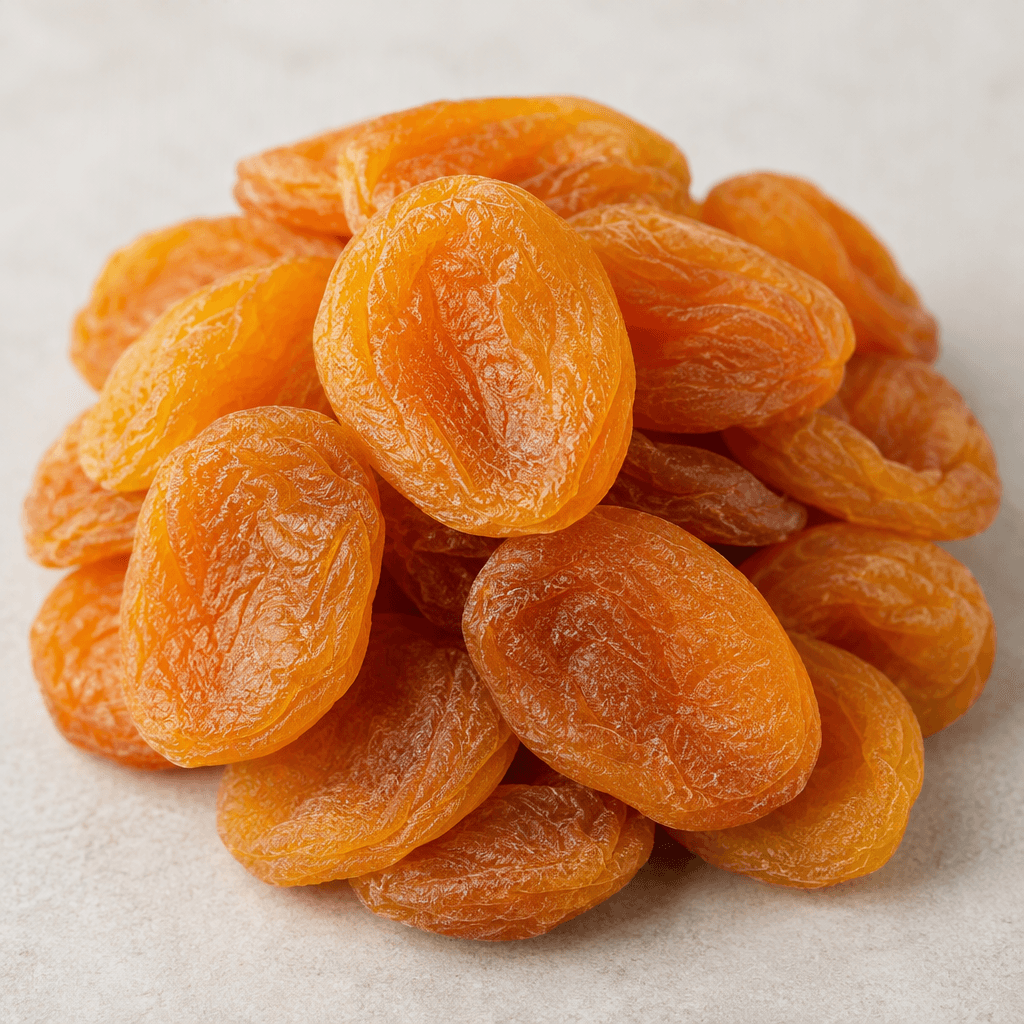
Dried apricots Calories
Rich in fiber and potassium, natural sweet snack
In season: Summer · Autumn
CALORIES
GI
POTASSIUM
FIBER
Quick answer
5 piece (medium) of Dried apricots (40 g) has 96 calories. That works out to 241 calories per 100 g. It contains 25.6 g of carbs, 1.4 g of protein, 0.2 g of fat and 2.9 g of fiber. Its 144 µg of Vitamin A covers 16% of the Daily Value. Its glycemic index is 30 (medium), so it raises blood sugar at a moderate pace.
What is Dried apricots?
Dried apricots are ripe apricots with the stones removed and the fruit dried, traditionally in the sun or in drying rooms. They are especially familiar in Turkish and Middle Eastern food traditions, where they may be soft and plump or firmer and more chewy; their colour ranges from bright orange to deep amber. Their concentrated sweetness makes them easy to snack on by themselves, and they are also served with nuts, added to porridge or baked goods, or simmered into compotes.
They provide fibre and potassium, while drying concentrates their naturally occurring sugars. For a simple snack with more staying power, pair a few with plain yoghurt or a small handful of nuts. Chopped dried apricots also bring sweetness and a pleasantly chewy texture to salads, grain dishes and desserts.
Dried apricots Nutrition Facts
Selected: 100 g
241
KCAL / 100G
Carbs
63.9g
· 23% DV
Protein
3.4g
· 7% DV
Fat
0.5g
· 1% DV
Fiber
7.3g
· 26% DV
DV is the share of the daily value covered, on a 2,000 kcal reference diet.
Calories come from: Carbs 93% · Protein 5% · Fat 2%
Dried apricots Vitamins & Minerals
Vitamins
Vitamin A
360µg · 40% DV
Vitamin E
4.3mg · 29% DV
B3
2.6mg · 16% DV
B5
0.5mg · 10% DV
Minerals
Potassium ⭐
1162mg · 34% DV
Iron
3mg · 17% DV
Phosphorus
71mg · 10% DV
Magnesium
32mg · 8% DV
How Nutritious Is Dried apricots?
Nutrient density
High
How many vitamins, minerals and how much fiber this food carries per calorie. A high score means a lot of nutrition for few calories.
Satiety score
Medium
An EatBetter score computed from fiber, protein and calorie density. A high score means staying full longer on the same calories.
Both scores are calculated per 100 g and do not change with the selected portion. The satiety score is EatBetter's own calculation, not a clinical measure.
Dried apricots Glycemic Index
GLYCEMIC INDEX
GLYCEMIC LOAD
Accounts for portion size — a more realistic measure than GI alone.
How to Burn Off Dried apricots
To burn the 241 calories in 100 g:
🚶
Walking (5 km/h)
🏃
Running (8 km/h)
🚴
Cycling
🏊
Swimming
Times are calculated with the MET equation for a 70 kg adult. Actual burn varies with your weight, age and pace.
Is Dried apricots Processed?
NOVA 2
Minimally Processed
1. Unprocessed
2. Minimally Processed
3. Processed
4. Ultra-Processed
NOVA classifies foods into 4 groups by industrial processing. NOVA 1 (unprocessed) is the healthiest.
Does Dried apricots Contain Allergens?
No known major allergens
Which Diets Is Dried apricots Good For?
Vegan
✓ Suitable
Vegetarian
✓ Suitable
Gluten-Free
✓ Suitable
Dairy-Free
— Not suitable
Mediterranean
✓ Suitable
Paleo
✓ Suitable
Whole30
— Not suitable
DASH
— Not suitable
Keto
— Not suitable
Low FODMAP
— Not suitable
Dried apricots Fat Profile
SATURATED
0.02g
MONOUNSATURATED
0.08g
POLYUNSATURATED
0.09g
Omega 6:3 ratio 9:1
Above the ideal 4:1 (9:1).
Compare Dried apricots
Foods Similar to Dried apricots
Frequently Asked Questions About Dried apricots
Are dried apricots good for you?
Yes, dried apricots are a fruit-based snack that provides fibre and potassium. Their nutrients and natural sugars are concentrated by drying, so a modest portion is a practical way to enjoy them without eating a large amount at once.
Do dried apricots help with constipation?
Yes, the fibre in dried apricots can support regular bowel movements. Drink water alongside them, and increase the amount gradually; a sudden increase in dried fruit may cause bloating for some people.
How many dried apricots should you eat a day?
Five medium dried apricots, about 40 g, is a typical serving. It is a useful snack-sized portion, not a required daily amount; adjust it to your appetite and the rest of your meals.
Should you soak dried apricots before eating them?
No, dried apricots do not need soaking before you eat them. Soak them briefly in warm water if you want a softer texture, or add them directly to porridge, baked goods, or savoury dishes.
How should you store dried apricots?
Keep dried apricots sealed in a cool, dry place away from sunlight and heat. Refrigerate them in warm or humid conditions, and discard them if you see mould or notice an unusual sour smell or texture.
Why are some dried apricots treated with sulfites?
Sulfites help dried apricots retain their bright orange colour and slow discolouration. Unsulfured apricots are usually darker; people who are sensitive to sulfites should choose an unsulfured variety rather than relying on colour alone.
Can dried apricots raise blood sugar?
Yes, dried apricots contain natural sugars and carbohydrates, so they can raise blood sugar. Their sugars are concentrated by drying; keeping the portion moderate and eating them as part of a meal can help avoid a large intake at once.
Are dried apricots healthier than fresh apricots?
Neither is automatically healthier: dried apricots are more concentrated because most of their water has been removed, while fresh apricots provide more volume and water. Choose dried ones for a portable snack and fresh ones when you want a larger, juicier portion.
Can dogs eat dried apricots?
A small piece of dried apricot flesh is not toxic to dogs, but it is sugary and can be difficult to chew. Never give a dog the apricot pit, and avoid dried fruit mixes that may contain raisins, which are toxic to dogs.
Can you eat apricot kernels with dried apricots?
No, do not eat apricot kernels. They can release amygdalin, which produces cyanide in the body and may cause poisoning; the dried apricot fruit is edible, but its kernel is not a safe snack.
Have another question about Dried apricots?
Ask the AI nutrition coach — calories, portions, alternatives and more, answered in seconds in the app.

Scan calories with your camera
Instant AI nutrition analysis

Nutrition data compiled from USDA FoodData Central and scientific sources.