

Ready & Packaged Foods
All →Vegetables & Legumes
All →Desserts & Confectionery
All →Meat & Protein
All →Grains & Bakery
All →Beverages
All →Milk & Dairy
All →

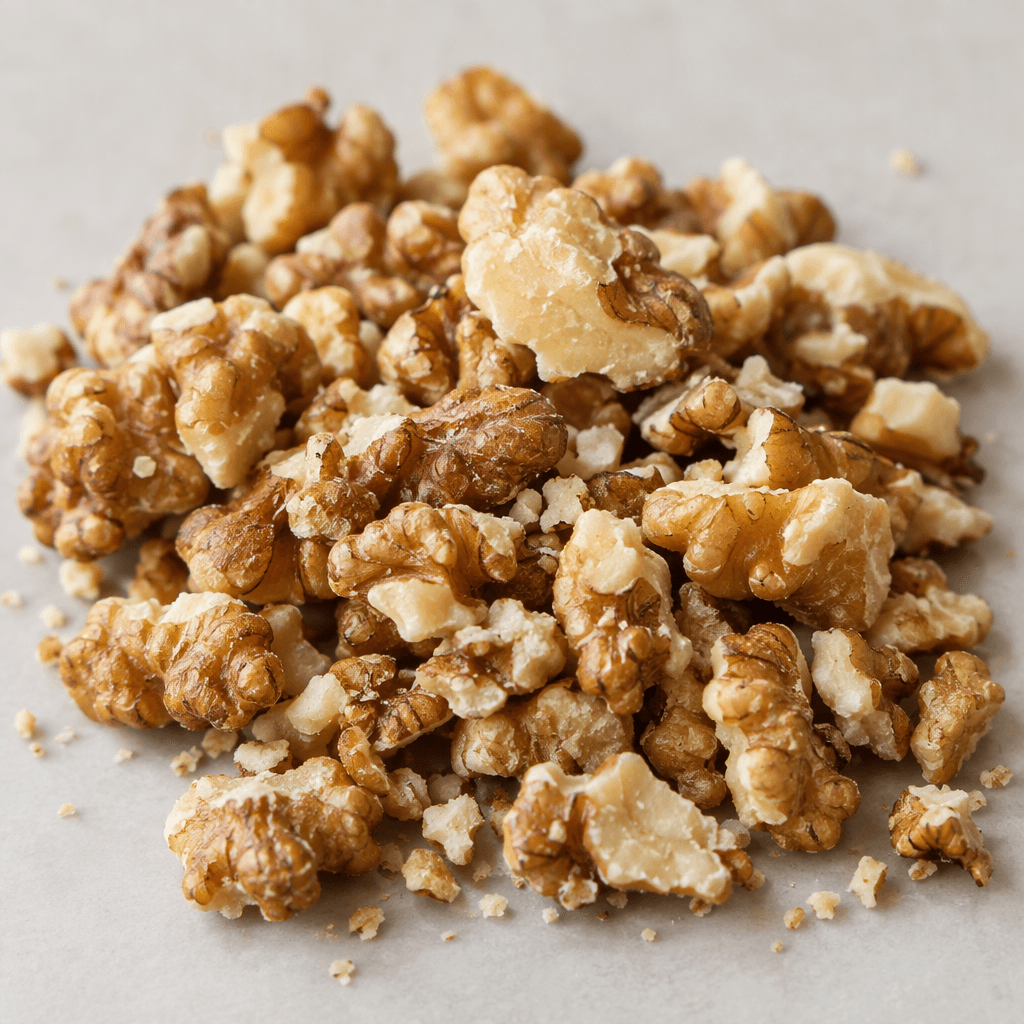
Crushed walnuts Calories
Rich in omega-3 ALA, copper, and manganese
In season: Spring · Summer · Autumn · Winter
CALORIES
GI
POTASSIUM
FIBER
Quick answer
1 tablespoon (chopped) of Crushed walnuts (8 g) has 52 calories. That works out to 654 calories per 100 g. It contains 1.1 g of carbs, 1.2 g of protein, 5.2 g of fat and 0.5 g of fiber. Its 0.1 mg of Copper covers 14% of the Daily Value. Its glycemic index is 15 (low), so it raises blood sugar slowly.
What is Crushed walnuts?
Crushed walnuts are walnut kernels broken into uneven pieces, from coarse chunks to fine crumbs. They are an ingredient rather than a dish, adding the walnuts’ rich, earthy flavour and a texture that can be either tender or crunchy depending on the size of the pieces.
They are sprinkled over porridge, yoghurt, salads and roasted vegetables, and folded into cakes, breads and sauces. In many places, walnuts are also served with cheese or fruit as a snack. They are energy-dense and provide plant-based omega-3 ALA, along with copper and manganese. Add them just before serving to keep larger pieces crisp, or use a light scattering when you want their flavour without making a dish feel too rich.
Crushed walnuts Nutrition Facts
Selected: 100 g
654
KCAL / 100G
Carbs
13.7g
· 5% DV
Protein
15.2g
· 30% DV
Fat
65.2g
· 84% DV
Fiber
6.7g
· 24% DV
DV is the share of the daily value covered, on a 2,000 kcal reference diet.
Calories come from: Carbs 8% · Protein 9% · Fat 83%
Crushed walnuts Vitamins & Minerals
Vitamins
Biotin
19µg · 63% DV
B6
0.54mg · 32% DV
B1
0.34mg · 28% DV
Folate
98µg · 25% DV
Minerals
Copper
2mg · 222% DV
Manganese
3mg · 130% DV
Phosphorus
346mg · 49% DV
Magnesium
158mg · 38% DV
How Nutritious Is Crushed walnuts?
Nutrient density
High
How many vitamins, minerals and how much fiber this food carries per calorie. A high score means a lot of nutrition for few calories.
Satiety score
Medium
An EatBetter score computed from fiber, protein and calorie density. A high score means staying full longer on the same calories.
Both scores are calculated per 100 g and do not change with the selected portion. The satiety score is EatBetter's own calculation, not a clinical measure.
Crushed walnuts Glycemic Index
GLYCEMIC INDEX
GLYCEMIC LOAD
Accounts for portion size — a more realistic measure than GI alone.
How to Burn Off Crushed walnuts
To burn the 654 calories in 100 g:
🚶
Walking (5 km/h)
🏃
Running (8 km/h)
🚴
Cycling
🏊
Swimming
Times are calculated with the MET equation for a 70 kg adult. Actual burn varies with your weight, age and pace.
Is Crushed walnuts Processed?
NOVA 2
Minimally Processed
1. Unprocessed
2. Minimally Processed
3. Processed
4. Ultra-Processed
NOVA classifies foods into 4 groups by industrial processing. NOVA 1 (unprocessed) is the healthiest.
Does Crushed walnuts Contain Allergens?
Contains these allergens:
Which Diets Is Crushed walnuts Good For?
Vegan
✓ Suitable
Vegetarian
✓ Suitable
Gluten-Free
✓ Suitable
Dairy-Free
— Not suitable
Mediterranean
✓ Suitable
Paleo
✓ Suitable
Whole30
— Not suitable
DASH
— Not suitable
Keto
✓ Suitable
Low FODMAP
— Not suitable
Crushed walnuts Fat Profile
SATURATED
6.13g
MONOUNSATURATED
8.93g
POLYUNSATURATED
47.17g
Omega 6:3 ratio 4.2:1
Above the ideal 4:1 (4.2:1).
Compare Crushed walnuts
Foods Similar to Crushed walnuts
Frequently Asked Questions About Crushed walnuts
How should you store crushed walnuts?
Store crushed walnuts in an airtight container in a cool, dark place. Their natural oils can turn rancid faster when exposed to air, heat, and light, so refrigerate them if you will not use them soon.
Can you freeze crushed walnuts?
Yes, crushed walnuts freeze well. Seal them in an airtight freezer container or bag, and take out only what you need so the rest does not repeatedly thaw and refreeze.
How do you crush walnuts without turning them into a paste?
Put the walnuts in a sturdy bag and gently roll over them with a rolling pin, or pulse them briefly in a food processor. Stop as soon as they reach the size you want; prolonged processing releases oil and makes them clump.
Why do crushed walnuts taste bitter?
Crushed walnuts may taste bitter because their natural skin has a slightly astringent flavor, or because their oils have gone rancid. A sharp, stale smell or unpleasant bitterness is a reason to discard them.
Do crushed walnuts need to be toasted?
No, crushed walnuts do not need to be toasted before eating or adding to a recipe. Toasting brings out a deeper aroma, but small pieces brown quickly, so stir them constantly and remove them as soon as they smell fragrant.
Can you eat crushed walnuts raw?
Yes, crushed walnuts can be eaten raw. Sprinkle them over yogurt, oats, salads, or desserts, and keep opened walnuts sealed so they stay fresh and do not pick up odors.
Should you soak crushed walnuts before eating them?
No, soaking crushed walnuts is not necessary. It softens their texture and removes the crunch, so add them dry unless a particular recipe specifically calls for soaked walnuts.
What can you make with crushed walnuts?
Crushed walnuts work in both sweet and savory dishes. Add them to cookies, cakes, and baklava, or use them in salads, pasta, sauces, and dips for a nutty flavor and a bit of crunch.
Can crushed walnuts replace breadcrumbs in a recipe?
Sometimes, but crushed walnuts do not behave like breadcrumbs. They add fat and a nutty flavor rather than absorbing moisture in the same way, so they work best as a coating or topping when that taste and texture suit the dish.
Are crushed walnuts good for you?
Yes, crushed walnuts are a nutrient-rich food, including a source of plant-based omega-3 ALA. Add them to meals for flavor and texture, but remember that crushing does not change their nutritional properties or make them a treatment for any condition.
Have another question about Crushed walnuts?
Ask the AI nutrition coach — calories, portions, alternatives and more, answered in seconds in the app.

Scan calories with your camera
Instant AI nutrition analysis

Nutrition data compiled from USDA FoodData Central and scientific sources.