

Ready & Packaged Foods
All →Vegetables & Legumes
All →Desserts & Confectionery
All →Meat & Protein
All →Grains & Bakery
All →Beverages
All →Milk & Dairy
All →

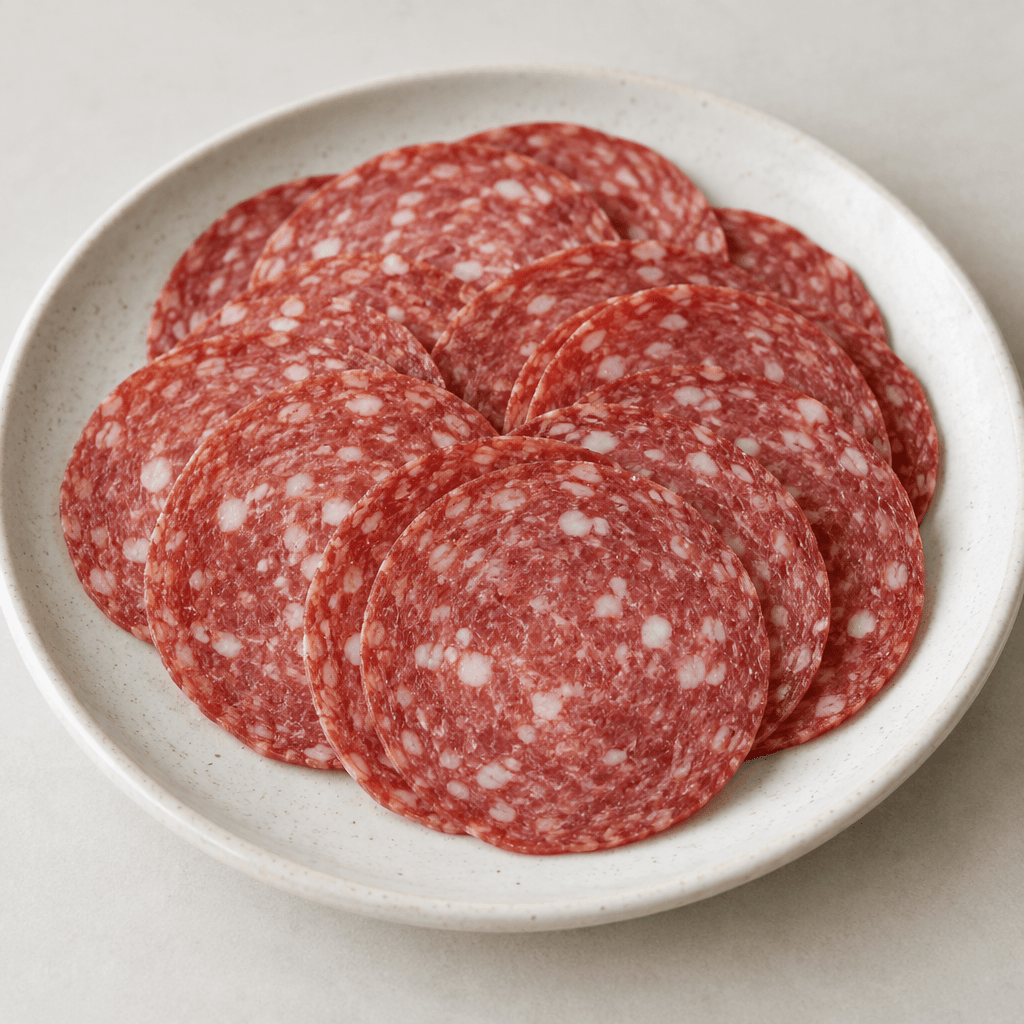
Sliced salami Calories
High protein, processed meat, salty, energy dense
In season: Spring · Summer · Autumn · Winter
CALORIES
GI
POTASSIUM
FIBER
Quick answer
5 slice (medium) of Sliced salami (30 g) has 123 calories. That works out to 410 calories per 100 g. It contains 0.8 g of carbs, 6.6 g of protein, 10.2 g of fat and 0 g of fiber. Its 0.6 µg of B12 covers 26% of the Daily Value. Its glycemic index is 0 (low), so it raises blood sugar slowly.
What is Sliced salami?
Sliced salami here refers to the Turkish-style deli meat called salam: seasoned meat made into a sausage, cooked and sold in thin rounds. Its recipe varies by producer; it is generally softer and milder than the dry-cured Italian salami familiar in many English-speaking countries.
The slices taste savoury and salty, with a tender, slightly springy texture. In Turkey they are commonly eaten in sandwiches or toast, or alongside bread at breakfast; elsewhere, they also work well on sandwiches, crackers or a casual snack board. Sliced salami provides protein, but is also energy-dense and high in fat. For a lighter serving, use a few slices with plenty of salad or vegetables.
Sliced salami Nutrition Facts
Selected: 100 g
410
KCAL / 100G
Carbs
2.5g
· 1% DV
Protein
22g
· 44% DV
Fat
34g
· 44% DV
Fiber
0g
· 0% DV
DV is the share of the daily value covered, on a 2,000 kcal reference diet.
Calories come from: Carbs 2% · Protein 22% · Fat 76%
Sliced salami Vitamins & Minerals
Vitamins
B12
2.1µg · 88% DV
B1
0.45mg · 38% DV
B3
4.7mg · 29% DV
B5
1.1mg · 22% DV
Minerals
Sodium
1700mg · 74% DV
Phosphorus
210mg · 30% DV
Selenium
13µg · 24% DV
Zinc
2mg · 18% DV
How Nutritious Is Sliced salami?
Nutrient density
Medium
How many vitamins, minerals and how much fiber this food carries per calorie. A high score means a lot of nutrition for few calories.
Satiety score
Low
An EatBetter score computed from fiber, protein and calorie density. A high score means staying full longer on the same calories.
Both scores are calculated per 100 g and do not change with the selected portion. The satiety score is EatBetter's own calculation, not a clinical measure.
Sliced salami Glycemic Index
GLYCEMIC INDEX
GLYCEMIC LOAD
Accounts for portion size — a more realistic measure than GI alone.
How to Burn Off Sliced salami
To burn the 410 calories in 100 g:
🚶
Walking (5 km/h)
🏃
Running (8 km/h)
🚴
Cycling
🏊
Swimming
Times are calculated with the MET equation for a 70 kg adult. Actual burn varies with your weight, age and pace.
Is Sliced salami Processed?
NOVA 3
Processed
1. Unprocessed
2. Minimally Processed
3. Processed
4. Ultra-Processed
NOVA classifies foods into 4 groups by industrial processing. NOVA 1 (unprocessed) is the healthiest.
Does Sliced salami Contain Allergens?
No known major allergens
Which Diets Is Sliced salami Good For?
Vegan
— Not suitable
Vegetarian
— Not suitable
Gluten-Free
✓ Suitable
Dairy-Free
— Not suitable
Mediterranean
✓ Suitable
Paleo
✓ Suitable
Whole30
— Not suitable
DASH
— Not suitable
Keto
✓ Suitable
Low FODMAP
— Not suitable
Sliced salami Fat Profile
SATURATED
13.5g
MONOUNSATURATED
15.5g
POLYUNSATURATED
3.2g
Omega 6:3 ratio 27.5:1
Above the ideal 4:1 (27.5:1).
Compare Sliced salami
Foods Similar to Sliced salami
Frequently Asked Questions About Sliced salami
Is sliced salami already cooked, or do you need to cook it?
Sliced salami sold as a ready-to-eat deli meat is usually heat-treated during production, so it can be eaten without further cooking. Check the package instructions, since products vary; cooking it in a sandwich or skillet is optional, not required for ordinary serving.
How long does sliced salami last after opening?
Keep sliced salami tightly wrapped or in a sealed container in the refrigerator and use it within a few days after opening. Follow any shorter use-by guidance on the package, and discard it if it develops a sour smell, slimy surface, or unusual discoloration.
Can you freeze sliced salami?
Yes, sliced salami can be frozen. Separate it into portions, seal it well to limit freezer burn, and thaw it in the refrigerator. The slices may be softer or slightly less appealing in texture after thawing, so use them in cooked dishes or sandwiches soon afterward.
What is sliced salami made of?
Sliced salami is typically made from meat, fat, salt, and seasonings, with curing or preserving ingredients varying by product. Recipes differ between brands and styles, so it is not always the same as traditionally dry-cured Italian salami; check the package for its specific ingredients.
Can you eat sliced salami cold straight from the package?
Yes, sliced salami sold as ready-to-eat can generally be eaten cold straight from the package. Keep it refrigerated and avoid leaving it at room temperature for extended periods. If the package says it must be cooked, follow that instruction instead.
What is the difference between sliced salami and pepperoni?
Pepperoni is a specific type of seasoned salami, commonly spiced with paprika or chili and often used as a pizza topping. Sliced salami is a broader term covering many styles, which can differ in seasoning, curing, texture, and whether they are intended to be eaten cold.
Can you cook sliced salami in a pan?
Yes, sliced salami can be cooked briefly in a pan; it will release some fat and may crisp at the edges. Use moderate heat and avoid cooking it for too long, since thin slices can dry out quickly and their salty flavor can become more pronounced.
Why does sliced salami have white flecks?
Small white flecks inside sliced salami are usually pieces of fat included in the mixture. They are different from mold growing on the surface. If you notice fuzzy growth, an off smell, or an unusual slimy texture, discard the salami rather than tasting it.
Is sliced salami healthy to eat regularly?
Sliced salami is best eaten occasionally rather than as an everyday staple because it is processed meat and can be high in salt. Vary your protein choices with foods such as beans, eggs, or fresh meat, and keep portions modest when you do serve salami.
Can you eat sliced salami during pregnancy?
Yes, sliced salami can be eaten during pregnancy if it is heated until steaming hot, which reduces the risk from bacteria that can contaminate refrigerated deli meats. Keep it properly refrigerated before heating, and ask your healthcare professional for individual guidance if you have specific concerns.
Have another question about Sliced salami?
Ask the AI nutrition coach — calories, portions, alternatives and more, answered in seconds in the app.

Scan calories with your camera
Instant AI nutrition analysis

Nutrition data compiled from USDA FoodData Central and scientific sources.