

Ready & Packaged Foods
All →Vegetables & Legumes
All →Desserts & Confectionery
All →Meat & Protein
All →Grains & Bakery
All →Beverages
All →Milk & Dairy
All →

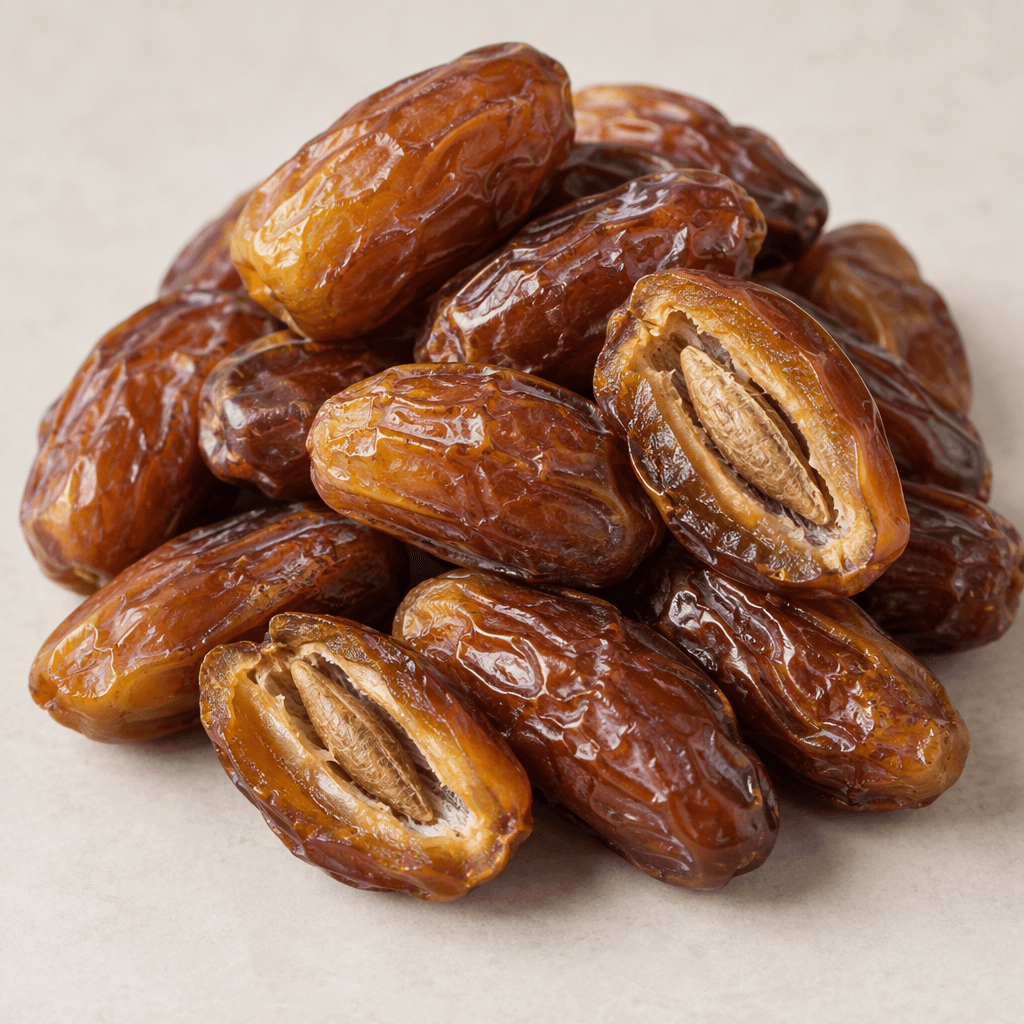
Date Calories
Natural energy source, high in fiber, potassium and magnesium.
In season: Autumn · Winter
CALORIES
GI
POTASSIUM
FIBER
Quick answer
3 piece (medium) of Date (24 g) has 66 calories. That works out to 277 calories per 100 g. It contains 18 g of carbs, 0.4 g of protein, 0 g of fat and 1.7 g of fiber. Its 0.1 mg of Copper covers 10% of the Daily Value. Its glycemic index is 42 (medium), so it raises blood sugar at a moderate pace.
What is Date?
A date is the fruit of the date palm, cultivated for centuries across the Middle East and North Africa. It is commonly sold dried or semi-dried, and can be eaten as is, with the pit removed, or chopped into porridge, yoghurt and baked goods.
Dates have a deep, honeyed sweetness and a soft, dense, sometimes sticky texture. They are enjoyed as everyday snacks in many date-growing regions and are often served to break the fast at iftar during Ramadan; elsewhere, they make a convenient bite with tea or coffee. Naturally sweet and rich in fibre, dates provide 7.1 g of fibre per 100 g. Pair one or two with plain yoghurt or nuts for a more balanced snack.
Date Nutrition Facts
Selected: 100 g
277
KCAL / 100G
Carbs
75g
· 27% DV
Protein
1.8g
· 4% DV
Fat
0.2g
· 0% DV
Fiber
7.1g
· 25% DV
DV is the share of the daily value covered, on a 2,000 kcal reference diet.
Calories come from: Carbs 97% · Protein 2% · Fat 1%
Date Vitamins & Minerals
Vitamins
B5
0.8mg · 16% DV
B6
0.24mg · 14% DV
B3
1.6mg · 10% DV
Biotin
1.7µg · 6% DV
Minerals
Potassium ⭐
696mg · 20% DV
Magnesium
54mg · 13% DV
Phosphorus
62mg · 9% DV
Calcium
64mg · 6% DV
How Nutritious Is Date?
Nutrient density
High
How many vitamins, minerals and how much fiber this food carries per calorie. A high score means a lot of nutrition for few calories.
Satiety score
Medium
An EatBetter score computed from fiber, protein and calorie density. A high score means staying full longer on the same calories.
Both scores are calculated per 100 g and do not change with the selected portion. The satiety score is EatBetter's own calculation, not a clinical measure.
Date Glycemic Index
GLYCEMIC INDEX
GLYCEMIC LOAD
Accounts for portion size — a more realistic measure than GI alone.
How to Burn Off Date
To burn the 277 calories in 100 g:
🚶
Walking (5 km/h)
🏃
Running (8 km/h)
🚴
Cycling
🏊
Swimming
Times are calculated with the MET equation for a 70 kg adult. Actual burn varies with your weight, age and pace.
Is Date Processed?
NOVA 2
Minimally Processed
1. Unprocessed
2. Minimally Processed
3. Processed
4. Ultra-Processed
NOVA classifies foods into 4 groups by industrial processing. NOVA 1 (unprocessed) is the healthiest.
Does Date Contain Allergens?
No known major allergens
Which Diets Is Date Good For?
Vegan
✓ Suitable
Vegetarian
✓ Suitable
Gluten-Free
✓ Suitable
Dairy-Free
— Not suitable
Mediterranean
✓ Suitable
Paleo
✓ Suitable
Whole30
— Not suitable
DASH
— Not suitable
Keto
— Not suitable
Low FODMAP
— Not suitable
Date Fat Profile
SATURATED
0.03g
MONOUNSATURATED
0.04g
POLYUNSATURATED
0.05g
Omega 6:3 ratio 3:1
Below the ideal 4:1 — a good omega balance.
Compare Date
Foods Similar to Date
Frequently Asked Questions About Date
Are dates good for you?
Yes, dates are a fruit that provides fiber and minerals, and they can be a satisfying sweet snack. Their sweetness is concentrated, so pairing a few with plain yogurt or nuts can make a more filling snack than eating them on their own.
How many dates should you eat in a day?
There is no fixed daily number that suits everyone. Dates are small but sweet and filling, so start with a modest portion and see how it fits your appetite and meals; eating them alongside nuts or yogurt can make a snack more satisfying.
Can people with diabetes eat dates?
Yes, people with diabetes can include dates, but dates contain natural sugars and can raise blood glucose. Keep the portion in line with your individual meal plan; ask your clinician or dietitian for guidance if you are unsure how they affect your readings.
Do dates need to be refrigerated?
No, dates do not have to be refrigerated if you will eat them soon and keep them sealed in a cool, dry place. Refrigeration helps them stay fresh longer, especially in a warm or humid kitchen; store them in an airtight container to protect their texture.
Should you wash dates before eating them?
Yes, rinse dates under clean running water before eating, especially if they were sold loose. Dry them before storing, since trapped moisture can encourage spoilage. If they are pitted, check the cavity for any debris before serving.
Can you eat date pits?
No, do not swallow date pits: they are hard and can pose a choking risk. Remove the pit before eating dates, particularly when serving them to children. Some products use roasted, ground pits, but that is different from eating one whole.
What is the difference between Medjool and Deglet Noor dates?
Medjool dates are usually larger, softer, and more caramel-like, while Deglet Noor dates tend to be firmer, less moist, and more delicate in flavor. Either can be eaten as a snack; the firmer texture of Deglet Noor also works well in chopped recipes.
Can you freeze dates?
Yes, dates freeze well. Remove any pits if you plan to use them in recipes, pack the dates airtight, and thaw only what you need. They may become softer after thawing, which is usually unnoticeable when blended into smoothies or chopped into baking.
Are fresh dates different from dried dates?
Yes, fresh dates contain more moisture and can be soft or slightly crisp depending on ripeness; dried dates are denser and taste more concentrated. Many dates sold in shops are ripe and dried, and their texture varies by variety and how they were stored.
Do dates help with constipation?
Dates may help support regular bowel movements because they contain fiber, especially when eaten with enough fluid. Increase fiber gradually rather than eating a large amount at once, since a sudden increase can cause bloating or discomfort.
Have another question about Date?
Ask the AI nutrition coach — calories, portions, alternatives and more, answered in seconds in the app.

Scan calories with your camera
Instant AI nutrition analysis

Nutrition data compiled from USDA FoodData Central and scientific sources.