

Ready & Packaged Foods
All →Vegetables & Legumes
All →Desserts & Confectionery
All →Meat & Protein
All →Grains & Bakery
All →Beverages
All →Milk & Dairy
All →

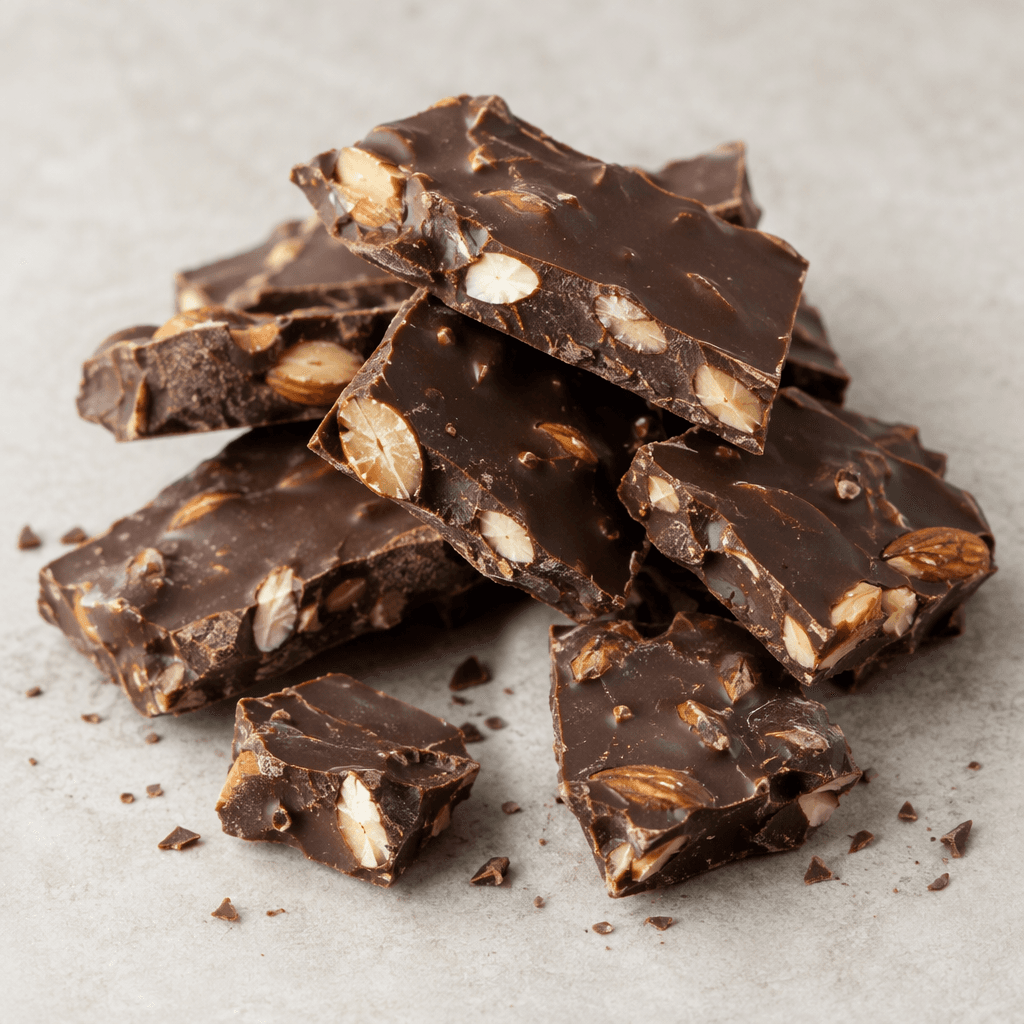
Dark chocolate with almonds Calories
Rich in antioxidants, healthy fats from almonds
In season: Spring · Summer · Autumn · Winter
CALORIES
GI
POTASSIUM
FIBER
Quick answer
1 piece (medium) of Dark chocolate with almonds (30 g) has 162 calories. That works out to 540 calories per 100 g. It contains 11.4 g of carbs, 2.6 g of protein, 11.7 g of fat and 2.6 g of fiber. Its 0.4 mg of Copper covers 40% of the Daily Value. Its glycemic index is 25 (low), so it raises blood sugar slowly.
What is Dark chocolate with almonds?
Dark chocolate with almonds combines cocoa-based dark chocolate with pieces of almond. Its flavour is deep and bittersweet, while the nuts add a toasted note and a crisp contrast to the smooth chocolate. It works as a small after-dinner treat, alongside coffee or tea, or broken over porridge and desserts. In places where chocolate is commonly served with coffee, a modest piece makes an easy pairing; it also travels well as a snack.
It is energy-dense, with fat from both the chocolate and almonds, and provides some fibre. A 100 g portion has 540 kcal, so a few squares are often enough when you want something sweet. Pair it with fresh fruit for a simple snack, or chop a little over plain yoghurt.
Dark chocolate with almonds Nutrition Facts
Selected: 100 g
540
KCAL / 100G
Carbs
38g
· 14% DV
Protein
8.5g
· 17% DV
Fat
39g
· 50% DV
Fiber
8.5g
· 30% DV
DV is the share of the daily value covered, on a 2,000 kcal reference diet.
Calories come from: Carbs 28% · Protein 6% · Fat 66%
Dark chocolate with almonds Vitamins & Minerals
Vitamins
Vitamin E
4.5mg · 30% DV
Biotin
7µg · 23% DV
B2
0.25mg · 19% DV
B3
1.2mg · 8% DV
Minerals
Copper
1mg · 111% DV
Manganese
2mg · 87% DV
Magnesium
140mg · 33% DV
Phosphorus
210mg · 30% DV
How Nutritious Is Dark chocolate with almonds?
Nutrient density
Medium
How many vitamins, minerals and how much fiber this food carries per calorie. A high score means a lot of nutrition for few calories.
Satiety score
Medium
An EatBetter score computed from fiber, protein and calorie density. A high score means staying full longer on the same calories.
Both scores are calculated per 100 g and do not change with the selected portion. The satiety score is EatBetter's own calculation, not a clinical measure.
Dark chocolate with almonds Glycemic Index
GLYCEMIC INDEX
GLYCEMIC LOAD
Accounts for portion size — a more realistic measure than GI alone.
How to Burn Off Dark chocolate with almonds
To burn the 540 calories in 100 g:
🚶
Walking (5 km/h)
🏃
Running (8 km/h)
🚴
Cycling
🏊
Swimming
Times are calculated with the MET equation for a 70 kg adult. Actual burn varies with your weight, age and pace.
Is Dark chocolate with almonds Processed?
NOVA 3
Processed
1. Unprocessed
2. Minimally Processed
3. Processed
4. Ultra-Processed
NOVA classifies foods into 4 groups by industrial processing. NOVA 1 (unprocessed) is the healthiest.
Does Dark chocolate with almonds Contain Allergens?
Contains these allergens:
Which Diets Is Dark chocolate with almonds Good For?
Vegan
— Not suitable
Vegetarian
✓ Suitable
Gluten-Free
— Not suitable
Dairy-Free
— Not suitable
Mediterranean
✓ Suitable
Paleo
— Not suitable
Whole30
— Not suitable
DASH
— Not suitable
Keto
— Not suitable
Low FODMAP
— Not suitable
Dark chocolate with almonds Fat Profile
SATURATED
16g
MONOUNSATURATED
18g
POLYUNSATURATED
8.5g
Omega 6:3 ratio 54.7:1
Above the ideal 4:1 (54.7:1).
Compare Dark chocolate with almonds
Foods Similar to Dark chocolate with almonds
Frequently Asked Questions About Dark chocolate with almonds
Is dark chocolate with almonds good for you?
Dark chocolate with almonds can be a satisfying treat: cocoa contains antioxidant compounds, and almonds provide mostly unsaturated fats. It is still a sweet with substantial energy, so its benefits do not make it a substitute for a balanced diet or a reason to eat it freely.
Does dark chocolate with almonds contain caffeine?
Yes, dark chocolate with almonds contains some caffeine from the cocoa, and darker, higher-cocoa chocolate generally has more. It usually provides much less caffeine than coffee, but a serving late in the day may affect people who are sensitive to caffeine.
Can people with diabetes eat dark chocolate with almonds?
Yes, some people with diabetes can fit dark chocolate with almonds into a meal plan, but its carbohydrates can still raise blood glucose. The amount that suits you depends on your meal plan and medication, so ask your clinician or dietitian for individual guidance.
How should you store dark chocolate with almonds?
Keep dark chocolate with almonds tightly wrapped in a cool, dry, dark place, away from strong-smelling foods. Heat can soften it and temperature swings can cause surface bloom. If you refrigerate it, seal it well and let the unopened package warm before opening.
Why does dark chocolate with almonds get white spots?
White spots on dark chocolate with almonds are usually cocoa butter or sugar bloom, caused by temperature changes or moisture. Bloom affects appearance and texture more than safety; discard the chocolate if it also has an off smell, unusual taste, or signs of spoilage.
Can you bake with dark chocolate with almonds?
Yes, you can chop dark chocolate with almonds into cookies, brownies, or a cake topping. The almond pieces add crunch, so it will not behave like plain chocolate in recipes that need a completely smooth melted chocolate mixture.
How do you melt dark chocolate with almonds without burning it?
Chop dark chocolate with almonds and heat it gently in a dry bowl over barely simmering water, stirring often. Keep water and steam out of the chocolate, since moisture can make it seize; expect the melted mixture to stay textured because of the almonds.
What is the difference between dark chocolate with almonds and chocolate-covered almonds?
Dark chocolate with almonds has almond pieces mixed through a chocolate bar, so each break gives a mix of chocolate and nuts. Chocolate-covered almonds are whole nuts coated individually, giving a thicker chocolate shell and a more distinct nut-to-chocolate bite.
Can dogs eat dark chocolate with almonds?
No, do not give dark chocolate with almonds to dogs. Cocoa contains theobromine, which is toxic to dogs, and the risk depends on the chocolate and the amount eaten. If your dog has eaten any, contact a veterinarian promptly rather than waiting for symptoms.
Does dark chocolate with almonds taste less bitter than plain dark chocolate?
Often, but not always: almond pieces add a roasted, mildly sweet flavor and a crunchy contrast that can soften the impression of bitterness. The cocoa still sets the main flavor, so a high-cocoa bar can remain quite bitter.
Have another question about Dark chocolate with almonds?
Ask the AI nutrition coach — calories, portions, alternatives and more, answered in seconds in the app.

Scan calories with your camera
Instant AI nutrition analysis

Nutrition data compiled from USDA FoodData Central and scientific sources.