

Ready & Packaged Foods
All →Vegetables & Legumes
All →Desserts & Confectionery
All →Meat & Protein
All →Grains & Bakery
All →Beverages
All →Milk & Dairy
All →

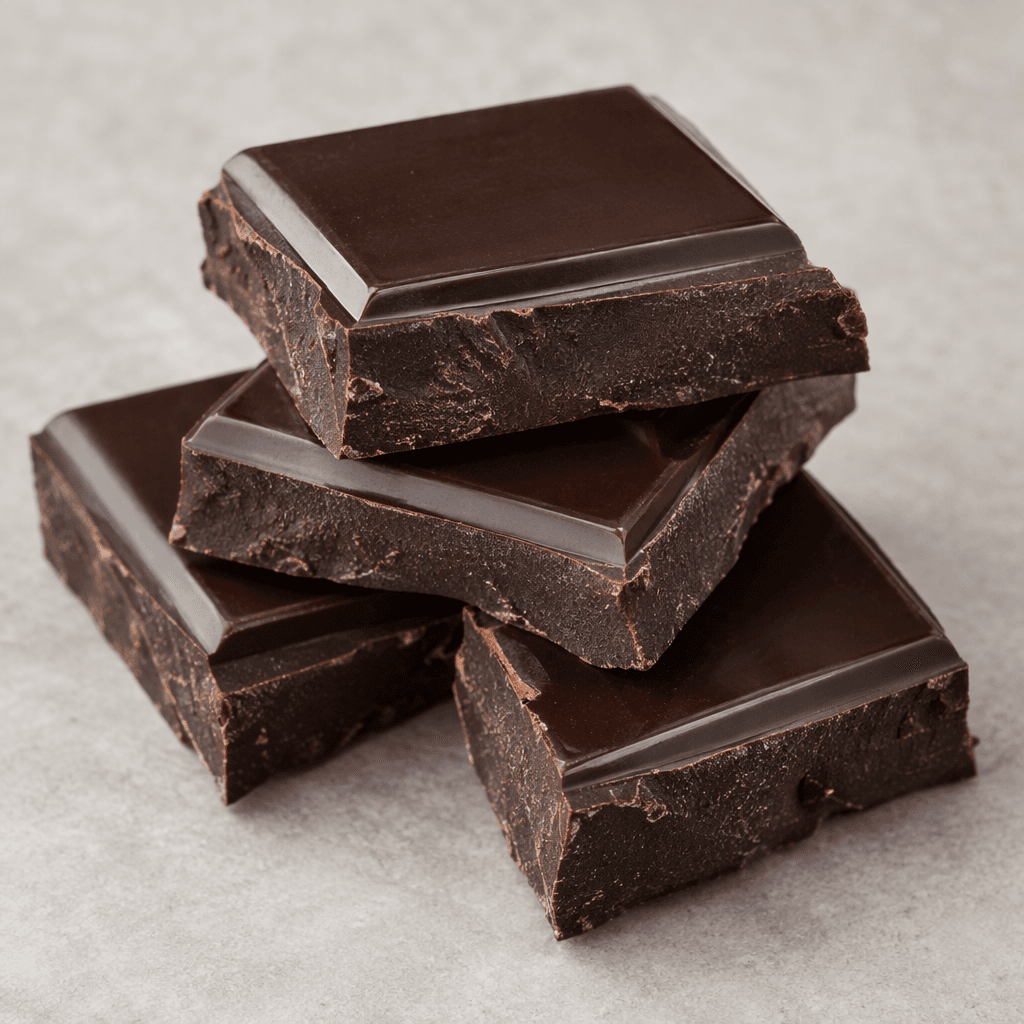
Dark Chocolate (82% cocoa) Calories
High cocoa, antioxidants, magnesium, fiber
In season: Winter · Autumn
CALORIES
GI
POTASSIUM
FIBER
Quick answer
1 piece (medium) of Dark Chocolate (82% cocoa) (20 g) has 114 calories. That works out to 570 calories per 100 g. It contains 6.4 g of carbs, 1.6 g of protein, 8.8 g of fat and 2.2 g of fiber. Its 0.4 mg of Copper covers 40% of the Daily Value. Its glycemic index is 25 (low), so it raises blood sugar slowly.
What is Dark Chocolate (82% cocoa)?
Dark Chocolate (82% cocoa) is a deeply cocoa-forward chocolate made largely from cocoa solids and cocoa butter, with less sweetness than milk chocolate. Its firm bar snaps into pieces and melts slowly, bringing roasted, gently bitter flavours that can have fruity or earthy notes. It is enjoyed on its own, with coffee or tea, and grated or melted into desserts; a little can add a pronounced chocolate flavour to baking.
Its high cocoa content makes it rich in fat and fibre, with 11 g of fibre per 100 g. Pair a small piece with fresh fruit or unsweetened coffee if you want a contrast to its intensity, or use it in a dessert and adjust the added sugar to taste.
Dark Chocolate (82% cocoa) Nutrition Facts
Selected: 100 g
570
KCAL / 100G
Carbs
32g
· 12% DV
Protein
8g
· 16% DV
Fat
44g
· 56% DV
Fiber
11g
· 39% DV
DV is the share of the daily value covered, on a 2,000 kcal reference diet.
Calories come from: Carbs 23% · Protein 6% · Fat 71%
Dark Chocolate (82% cocoa) Vitamins & Minerals
Vitamins
B2
0.25mg · 19% DV
B1
0.08mg · 7% DV
B3
1.1mg · 7% DV
Biotin
2µg · 7% DV
Minerals
Copper
2mg · 222% DV
Iron
12mg · 67% DV
Magnesium
228mg · 54% DV
Phosphorus
308mg · 44% DV
How Nutritious Is Dark Chocolate (82% cocoa)?
Nutrient density
Medium
How many vitamins, minerals and how much fiber this food carries per calorie. A high score means a lot of nutrition for few calories.
Satiety score
Medium
An EatBetter score computed from fiber, protein and calorie density. A high score means staying full longer on the same calories.
Both scores are calculated per 100 g and do not change with the selected portion. The satiety score is EatBetter's own calculation, not a clinical measure.
Dark Chocolate (82% cocoa) Glycemic Index
GLYCEMIC INDEX
GLYCEMIC LOAD
Accounts for portion size — a more realistic measure than GI alone.
How to Burn Off Dark Chocolate (82% cocoa)
To burn the 570 calories in 100 g:
🚶
Walking (5 km/h)
🏃
Running (8 km/h)
🚴
Cycling
🏊
Swimming
Times are calculated with the MET equation for a 70 kg adult. Actual burn varies with your weight, age and pace.
Is Dark Chocolate (82% cocoa) Processed?
NOVA 3
Processed
1. Unprocessed
2. Minimally Processed
3. Processed
4. Ultra-Processed
NOVA classifies foods into 4 groups by industrial processing. NOVA 1 (unprocessed) is the healthiest.
Does Dark Chocolate (82% cocoa) Contain Allergens?
Contains these allergens:
Which Diets Is Dark Chocolate (82% cocoa) Good For?
Vegan
— Not suitable
Vegetarian
✓ Suitable
Gluten-Free
— Not suitable
Dairy-Free
— Not suitable
Mediterranean
— Not suitable
Paleo
— Not suitable
Whole30
— Not suitable
DASH
— Not suitable
Keto
— Not suitable
Low FODMAP
— Not suitable
Dark Chocolate (82% cocoa) Fat Profile
SATURATED
26g
MONOUNSATURATED
13g
POLYUNSATURATED
2g
Omega 6:3 ratio 15.7:1
Above the ideal 4:1 (15.7:1).
Compare Dark Chocolate (82% cocoa)
Foods Similar to Dark Chocolate (82% cocoa)
Frequently Asked Questions About Dark Chocolate (82% cocoa)
Is 82% dark chocolate good for you?
Yes, 82% dark chocolate provides cocoa-derived fiber and antioxidant compounds. It is still an energy-dense sweet, so its cocoa content does not make unlimited portions beneficial.
What does 82% mean on dark chocolate?
It means that 82% of the bar’s weight comes from cocoa-derived ingredients, such as cocoa solids and cocoa butter. The remaining ingredients are often mostly sugar, but the percentage alone does not reveal the exact sugar content.
How much 82% dark chocolate can you eat in a day?
A medium piece, about 20 g, is a practical portion for many people. Larger servings add up quickly, and high-cocoa chocolate also contains stimulating compounds such as caffeine and theobromine.
Does 82% dark chocolate contain caffeine?
Yes, 82% dark chocolate contains caffeine as well as theobromine. The amount varies by product, but high-cocoa chocolate generally has more of these stimulants than milk chocolate.
Can dogs eat 82% dark chocolate?
No, dogs should not eat 82% dark chocolate. Cocoa contains theobromine, which is toxic to dogs; if your dog has eaten any, contact a veterinarian promptly and tell them how much.
Why does 82% dark chocolate taste bitter?
82% dark chocolate tastes bitter because it contains a high proportion of cocoa ingredients and less sugar to balance cocoa’s naturally bitter compounds. That strong flavor is normal and does not by itself mean the chocolate has gone bad.
Why does 82% dark chocolate turn white?
A white or grayish film is usually cocoa butter or sugar that has risen to the surface after temperature or humidity changes. It is generally a quality change rather than a sign of spoilage, provided the chocolate smells and tastes normal.
How should you store 82% dark chocolate?
Keep 82% dark chocolate sealed in a cool, dry place away from sunlight, heat, and strong-smelling foods. Avoid frequent temperature changes, which can cause a pale surface bloom and affect its texture.
Can you bake with 82% dark chocolate?
Yes, 82% dark chocolate works well in brownies, cookies, ganache, and chocolate sauces. Its flavor is less sweet than many baking chocolates, so a recipe may need additional sugar to taste balanced.
Can you use 82% dark chocolate instead of cocoa powder?
No, not as a direct one-for-one substitute. 82% dark chocolate contains cocoa butter and usually sugar, while cocoa powder has much less fat; swapping them changes a recipe’s texture and sweetness.
Have another question about Dark Chocolate (82% cocoa)?
Ask the AI nutrition coach — calories, portions, alternatives and more, answered in seconds in the app.

Scan calories with your camera
Instant AI nutrition analysis

Nutrition data compiled from USDA FoodData Central and scientific sources.