

Ready & Packaged Foods
All →Vegetables & Legumes
All →Desserts & Confectionery
All →Meat & Protein
All →Grains & Bakery
All →Beverages
All →Milk & Dairy
All →

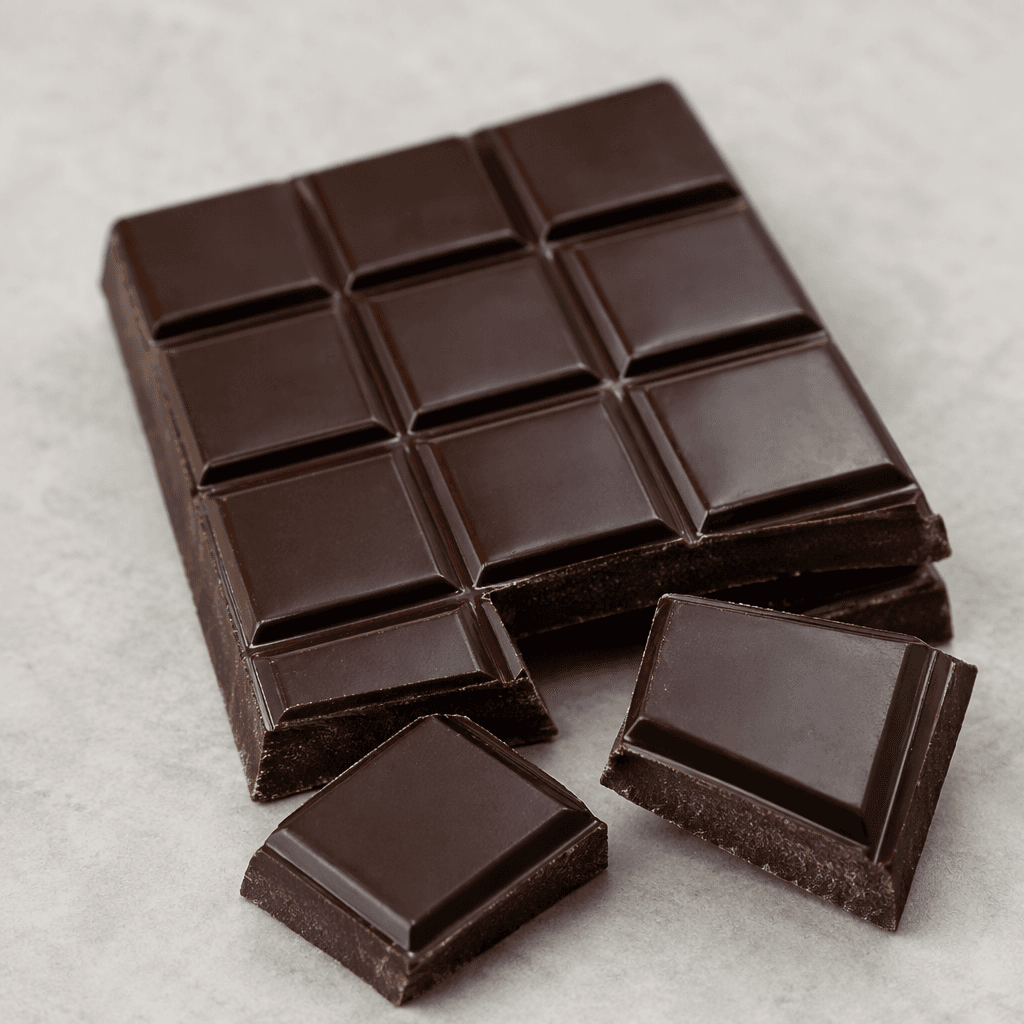
Dark Chocolate 74% Calories
Rich in cocoa, antioxidants, magnesium source
CALORIES
GI
POTASSIUM
FIBER
Quick answer
2 piece (medium) of Dark Chocolate 74% (20 g) has 114 calories. That works out to 570 calories per 100 g. It contains 9.2 g of carbs, 1.6 g of protein, 8.2 g of fat and 2.2 g of fiber. Its 0.4 mg of Copper covers 40% of the Daily Value. Its glycemic index is 25 (low), so it raises blood sugar slowly.
What is Dark Chocolate 74%?
Dark Chocolate 74% is a cocoa-rich chocolate made with cocoa solids and cocoa butter, with sugar for sweetness. The percentage indicates how much of the bar comes from cocoa ingredients, giving it a more pronounced cocoa taste than milk chocolate.
Its flavour is bittersweet, and its firm, smooth texture melts slowly. Enjoy a few squares with coffee or tea, eat it on its own, or chop it into baking and desserts. It is energy-dense, with some fibre from the cocoa. A small portion pairs well with fresh fruit or a handful of nuts when you want something sweet without making chocolate the whole snack.
Dark Chocolate 74% Nutrition Facts
Selected: 100 g
570
KCAL / 100G
Carbs
46g
· 17% DV
Protein
7.8g
· 16% DV
Fat
41g
· 53% DV
Fiber
11g
· 39% DV
DV is the share of the daily value covered, on a 2,000 kcal reference diet.
Calories come from: Carbs 31% · Protein 5% · Fat 64%
Dark Chocolate 74% Vitamins & Minerals
Vitamins
B2
0.25mg · 19% DV
Vitamin K
9µg · 8% DV
B1
0.08mg · 7% DV
B3
1.1mg · 7% DV
Minerals
Copper
2mg · 222% DV
Magnesium
228mg · 54% DV
Iron
9mg · 50% DV
Phosphorus
308mg · 44% DV
How Nutritious Is Dark Chocolate 74%?
Nutrient density
Medium
How many vitamins, minerals and how much fiber this food carries per calorie. A high score means a lot of nutrition for few calories.
Satiety score
Medium
An EatBetter score computed from fiber, protein and calorie density. A high score means staying full longer on the same calories.
Both scores are calculated per 100 g and do not change with the selected portion. The satiety score is EatBetter's own calculation, not a clinical measure.
Dark Chocolate 74% Glycemic Index
GLYCEMIC INDEX
GLYCEMIC LOAD
Accounts for portion size — a more realistic measure than GI alone.
How to Burn Off Dark Chocolate 74%
To burn the 570 calories in 100 g:
🚶
Walking (5 km/h)
🏃
Running (8 km/h)
🚴
Cycling
🏊
Swimming
Times are calculated with the MET equation for a 70 kg adult. Actual burn varies with your weight, age and pace.
Is Dark Chocolate 74% Processed?
NOVA 3
Processed
1. Unprocessed
2. Minimally Processed
3. Processed
4. Ultra-Processed
NOVA classifies foods into 4 groups by industrial processing. NOVA 1 (unprocessed) is the healthiest.
Does Dark Chocolate 74% Contain Allergens?
No known major allergens
Which Diets Is Dark Chocolate 74% Good For?
Vegan
— Not suitable
Vegetarian
✓ Suitable
Gluten-Free
— Not suitable
Dairy-Free
— Not suitable
Mediterranean
✓ Suitable
Paleo
— Not suitable
Whole30
— Not suitable
DASH
— Not suitable
Keto
— Not suitable
Low FODMAP
— Not suitable
Dark Chocolate 74% Fat Profile
SATURATED
24.5g
MONOUNSATURATED
12.5g
POLYUNSATURATED
1.1g
Omega 6:3 ratio 6.9:1
Above the ideal 4:1 (6.9:1).
Compare Dark Chocolate 74%
Foods Similar to Dark Chocolate 74%
Frequently Asked Questions About Dark Chocolate 74%
Is 74% dark chocolate good for you?
74% dark chocolate can fit into a balanced diet in a modest portion. It contains cocoa compounds such as flavanols, but it is still energy-dense and often contains sugar, so its high cocoa percentage does not make it a food to eat without limit.
Does 74% dark chocolate contain caffeine?
Yes, 74% dark chocolate contains some caffeine, as well as the stimulant theobromine. The amount varies by product and is usually less than in coffee, but people who are sensitive to stimulants may find that eating it late affects their sleep.
Can dogs eat 74% dark chocolate?
No, dogs should not eat 74% dark chocolate. Cocoa contains theobromine and caffeine, which are toxic to dogs, and darker chocolate can be especially dangerous. If your dog has eaten some, contact a veterinarian promptly and share the amount and time eaten.
Can you bake with 74% dark chocolate?
Yes, 74% dark chocolate works well in brownies, cakes, cookies, and ganache. Its pronounced cocoa flavor makes baked goods less sweet than versions made with milk or lower-cocoa chocolate, so adjust the recipe’s sugar if you prefer a milder taste.
Why does 74% dark chocolate turn white?
A white film on 74% dark chocolate is usually chocolate bloom, caused by cocoa butter or sugar moving to the surface after temperature changes or moisture exposure. It may affect the texture, but the white coating alone does not mean the chocolate is unsafe.
How do you melt 74% dark chocolate without burning it?
Melt 74% dark chocolate gently in a dry bowl over simmering water or in a microwave using short bursts and frequent stirring. Keep water and steam out of the chocolate; even a little moisture can make it seize into a thick, grainy mass.
How should you store 74% dark chocolate?
Store 74% dark chocolate tightly wrapped in a cool, dry place away from strong odors and sunlight. Refrigeration can encourage condensation and surface bloom, so use it only in a warm climate and seal the chocolate well before chilling.
Does 74% dark chocolate help with weight loss?
No, 74% dark chocolate does not cause weight loss. A small portion may satisfy a chocolate craving, but eating large amounts adds substantial energy; its cocoa percentage does not cancel out that effect.
What does 74% mean on dark chocolate?
The 74% on dark chocolate means that cocoa-derived ingredients make up about 74% of the bar. The remaining ingredients commonly include sugar and cocoa butter, though the exact recipe varies; the percentage alone does not tell you how sweet or bitter the bar will taste.
Is 74% dark chocolate too bitter to eat on its own?
No, 74% dark chocolate is not necessarily too bitter to eat on its own; it has a stronger cocoa taste and less sweetness than milk chocolate. Try a small square with coffee, berries, or nuts if you want to balance its bitterness.
Have another question about Dark Chocolate 74%?
Ask the AI nutrition coach — calories, portions, alternatives and more, answered in seconds in the app.

Scan calories with your camera
Instant AI nutrition analysis

Nutrition data compiled from USDA FoodData Central and scientific sources.