

Ready & Packaged Foods
All →Vegetables & Legumes
All →Desserts & Confectionery
All →Meat & Protein
All →Grains & Bakery
All →Beverages
All →Milk & Dairy
All →

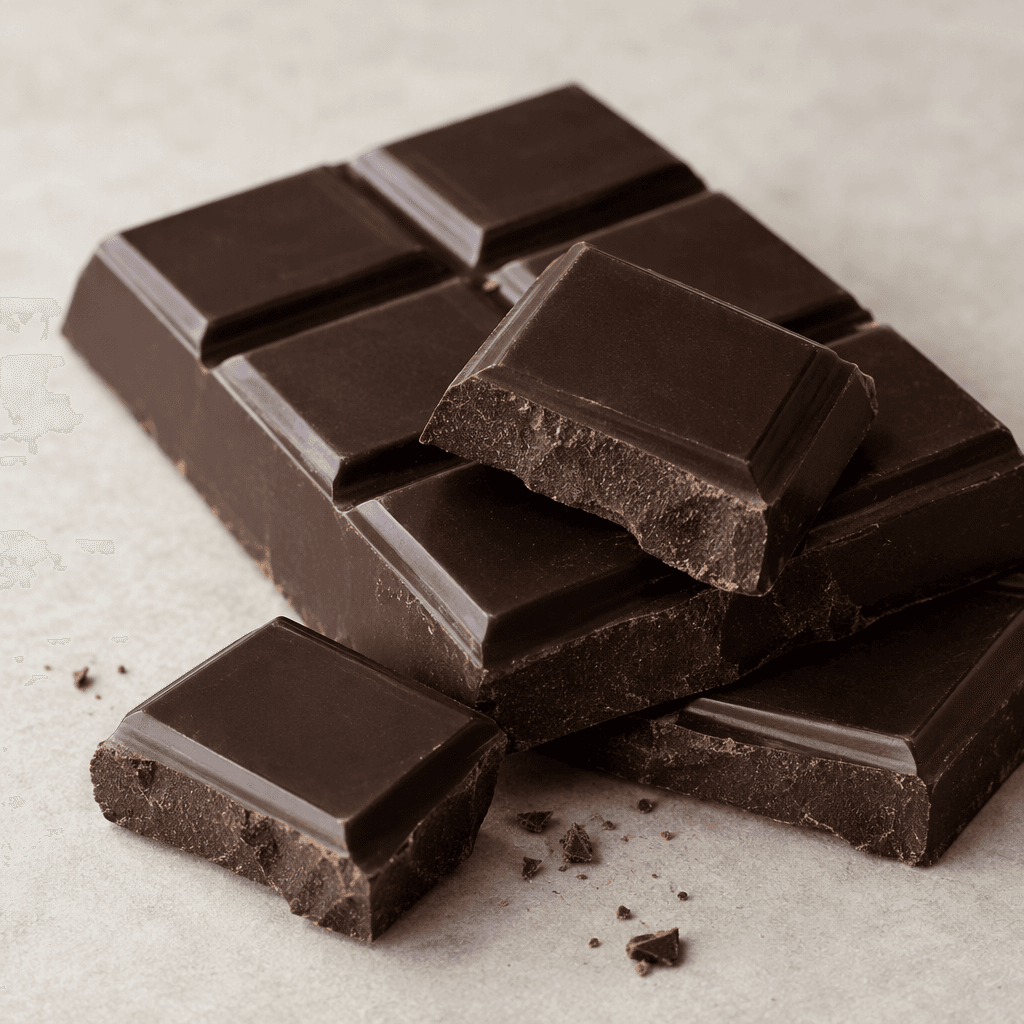
Dark Chocolate (70% cocoa) Calories
High cocoa, antioxidants, magnesium, fiber
In season: Spring · Summer · Autumn · Winter
CALORIES
GI
POTASSIUM
FIBER
Quick answer
1 piece (medium) of Dark Chocolate (70% cocoa) (20 g) has 114 calories. That works out to 570 calories per 100 g. It contains 9.2 g of carbs, 1.6 g of protein, 8.4 g of fat and 2.2 g of fiber. Its 0.4 mg of Copper covers 40% of the Daily Value. Its glycemic index is 25 (low), so it raises blood sugar slowly.
What is Dark Chocolate (70% cocoa)?
Dark chocolate (70% cocoa) is made from cocoa solids and cocoa butter with sugar, with cocoa making up 70% of the bar. Compared with milk chocolate, it tends to be less sweet and has a deeper, more pronounced cocoa flavour. Chocolate has roots in the Americas, while cacao is now grown in several tropical regions.
The bar snaps cleanly and melts slowly, with a dense texture and a pleasantly bitter, roasted edge. It is eaten in small pieces on its own, alongside coffee or tea, or chopped into baking and desserts. It is energy-dense and contains fat, but also provides fibre; a modest piece can be satisfying. Try it with berries, orange, or nuts, or grate a little over porridge for a richer finish.
Dark Chocolate (70% cocoa) Nutrition Facts
Selected: 100 g
570
KCAL / 100G
Carbs
46g
· 17% DV
Protein
7.8g
· 16% DV
Fat
42g
· 54% DV
Fiber
11g
· 39% DV
DV is the share of the daily value covered, on a 2,000 kcal reference diet.
Calories come from: Carbs 31% · Protein 5% · Fat 64%
Dark Chocolate (70% cocoa) Vitamins & Minerals
Vitamins
B2
0.25mg · 19% DV
B1
0.08mg · 7% DV
B3
1.1mg · 7% DV
Biotin
2µg · 7% DV
Minerals
Copper
2mg · 222% DV
Iron
12mg · 67% DV
Magnesium
228mg · 54% DV
Phosphorus
312mg · 45% DV
How Nutritious Is Dark Chocolate (70% cocoa)?
Nutrient density
Medium
How many vitamins, minerals and how much fiber this food carries per calorie. A high score means a lot of nutrition for few calories.
Satiety score
Medium
An EatBetter score computed from fiber, protein and calorie density. A high score means staying full longer on the same calories.
Both scores are calculated per 100 g and do not change with the selected portion. The satiety score is EatBetter's own calculation, not a clinical measure.
Dark Chocolate (70% cocoa) Glycemic Index
GLYCEMIC INDEX
GLYCEMIC LOAD
Accounts for portion size — a more realistic measure than GI alone.
How to Burn Off Dark Chocolate (70% cocoa)
To burn the 570 calories in 100 g:
🚶
Walking (5 km/h)
🏃
Running (8 km/h)
🚴
Cycling
🏊
Swimming
Times are calculated with the MET equation for a 70 kg adult. Actual burn varies with your weight, age and pace.
Is Dark Chocolate (70% cocoa) Processed?
NOVA 3
Processed
1. Unprocessed
2. Minimally Processed
3. Processed
4. Ultra-Processed
NOVA classifies foods into 4 groups by industrial processing. NOVA 1 (unprocessed) is the healthiest.
Does Dark Chocolate (70% cocoa) Contain Allergens?
Contains these allergens:
Which Diets Is Dark Chocolate (70% cocoa) Good For?
Vegan
— Not suitable
Vegetarian
✓ Suitable
Gluten-Free
— Not suitable
Dairy-Free
— Not suitable
Mediterranean
✓ Suitable
Paleo
— Not suitable
Whole30
— Not suitable
DASH
— Not suitable
Keto
— Not suitable
Low FODMAP
— Not suitable
Dark Chocolate (70% cocoa) Fat Profile
SATURATED
24.5g
MONOUNSATURATED
12.5g
POLYUNSATURATED
1.2g
Omega 6:3 ratio 22:1
Above the ideal 4:1 (22:1).
Compare Dark Chocolate (70% cocoa)
Foods Similar to Dark Chocolate (70% cocoa)
Frequently Asked Questions About Dark Chocolate (70% cocoa)
Is dark chocolate (70% cocoa) good for you?
It can be a satisfying choice in moderation. Dark chocolate (70% cocoa) provides cocoa-derived fiber and minerals, but it also contains sugar and is energy-dense, so its benefits do not make unlimited portions a healthy choice.
Is dark chocolate (70% cocoa) toxic to dogs?
Yes, it can be toxic to dogs. Cocoa contains theobromine and caffeine, which dogs process slowly, and a higher cocoa percentage generally means more of these compounds. If your dog eats any, contact a veterinarian promptly.
Does dark chocolate (70% cocoa) contain caffeine?
Yes, dark chocolate (70% cocoa) contains caffeine as well as theobromine. The amount varies by product and is usually less than in coffee, but sensitive people may still notice restlessness or trouble sleeping after eating it.
How do you melt dark chocolate (70% cocoa) without burning it?
Melt dark chocolate (70% cocoa) gently in a double boiler or microwave it in short bursts, stirring between each one. Keep water and steam out of the chocolate, since even a little moisture can make it seize into a grainy mass.
Why does dark chocolate (70% cocoa) turn white, and is it safe to eat?
A whitish coating is usually fat or sugar bloom, caused by temperature changes or moisture. It is generally safe to eat if the chocolate smells normal and has no signs of mold, although its texture may be less smooth.
How should you store dark chocolate (70% cocoa) after opening?
Keep dark chocolate (70% cocoa) tightly wrapped in a cool, dry place away from sunlight and strong odors. Refrigeration can introduce moisture and unwanted smells; if heat makes it necessary, seal it in an airtight container first.
Can you use dark chocolate (70% cocoa) instead of baking chocolate?
Yes, dark chocolate (70% cocoa) can work in many baking recipes, but it is not a direct substitute for unsweetened baking chocolate because it contains sugar. Adjust the recipe’s added sugar, and expect a sweeter result than with unsweetened chocolate.
What does 70% mean on dark chocolate (70% cocoa)?
It means that cocoa ingredients make up 70% of the chocolate, including cocoa solids and cocoa butter. The remaining portion is usually mostly sugar and other ingredients; it does not mean the bar contains 70% sugar.
Can dark chocolate (70% cocoa) help with weight loss?
No, dark chocolate (70% cocoa) does not cause weight loss. Its intense flavor may satisfy a chocolate craving with a small piece, but larger portions add substantial energy and can make it harder to maintain a calorie deficit.
Can people with diabetes eat dark chocolate (70% cocoa)?
Some people with diabetes can include dark chocolate (70% cocoa) in their meal plan, but 70% cocoa does not mean sugar-free. Count its carbohydrates and portion; ask your doctor or dietitian how it fits your individual plan.
Have another question about Dark Chocolate (70% cocoa)?
Ask the AI nutrition coach — calories, portions, alternatives and more, answered in seconds in the app.

Scan calories with your camera
Instant AI nutrition analysis

Nutrition data compiled from USDA FoodData Central and scientific sources.