

Ready & Packaged Foods
All →Vegetables & Legumes
All →Desserts & Confectionery
All →Meat & Protein
All →Grains & Bakery
All →Beverages
All →Milk & Dairy
All →

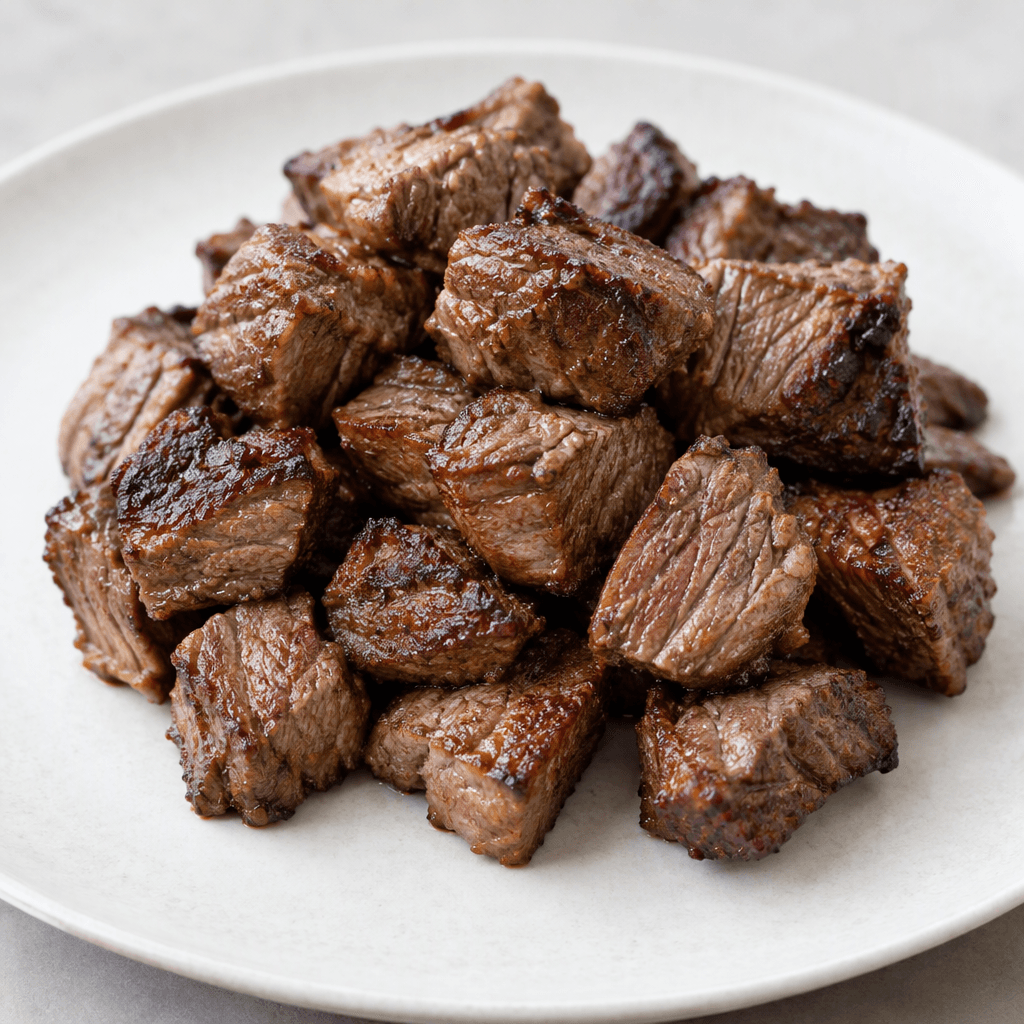
Beef, Cubed (Cooked) Calories
High in protein, iron, and B vitamins
In season: Spring · Summer · Autumn · Winter
CALORIES
GI
POTASSIUM
FIBER
Quick answer
100 g of Beef, Cubed (Cooked) has 250 calories. It contains 0 g of carbs, 26 g of protein, 17 g of fat and 0 g of fiber. Its 2.5 µg of B12 covers 104% of the Daily Value. Its glycemic index is 0 (low), so it raises blood sugar slowly.
What is Beef, Cubed (Cooked)?
Beef, cubed (cooked) is beef cut into small pieces and cooked, often by browning in a pan or simmering until tender. The cubes have a savoury, distinctly meaty flavour; their texture can be juicy and soft or firmer with browned edges, depending on how they were prepared.
It is served hot on its own or added to stews, grain bowls, salads and wraps. In many places, cooked beef cubes are also a convenient way to add meat to a quick weeknight meal. They provide substantial protein—26 g per 100 g—and contain no carbohydrates. For a lighter plate, pair them with vegetables and use only a little added oil when reheating or cooking.
Beef, Cubed (Cooked) Nutrition Facts
Selected: 100 g
250
KCAL / 100G
Carbs
0g
· 0% DV
Protein
26g
· 52% DV
Fat
17g
· 22% DV
Fiber
0g
· 0% DV
DV is the share of the daily value covered, on a 2,000 kcal reference diet.
Calories come from: Carbs 0% · Protein 40% · Fat 60%
Beef, Cubed (Cooked) Vitamins & Minerals
Vitamins
B12
2.5µg · 104% DV
B3
4.8mg · 30% DV
B6
0.4mg · 24% DV
B2
0.22mg · 17% DV
Minerals
Zinc
5mg · 45% DV
Selenium
18µg · 33% DV
Phosphorus
210mg · 30% DV
Iron
3mg · 17% DV
How Nutritious Is Beef, Cubed (Cooked)?
Nutrient density
High
How many vitamins, minerals and how much fiber this food carries per calorie. A high score means a lot of nutrition for few calories.
Satiety score
Medium
An EatBetter score computed from fiber, protein and calorie density. A high score means staying full longer on the same calories.
Both scores are calculated per 100 g and do not change with the selected portion. The satiety score is EatBetter's own calculation, not a clinical measure.
Beef, Cubed (Cooked) Glycemic Index
GLYCEMIC INDEX
GLYCEMIC LOAD
Accounts for portion size — a more realistic measure than GI alone.
How to Burn Off Beef, Cubed (Cooked)
To burn the 250 calories in 100 g:
🚶
Walking (5 km/h)
🏃
Running (8 km/h)
🚴
Cycling
🏊
Swimming
Times are calculated with the MET equation for a 70 kg adult. Actual burn varies with your weight, age and pace.
Is Beef, Cubed (Cooked) Processed?
NOVA 2
Minimally Processed
1. Unprocessed
2. Minimally Processed
3. Processed
4. Ultra-Processed
NOVA classifies foods into 4 groups by industrial processing. NOVA 1 (unprocessed) is the healthiest.
Does Beef, Cubed (Cooked) Contain Allergens?
No known major allergens
Which Diets Is Beef, Cubed (Cooked) Good For?
Vegan
— Not suitable
Vegetarian
— Not suitable
Gluten-Free
✓ Suitable
Dairy-Free
— Not suitable
Mediterranean
✓ Suitable
Paleo
✓ Suitable
Whole30
— Not suitable
DASH
— Not suitable
Keto
✓ Suitable
Low FODMAP
— Not suitable
Beef, Cubed (Cooked) Fat Profile
SATURATED
7.2g
MONOUNSATURATED
7.5g
POLYUNSATURATED
0.4g
Omega 6:3 ratio 2.8:1
Below the ideal 4:1 — a good omega balance.
Compare Beef, Cubed (Cooked)
Foods Similar to Beef, Cubed (Cooked)
Frequently Asked Questions About Beef, Cubed (Cooked)
How do you reheat cooked cubed beef without drying it out?
Reheat cooked cubed beef gently in a covered pan with a splash of broth or water. Stir occasionally and take it off the heat once hot; prolonged heating can dry the meat and make it tougher.
How long does cooked cubed beef last in the fridge?
Cooked cubed beef keeps for 3–4 days in the refrigerator when stored in a covered container. Refrigerate it within 2 hours of cooking, or freeze it if you will not use it within that time.
Can you freeze cooked cubed beef?
Yes, cooked cubed beef freezes well. Pack it in an airtight container or freezer bag, and use it within 2–3 months for the best quality. Thaw it in the refrigerator before reheating.
What can you make with cooked cubed beef?
Cooked cubed beef works well in tacos, grain bowls, pasta, sandwiches, soups, and quick skillet meals. Add it near the end of cooking so it warms through without spending extra time simmering.
Why is cooked cubed beef tough?
Cooked cubed beef can turn tough when it is heated for too long or at a high temperature. Warm it gently with a little liquid; additional prolonged cooking usually makes already-cooked beef drier, not more tender.
Can you eat cooked cubed beef cold?
Yes, cooked cubed beef can be eaten cold if it was chilled promptly and kept refrigerated. It can be added straight to salads or sandwiches; discard it if it has been left at room temperature for over 2 hours.
Can cooked cubed beef be used in beef stew?
Yes, but add cooked cubed beef toward the end of the stew rather than simmering it from the start. It only needs to heat through, and a shorter time in the pot helps preserve its texture.
How do you know if cooked cubed beef has gone bad?
A sour or unusual smell, a sticky surface, or an unexpected change in color can indicate that cooked cubed beef has spoiled. Do not taste it to check, and discard leftovers kept refrigerated for more than 3–4 days.
Can cooked cubed beef go into soup?
Yes, cooked cubed beef is a convenient addition to soup. Stir it in during the final few minutes, giving it time to heat through without letting it boil for a long time and become tough.
How should you thaw frozen cooked cubed beef?
Thaw frozen cooked cubed beef in the refrigerator, ideally in a covered container to catch any liquid. For quicker use, reheat it directly from frozen in a covered pan with a splash of broth, stirring until hot throughout.
Have another question about Beef, Cubed (Cooked)?
Ask the AI nutrition coach — calories, portions, alternatives and more, answered in seconds in the app.

Scan calories with your camera
Instant AI nutrition analysis

Nutrition data compiled from USDA FoodData Central and scientific sources.