

Ready & Packaged Foods
All →Vegetables & Legumes
All →Desserts & Confectionery
All →Meat & Protein
All →Grains & Bakery
All →Beverages
All →Milk & Dairy
All →

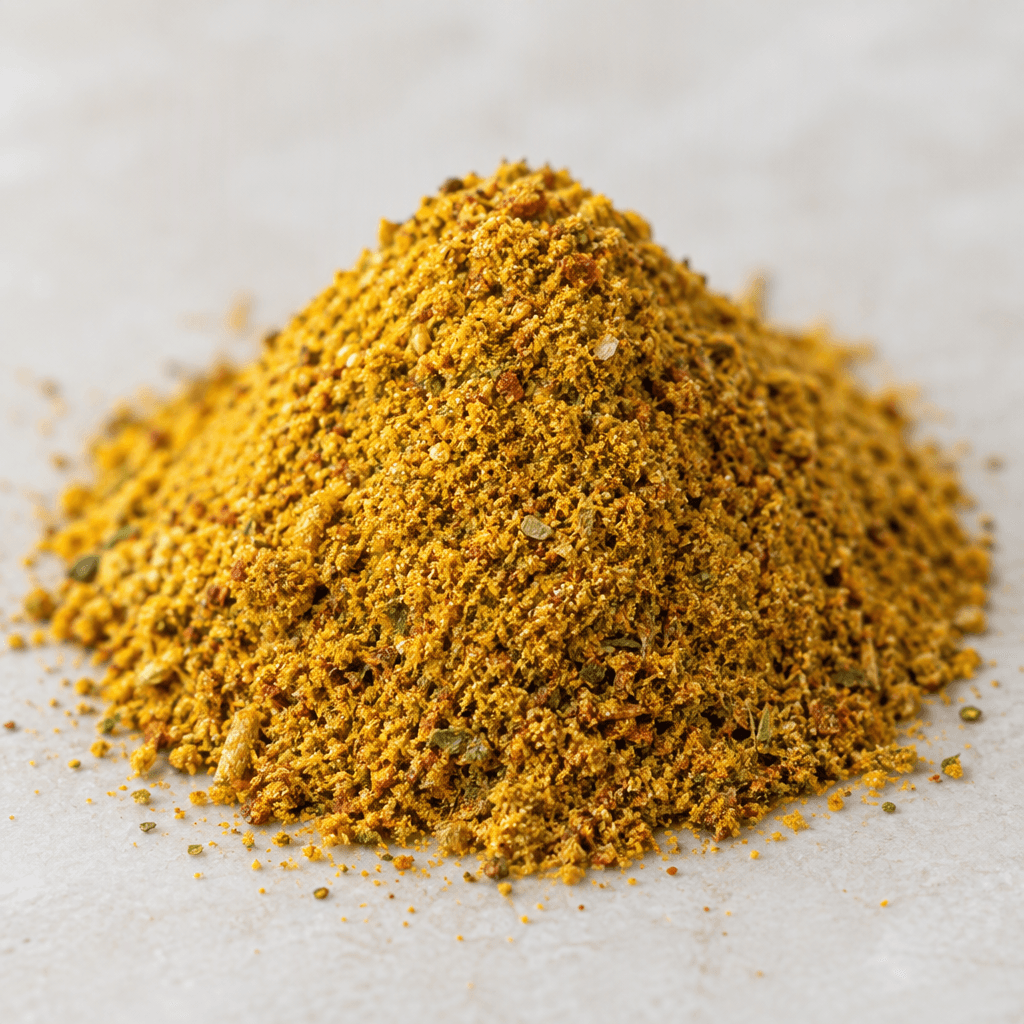
Curry Powder Calories
Spice blend, antioxidant, flavor enhancer
In season: Spring · Summer · Autumn · Winter
CALORIES
GI
POTASSIUM
FIBER
Quick answer
1 tablespoon (medium) of Curry Powder (7 g) has 23 calories. That works out to 325 calories per 100 g. It contains 3.9 g of carbs, 1 g of protein, 1 g of fat and 2.3 g of fiber. Its 0.4 mg of Manganese covers 18% of the Daily Value. Its glycemic index is 35 (low), so it raises blood sugar slowly.
What is Curry Powder?
Curry powder is a ground blend of spices, often including turmeric, coriander and cumin, with the exact mix varying by maker. The familiar ready-made powder is generally understood to have been developed in Britain as a convenient seasoning inspired by South Asian cooking; it is not one fixed blend used throughout India or its neighbouring cuisines.
Its flavour is warm and fragrant, with earthiness from the spices and a colour often supplied by turmeric. Add it to curries, soups, roasted vegetables, rice or marinades; in many English-speaking kitchens it is also used to season chicken salad and quick weeknight dishes. It contributes flavour in a small amount, rather than serving as a major source of nutrients. Blooming it briefly in oil can deepen its aroma, while pairing it with yoghurt or coconut milk softens the heat and rounds out a sauce.
Curry Powder Nutrition Facts
Selected: 100 g
325
KCAL / 100G
Carbs
55g
· 20% DV
Protein
14.3g
· 29% DV
Fat
13.8g
· 18% DV
Fiber
33g
· 118% DV
DV is the share of the daily value covered, on a 2,000 kcal reference diet.
Calories come from: Carbs 55% · Protein 14% · Fat 31%
Curry Powder Vitamins & Minerals
Vitamins
Vitamin A
1100µg · 122% DV
Vitamin K
53µg · 44% DV
B6
0.5mg · 29% DV
Biotin
7µg · 23% DV
Minerals
Manganese
6mg · 261% DV
Iron
21mg · 117% DV
Copper
1mg · 111% DV
Magnesium
260mg · 62% DV
How Nutritious Is Curry Powder?
Nutrient density
High
How many vitamins, minerals and how much fiber this food carries per calorie. A high score means a lot of nutrition for few calories.
Satiety score
Medium
An EatBetter score computed from fiber, protein and calorie density. A high score means staying full longer on the same calories.
Both scores are calculated per 100 g and do not change with the selected portion. The satiety score is EatBetter's own calculation, not a clinical measure.
Curry Powder Glycemic Index
GLYCEMIC INDEX
GLYCEMIC LOAD
Accounts for portion size — a more realistic measure than GI alone.
How to Burn Off Curry Powder
To burn the 325 calories in 100 g:
🚶
Walking (5 km/h)
🏃
Running (8 km/h)
🚴
Cycling
🏊
Swimming
Times are calculated with the MET equation for a 70 kg adult. Actual burn varies with your weight, age and pace.
Is Curry Powder Processed?
NOVA 2
Minimally Processed
1. Unprocessed
2. Minimally Processed
3. Processed
4. Ultra-Processed
NOVA classifies foods into 4 groups by industrial processing. NOVA 1 (unprocessed) is the healthiest.
Does Curry Powder Contain Allergens?
No known major allergens
Which Diets Is Curry Powder Good For?
Vegan
✓ Suitable
Vegetarian
✓ Suitable
Gluten-Free
✓ Suitable
Dairy-Free
— Not suitable
Mediterranean
✓ Suitable
Paleo
✓ Suitable
Whole30
— Not suitable
DASH
— Not suitable
Keto
✓ Suitable
Low FODMAP
— Not suitable
Curry Powder Fat Profile
SATURATED
2.1g
MONOUNSATURATED
2.8g
POLYUNSATURATED
7.2g
Omega 6:3 ratio 4.6:1
Above the ideal 4:1 (4.6:1).
Compare Curry Powder
Foods Similar to Curry Powder
Frequently Asked Questions About Curry Powder
What is curry powder?
Curry powder is a dry blend of ground spices, not a single spice or one fixed recipe. It is commonly used in British and other international cooking; blends vary in flavor, color and heat, and are not interchangeable with every Indian spice mixture.
What is curry powder made of?
Curry powder commonly contains turmeric, coriander, cumin and fenugreek, with ingredients such as ginger, black pepper, mustard or chilli added in varying amounts. There is no standard formula, so check the ingredient list if you need to avoid a particular spice.
What is the difference between curry powder and curry paste?
Curry powder is a dry spice blend, while curry paste is a moist mixture that often includes fresh ingredients such as chilli, garlic, ginger and lemongrass. They behave differently in recipes, so they generally cannot be swapped spoon for spoon.
What can I use instead of curry powder?
For a quick substitute, combine ground coriander, cumin and turmeric, then add black pepper and chilli to taste. The result will not exactly match a particular curry powder, since commercial blends have different ingredients and proportions.
How do you use curry powder?
Briefly cook curry powder in oil with onions or other aromatics before adding liquid or the main ingredients. This helps release its flavor. Add it to lentils, vegetables, soups or meat dishes, and avoid scorching it over high heat.
Is curry powder spicy?
Curry powder is not necessarily spicy; its heat depends on whether and how much chilli the blend contains. Some blends are mild and earthy, while others have a noticeable kick. Start with a small amount and taste as you cook.
How do you make curry powder at home?
Mix ground turmeric, coriander and cumin, then add smaller amounts of fenugreek, black pepper, ginger and chilli if desired. Adjust the proportions to suit your cooking, and store the homemade blend in an airtight jar away from heat and light.
How should curry powder be stored?
Keep curry powder in a tightly sealed container in a cool, dry cupboard, away from sunlight, steam and the stove. Moisture can cause clumping, while heat and light gradually weaken its aroma and color.
Does curry powder expire?
Curry powder can lose its aroma and flavor over time, even when stored properly, but a dry blend does not usually spoil quickly. Replace it if it smells flat, has lost much of its color, or has become damp or moldy.
What is the difference between curry powder and garam masala?
Curry powder is often yellow from turmeric and may contain fenugreek and chilli; garam masala is a separate Indian spice blend, commonly built around warming spices such as cardamom, cinnamon and cloves. Recipes and regional versions vary for both.
Have another question about Curry Powder?
Ask the AI nutrition coach — calories, portions, alternatives and more, answered in seconds in the app.

Scan calories with your camera
Instant AI nutrition analysis

Nutrition data compiled from USDA FoodData Central and scientific sources.