

Ready & Packaged Foods
All →Vegetables & Legumes
All →Desserts & Confectionery
All →Meat & Protein
All →Grains & Bakery
All →Beverages
All →Milk & Dairy
All →

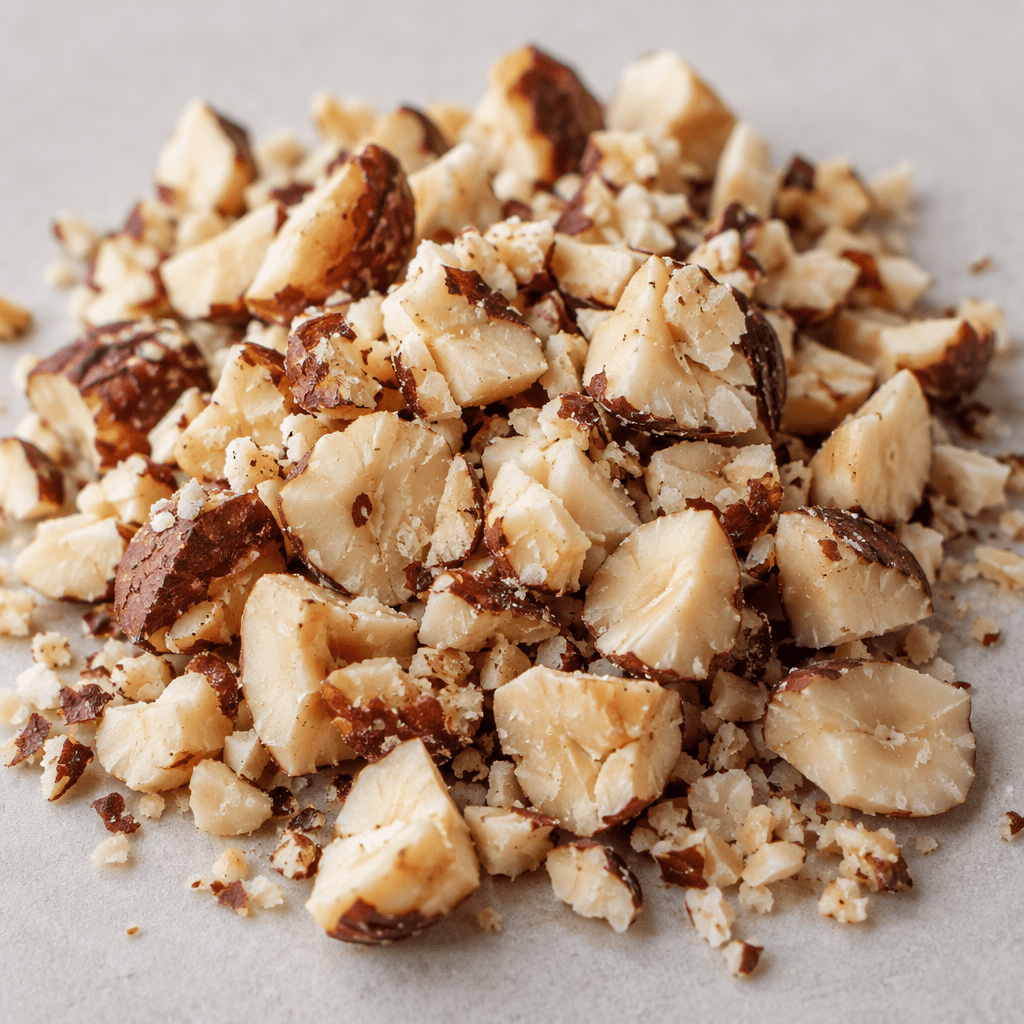
Crushed hazelnut Calories
Rich in healthy fats, vitamin E, and manganese
CALORIES
GI
POTASSIUM
FIBER
Quick answer
2 tablespoon (shredded) of Crushed hazelnut (15 g) has 94 calories. That works out to 628 calories per 100 g. It contains 2.5 g of carbs, 2.2 g of protein, 9.1 g of fat and 1.5 g of fiber. Its 0.9 mg of Manganese covers 40% of the Daily Value. Its glycemic index is 15 (low), so it raises blood sugar slowly.
What is Crushed hazelnut?
Crushed hazelnut is hazelnut kernel broken into small, irregular pieces. Hazelnuts are strongly associated with Turkey’s Black Sea region, as well as with European growing regions, and the chopped form is a handy ingredient for adding their flavour without using whole nuts.
Its toasted, gently sweet taste and crunchy texture work well scattered over porridge, yoghurt, fruit or salads, and folded into cakes, biscuits, chocolate desserts and granola. In Turkey and across Europe, it is especially familiar in baking and confectionery; elsewhere, it also makes an easy topping for everyday breakfasts. It is rich in fats and fibre, so a small sprinkle can add plenty of flavour and substance. Pair it with fresh fruit or plain yoghurt for a simple snack.
Crushed hazelnut Nutrition Facts
Selected: 100 g
628
KCAL / 100G
Carbs
16.7g
· 6% DV
Protein
15g
· 30% DV
Fat
60.8g
· 78% DV
Fiber
9.7g
· 35% DV
DV is the share of the daily value covered, on a 2,000 kcal reference diet.
Calories come from: Carbs 10% · Protein 9% · Fat 81%
Crushed hazelnut Vitamins & Minerals
Vitamins
Vitamin E
15.03mg · 100% DV
B1
0.64mg · 53% DV
B6
0.56mg · 33% DV
Folate
113µg · 28% DV
Minerals
Manganese
6mg · 261% DV
Copper
2mg · 222% DV
Phosphorus
290mg · 41% DV
Magnesium
163mg · 39% DV
How Nutritious Is Crushed hazelnut?
Nutrient density
High
How many vitamins, minerals and how much fiber this food carries per calorie. A high score means a lot of nutrition for few calories.
Satiety score
Medium
An EatBetter score computed from fiber, protein and calorie density. A high score means staying full longer on the same calories.
Both scores are calculated per 100 g and do not change with the selected portion. The satiety score is EatBetter's own calculation, not a clinical measure.
Crushed hazelnut Glycemic Index
GLYCEMIC INDEX
GLYCEMIC LOAD
Accounts for portion size — a more realistic measure than GI alone.
How to Burn Off Crushed hazelnut
To burn the 628 calories in 100 g:
🚶
Walking (5 km/h)
🏃
Running (8 km/h)
🚴
Cycling
🏊
Swimming
Times are calculated with the MET equation for a 70 kg adult. Actual burn varies with your weight, age and pace.
Is Crushed hazelnut Processed?
NOVA 2
Minimally Processed
1. Unprocessed
2. Minimally Processed
3. Processed
4. Ultra-Processed
NOVA classifies foods into 4 groups by industrial processing. NOVA 1 (unprocessed) is the healthiest.
Does Crushed hazelnut Contain Allergens?
Contains these allergens:
Which Diets Is Crushed hazelnut Good For?
Vegan
✓ Suitable
Vegetarian
✓ Suitable
Gluten-Free
✓ Suitable
Dairy-Free
— Not suitable
Mediterranean
✓ Suitable
Paleo
✓ Suitable
Whole30
— Not suitable
DASH
— Not suitable
Keto
✓ Suitable
Low FODMAP
— Not suitable
Crushed hazelnut Fat Profile
SATURATED
4.46g
MONOUNSATURATED
45.65g
POLYUNSATURATED
7.92g
Omega 6:3 ratio 88:1
Above the ideal 4:1 (88:1).
Compare Crushed hazelnut
Foods Similar to Crushed hazelnut
Frequently Asked Questions About Crushed hazelnut
What can you use crushed hazelnut for?
Crushed hazelnut adds crunch and a toasted, nutty flavor to cookies, cakes, pastries, granola, and savory coatings. Sprinkle it over yogurt or cooked vegetables just before serving to keep the pieces crisp.
Can you toast crushed hazelnut?
Yes, you can toast crushed hazelnut in a dry pan or oven. The small pieces brown quickly, so stir often and remove them as soon as they smell fragrant; carryover heat can darken them further.
How should you store crushed hazelnut?
Store crushed hazelnut in an airtight container in a cool, dark, dry place. Because cutting exposes more surface to air, it can lose freshness and absorb odors faster than whole hazelnuts; keep it away from heat and moisture.
Can you freeze crushed hazelnut?
Yes, crushed hazelnut freezes well when sealed in an airtight bag or container. Divide it into portions before freezing so you can take out only what you need, and avoid refreezing it after it has thawed.
Do you need to wash crushed hazelnut?
No, crushed hazelnut usually does not need washing. Water can dampen the small pieces and make them harder to store; if you see debris, pick it out rather than rinsing the nuts.
Is crushed hazelnut raw or roasted?
Crushed hazelnut can be either raw or roasted; “crushed” describes its size, not how it was prepared. Raw pieces have a milder flavor, while roasted ones taste more pronounced and aromatic.
Do you need to remove the skin from crushed hazelnut?
No, the brown skin flecks on crushed hazelnut are edible and do not need to be removed. They can taste slightly bitter; for a milder flavor, toast the pieces and rub away loose skin before using them.
Can you use crushed hazelnut instead of whole hazelnuts in a recipe?
Yes, crushed hazelnut can replace whole hazelnuts when a recipe calls for chopped nuts or a topping. It will not provide the same whole-nut crunch, and smaller pieces may brown faster during baking.
How can you tell if crushed hazelnut has gone rancid?
Rancid crushed hazelnut often smells sour, stale, or paint-like rather than pleasantly nutty. A sharp, bitter taste is another warning sign; discard it instead of trying to mask the flavor in a recipe.
Can you make hazelnut butter with crushed hazelnut?
Yes, crushed hazelnut can be blended into hazelnut butter, but a small amount may not reach the blades well. Use enough to keep the mixture moving, then blend until it releases its oils and becomes smooth.
Have another question about Crushed hazelnut?
Ask the AI nutrition coach — calories, portions, alternatives and more, answered in seconds in the app.

Scan calories with your camera
Instant AI nutrition analysis

Nutrition data compiled from USDA FoodData Central and scientific sources.