

Ready & Packaged Foods
All →Vegetables & Legumes
All →Desserts & Confectionery
All →Meat & Protein
All →Grains & Bakery
All →Beverages
All →Milk & Dairy
All →

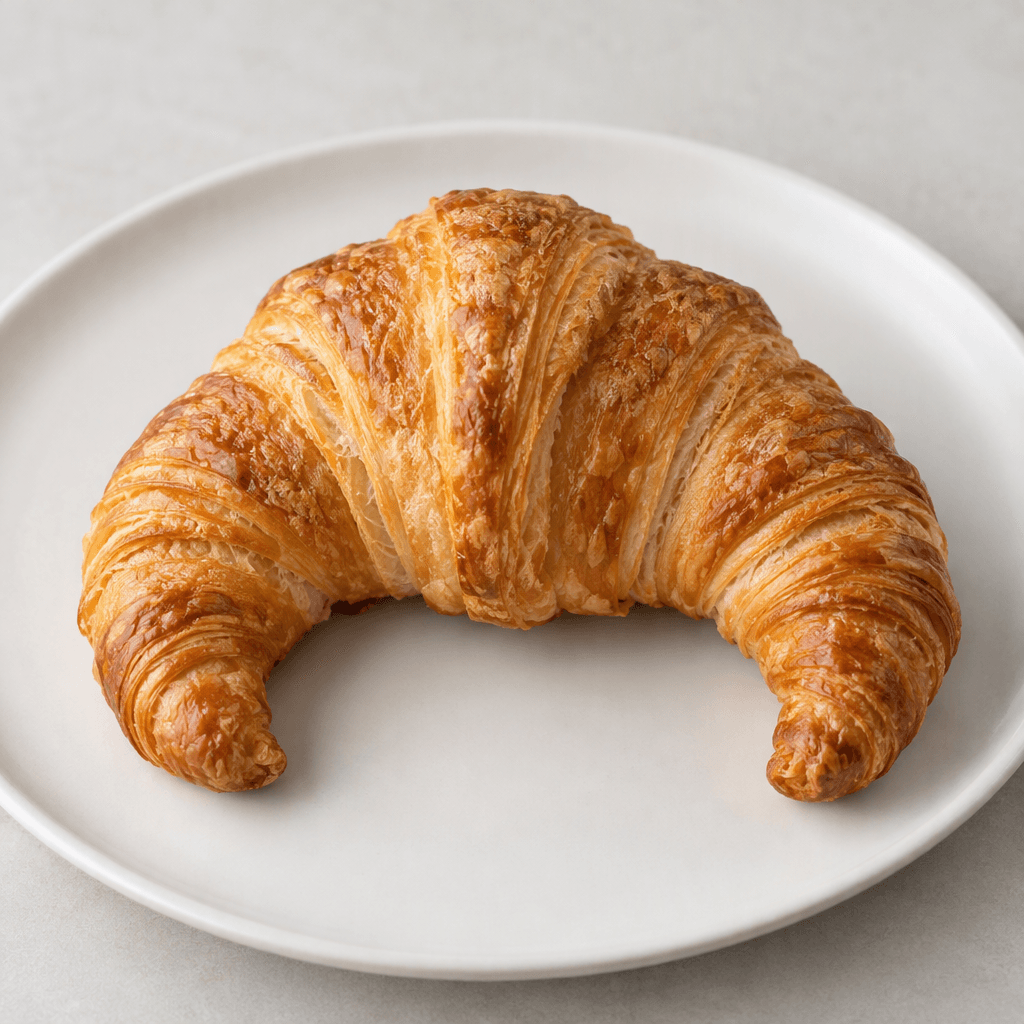
Croissant Calories
Buttery, flaky French pastry
In season: Spring · Summer · Autumn · Winter
CALORIES
GI
POTASSIUM
FIBER
Quick answer
1 piece (medium) of Croissant (55 g) has 223 calories. That works out to 406 calories per 100 g. It contains 25.1 g of carbs, 4.5 g of protein, 11.9 g of fat and 1.3 g of fiber. Its 6.1 µg of Selenium covers 11% of the Daily Value. Its glycemic index is 67 (high), so it raises blood sugar quickly.
What is Croissant?
A croissant is a crescent-shaped, yeasted pastry made by folding butter into dough in repeated layers. Closely associated with French baking, it emerges from the oven crisp and flaky outside, with a tender, airy centre. Its delicate layers are best enjoyed fresh, when they pull apart easily.
In France, it is a familiar breakfast pastry, often served with coffee; elsewhere, it is also a popular choice in cafés or for a quick breakfast. Croissants are rich in carbohydrates and fat, with 406 calories per 100 g. For a more filling meal, pair one with fruit and yogurt or eggs rather than adding another pastry.
Croissant Nutrition Facts
Selected: 100 g
406
KCAL / 100G
Carbs
45.6g
· 17% DV
Protein
8.2g
· 16% DV
Fat
21.6g
· 28% DV
Fiber
2.4g
· 9% DV
DV is the share of the daily value covered, on a 2,000 kcal reference diet.
Calories come from: Carbs 45% · Protein 8% · Fat 47%

Log this food in EatBetter
100,000+ people use it
- Get your daily calorie target
- Snap your meal, log it in seconds
- See every vitamin and mineral

📸 Scan the code to get the app free.

Croissant Vitamins & Minerals
Vitamins
B2
0.22mg · 17% DV
B1
0.18mg · 15% DV
Vitamin A
120µg · 13% DV
B3
2.1mg · 13% DV
Minerals
Selenium
11µg · 20% DV
Sodium
370mg · 16% DV
Phosphorus
95mg · 14% DV
Iron
2mg · 11% DV
Potassium ⭐
110mg · 3% DV
How Nutritious Is Croissant?
Nutrient density
Low
How many vitamins, minerals and how much fiber this food carries per calorie. A high score means a lot of nutrition for few calories.
Satiety score
Low
An EatBetter score computed from fiber, protein and calorie density. A high score means staying full longer on the same calories.
Both scores are calculated per 100 g and do not change with the selected portion. The satiety score is EatBetter's own calculation, not a clinical measure.
Croissant Glycemic Index
GLYCEMIC INDEX
GLYCEMIC LOAD
Accounts for portion size — a more realistic measure than GI alone.
How to Burn Off Croissant
To burn the 406 calories in 100 g:
🚶
Walking (5 km/h)
🏃
Running (8 km/h)
🚴
Cycling
🏊
Swimming
Times are calculated with the MET equation for a 70 kg adult. Actual burn varies with your weight, age and pace.
Is Croissant Processed?
NOVA 3
Processed
1. Unprocessed
2. Minimally Processed
3. Processed
4. Ultra-Processed
NOVA classifies foods into 4 groups by industrial processing. NOVA 1 (unprocessed) is the healthiest.
Does Croissant Contain Allergens?
Contains these allergens:
Which Diets Is Croissant Good For?
Vegan
— Not suitable
Vegetarian
— Not suitable
Gluten-Free
— Not suitable
Dairy-Free
— Not suitable
Mediterranean
✓ Suitable
Paleo
— Not suitable
Whole30
— Not suitable
DASH
— Not suitable
Keto
— Not suitable
Low FODMAP
— Not suitable
Croissant Fat Profile
SATURATED
13.2g
MONOUNSATURATED
5.8g
POLYUNSATURATED
1.3g
Omega 6:3 ratio 17.1:1
Above the ideal 4:1 (17.1:1).
Compare Croissant
Foods Similar to Croissant
Frequently Asked Questions About Croissant
How do you pronounce croissant?
Croissant is commonly pronounced “kwah-SAHN” in English, with the final “t” silent. English speakers may also use a pronunciation closer to the French “krwa-sahn.” Both are widely understood when ordering the pastry.
What is a croissant made of?
A classic croissant is made from flour, water or milk, yeast, salt, a little sugar, and butter. The dough is folded around butter repeatedly, then shaped, proofed, and baked to create its crisp, layered texture.
Why are croissants crescent-shaped?
Croissants are often crescent-shaped because the form recalls the crescent-shaped Austrian kipferl, a pastry associated with the croissant’s origins. Many French bakeries also make straight croissants, often using shape to distinguish butter croissants from versions made with other fats.
Is a croissant French or Austrian?
The croissant is a French pastry with roots in the Austrian kipferl. French bakers developed the laminated, buttery dough that defines the modern croissant, so its history spans both culinary traditions rather than belonging neatly to just one.
What is the difference between a croissant and a crescent roll?
A croissant is made by laminating dough with layers of butter, which gives it a flaky, open crumb. A crescent roll is usually a softer, breadier dough that may contain fat but is not folded into the same distinct layers.
How do you keep croissants fresh overnight?
Keep croissants at room temperature in an airtight container or bag overnight. Avoid refrigerating them, because the cold can make the pastry stale faster. For a crisp exterior the next day, warm the croissant briefly in an oven before serving.
Can you freeze croissants, and how do you thaw them?
Yes, croissants freeze well. Freeze them once fully cool in a sealed freezer bag, then thaw at room temperature or warm them in the oven from frozen. A short oven reheat helps bring back the flaky exterior better than a microwave.
How do you make a croissant crispy again?
Warm the croissant in an oven for a few minutes to refresh its crisp outer layers. A microwave heats it quickly but tends to make the pastry soft and chewy. Keep an eye on it so the buttery layers do not over-brown.
What do you eat with a croissant?
Croissants pair well with coffee, tea, jam, or fruit for breakfast; savory fillings such as eggs, cheese, and ham also work well. Their buttery flavor suits both sweet and savory accompaniments, so serve them plain or split and filled.
Can you make a sandwich with a croissant?
Yes, croissants make good sandwiches when split horizontally and filled with ingredients that are not too wet. Eggs, cheese, ham, or smoked salmon are common choices. Add moist fillings shortly before serving to help keep the flaky pastry from turning soggy.
Have another question about Croissant?
Ask the AI nutrition coach — calories, portions, alternatives and more, answered in seconds in the app.

Scan calories with your camera
Instant AI nutrition analysis

Nutrition data compiled from USDA FoodData Central and scientific sources.