

Ready & Packaged Foods
All →Vegetables & Legumes
All →Desserts & Confectionery
All →Meat & Protein
All →Grains & Bakery
All →Beverages
All →Milk & Dairy
All →

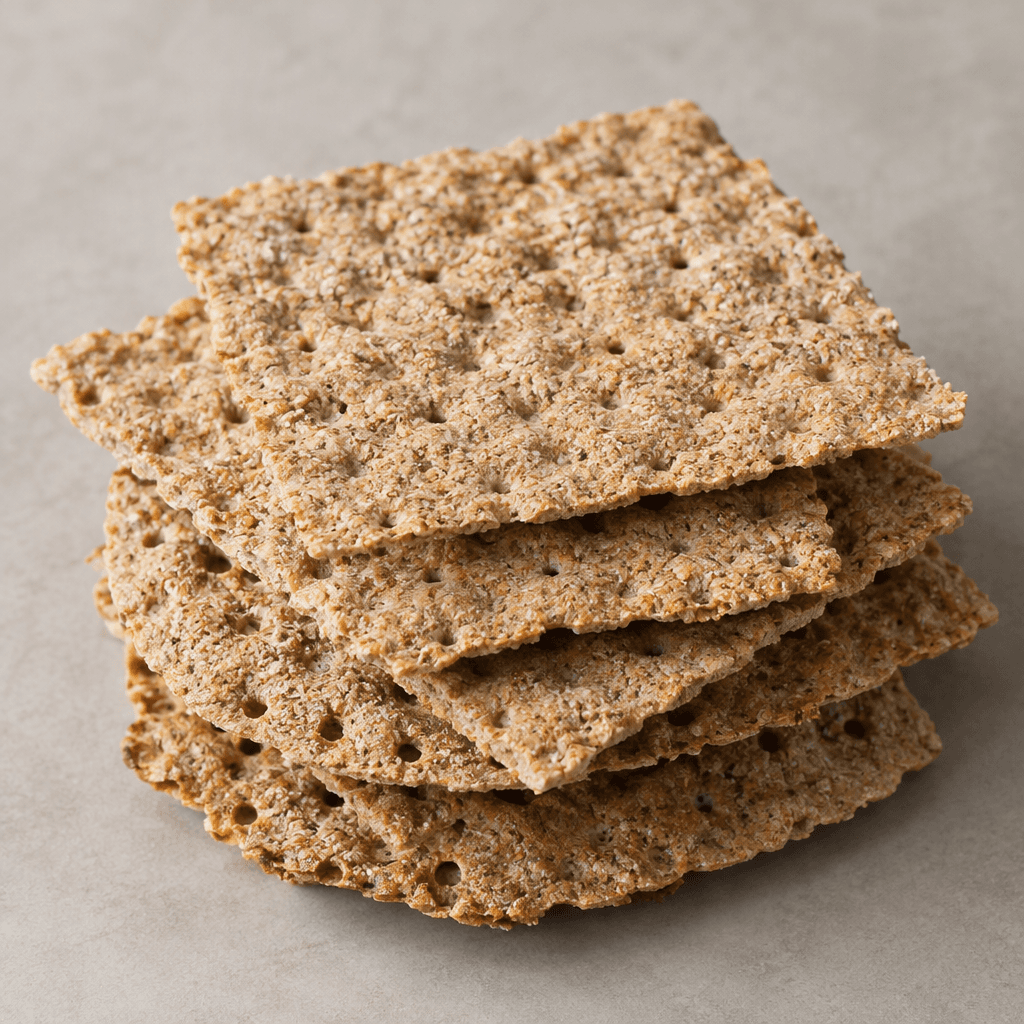
Crispbread Calories
Crunchy, high-fiber rye crispbread
In season: Spring · Summer · Autumn · Winter
CALORIES
GI
POTASSIUM
FIBER
Quick answer
2 slice (medium) of Crispbread (30 g) has 102 calories. That works out to 340 calories per 100 g. It contains 20.1 g of carbs, 2.7 g of protein, 0.8 g of fat and 4.5 g of fiber. Its 0.5 mg of Manganese covers 20% of the Daily Value. Its glycemic index is 55 (medium), so it raises blood sugar at a moderate pace.
What is Crispbread?
Crispbread is a thin, firm, dry-baked bread, commonly made with rye flour. It has deep roots in Sweden and other Nordic countries, where its porous surface and small holes help give it its characteristic brittle crunch. Some versions are round, others rectangular, and the flavour ranges from mild to distinctly rye-like.
In its Nordic home, it is often eaten with cheese, fish, or other savoury toppings, and it also works well as a simple snack. Elsewhere, it can stand in for toast at breakfast or pair with soup and salads. Crispbread is high in fibre and relatively low in fat; add a protein-rich topping such as egg or hummus to make it more satisfying.
Crispbread Nutrition Facts
Selected: 100 g
340
KCAL / 100G
Carbs
67g
· 24% DV
Protein
9g
· 18% DV
Fat
2.5g
· 3% DV
Fiber
15g
· 54% DV
DV is the share of the daily value covered, on a 2,000 kcal reference diet.
Calories come from: Carbs 82% · Protein 11% · Fat 7%
Crispbread Vitamins & Minerals
Vitamins
B1
0.35mg · 29% DV
B3
3.5mg · 22% DV
Biotin
6µg · 20% DV
B6
0.3mg · 18% DV
Minerals
Manganese
2mg · 87% DV
Phosphorus
190mg · 27% DV
Selenium
13µg · 24% DV
Sodium
420mg · 18% DV
How Nutritious Is Crispbread?
Nutrient density
Medium
How many vitamins, minerals and how much fiber this food carries per calorie. A high score means a lot of nutrition for few calories.
Satiety score
Medium
An EatBetter score computed from fiber, protein and calorie density. A high score means staying full longer on the same calories.
Both scores are calculated per 100 g and do not change with the selected portion. The satiety score is EatBetter's own calculation, not a clinical measure.
Crispbread Glycemic Index
GLYCEMIC INDEX
GLYCEMIC LOAD
Accounts for portion size — a more realistic measure than GI alone.
How to Burn Off Crispbread
To burn the 340 calories in 100 g:
🚶
Walking (5 km/h)
🏃
Running (8 km/h)
🚴
Cycling
🏊
Swimming
Times are calculated with the MET equation for a 70 kg adult. Actual burn varies with your weight, age and pace.
Is Crispbread Processed?
NOVA 3
Processed
1. Unprocessed
2. Minimally Processed
3. Processed
4. Ultra-Processed
NOVA classifies foods into 4 groups by industrial processing. NOVA 1 (unprocessed) is the healthiest.
Does Crispbread Contain Allergens?
Contains these allergens:
Which Diets Is Crispbread Good For?
Vegan
✓ Suitable
Vegetarian
✓ Suitable
Gluten-Free
— Not suitable
Dairy-Free
— Not suitable
Mediterranean
✓ Suitable
Paleo
— Not suitable
Whole30
— Not suitable
DASH
— Not suitable
Keto
— Not suitable
Low FODMAP
— Not suitable
Crispbread Fat Profile
SATURATED
0.4g
MONOUNSATURATED
0.5g
POLYUNSATURATED
1.2g
Omega 6:3 ratio 5.6:1
Above the ideal 4:1 (5.6:1).
Compare Crispbread
Foods Similar to Crispbread
Frequently Asked Questions About Crispbread
What is Crispbread made of?
Crispbread is a thin, dry bread usually made from rye flour, water and salt; some versions use other grains, seeds or leavening. The dough is rolled thin, perforated and baked until crisp.
Is Crispbread healthy?
Crispbread can be a nutritious choice, especially when it is made with whole-grain rye and provides plenty of fibre. Pair it with a protein-rich topping, such as egg or hummus, for a more satisfying snack or meal.
How do you eat Crispbread?
Eat Crispbread plain or use it as a base for toppings, much like an open sandwich. It works with cheese, eggs, vegetables or spreads; add moist toppings just before serving so the crispbread does not soften.
Is Crispbread healthier than regular bread?
Crispbread is drier and crunchier than regular bread, but neither is automatically healthier. Whole-grain ingredients and toppings matter more than texture; Crispbread is handy when you want a sturdy, crisp base rather than a soft slice.
What are the best toppings for Crispbread?
Cream cheese, hummus, mashed avocado, sliced egg, cheese and vegetables all work well on Crispbread. For a sweet topping, try nut butter or fruit. Add watery ingredients shortly before eating to preserve its crunch.
Can Crispbread help with weight loss?
Crispbread does not cause weight loss by itself. Its fibre may help make a snack more filling, but toppings such as cheese, nut butter or sweet spreads also affect how satisfying and substantial the snack is.
How do you keep Crispbread crisp?
Keep Crispbread in a tightly sealed package or airtight container in a cool, dry cupboard. Moisture makes it lose its crunch, so avoid leaving it exposed to air and follow the storage directions on the package.
Can Crispbread replace bread in a sandwich?
Yes, Crispbread can replace bread for an open-faced sandwich. Add cheese, egg, fish or vegetables to one piece; stacking another piece on top can make it crack, so serve it open-faced instead.
Can you freeze Crispbread?
Yes, you can freeze Crispbread, although its low moisture means freezing is rarely necessary. Seal it well before freezing, then let it thaw while still wrapped; if it softens, briefly warming it in the oven can restore some crunch.
Is Crispbread suitable for people with diabetes?
People with diabetes can include Crispbread in a meal, but rye crispbread still contains carbohydrates. The amount eaten and the foods paired with it affect the meal’s impact on blood glucose; a dietitian can help tailor portions to an individual plan.
Have another question about Crispbread?
Ask the AI nutrition coach — calories, portions, alternatives and more, answered in seconds in the app.

Scan calories with your camera
Instant AI nutrition analysis

Nutrition data compiled from USDA FoodData Central and scientific sources.