

Ready & Packaged Foods
All →Vegetables & Legumes
All →Desserts & Confectionery
All →Meat & Protein
All →Grains & Bakery
All →Beverages
All →Milk & Dairy
All →

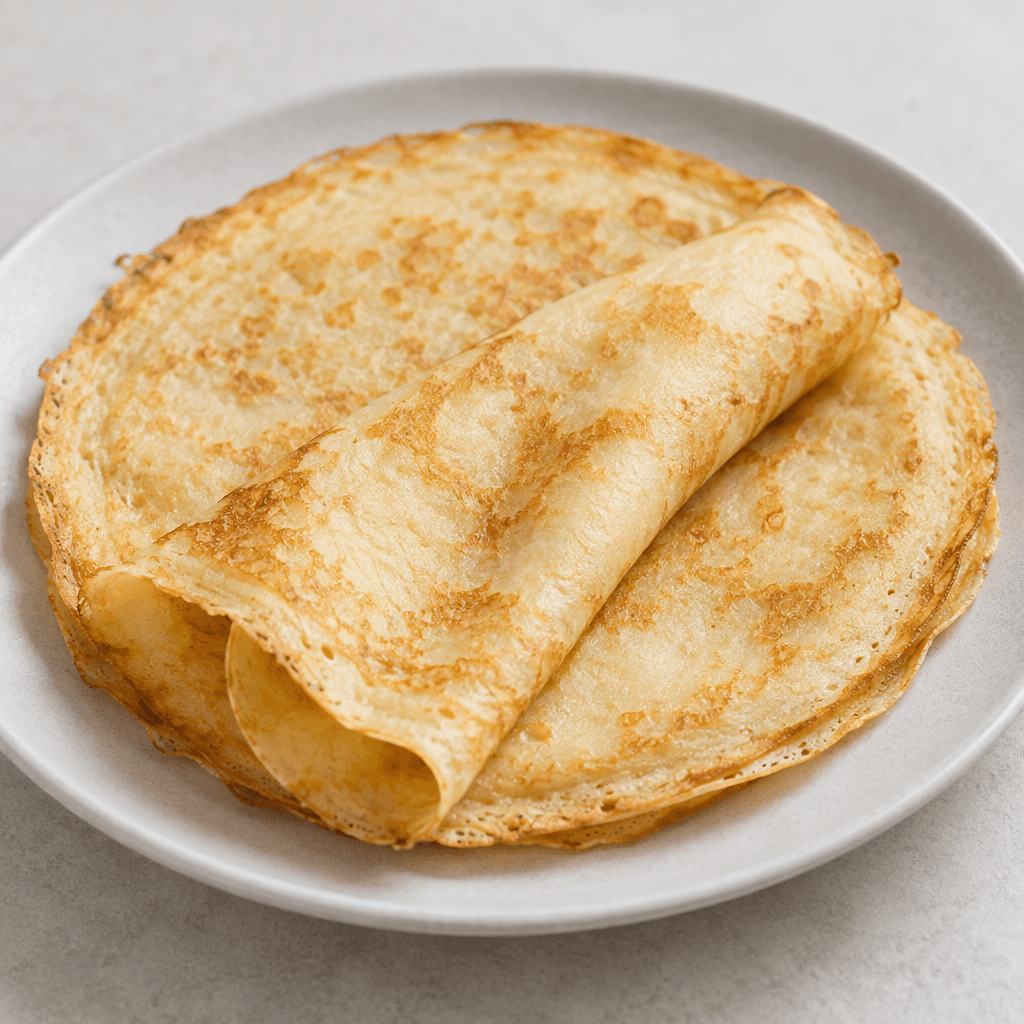
Crepe Calories
Thin pancake, versatile, sweet or savory
In season: Spring · Summer · Autumn · Winter
CALORIES
GI
POTASSIUM
FIBER
Quick answer
1 piece (medium) of Crepe (60 g) has 108 calories. That works out to 180 calories per 100 g. It contains 16.8 g of carbs, 3.3 g of protein, 3.3 g of fat and 0.6 g of fiber. Its 2.4 µg of Biotin covers 8% of the Daily Value. Its glycemic index is 70 (high), so it raises blood sugar quickly.
What is Crepe?
A crepe is a thin French-style pancake made from a pourable batter, usually cooked in a lightly greased pan until set and lightly golden. Its flexible shape makes it easy to fold or roll around a filling. In France, crepes are served with sweet toppings such as sugar, jam or chocolate, as well as savoury fillings. English-speaking households often enjoy them for breakfast, brunch or dessert, with fruit, yoghurt, cheese or vegetables. They are mainly a source of carbohydrates, with 28 g per 100 g. For a more balanced meal, fill a crepe with fruit and yoghurt or add vegetables and a protein-rich savoury filling; keep rich sauces or sugary toppings modest if you prefer a lighter serving.
Crepe Nutrition Facts
Selected: 100 g
180
KCAL / 100G
Carbs
28g
· 10% DV
Protein
5.5g
· 11% DV
Fat
5.5g
· 7% DV
Fiber
1g
· 4% DV
DV is the share of the daily value covered, on a 2,000 kcal reference diet.
Calories come from: Carbs 61% · Protein 12% · Fat 27%
Crepe Vitamins & Minerals
Vitamins
Biotin
4µg · 13% DV
B12
0.3µg · 13% DV
B2
0.15mg · 12% DV
B5
0.4mg · 8% DV
Minerals
Selenium
7µg · 13% DV
Phosphorus
90mg · 13% DV
Sodium
180mg · 8% DV
Calcium
65mg · 7% DV
How Nutritious Is Crepe?
Nutrient density
Medium
How many vitamins, minerals and how much fiber this food carries per calorie. A high score means a lot of nutrition for few calories.
Satiety score
Medium
An EatBetter score computed from fiber, protein and calorie density. A high score means staying full longer on the same calories.
Both scores are calculated per 100 g and do not change with the selected portion. The satiety score is EatBetter's own calculation, not a clinical measure.
Crepe Glycemic Index
GLYCEMIC INDEX
GLYCEMIC LOAD
Accounts for portion size — a more realistic measure than GI alone.
How to Burn Off Crepe
To burn the 180 calories in 100 g:
🚶
Walking (5 km/h)
🏃
Running (8 km/h)
🚴
Cycling
🏊
Swimming
Times are calculated with the MET equation for a 70 kg adult. Actual burn varies with your weight, age and pace.
Is Crepe Processed?
NOVA 3
Processed
1. Unprocessed
2. Minimally Processed
3. Processed
4. Ultra-Processed
NOVA classifies foods into 4 groups by industrial processing. NOVA 1 (unprocessed) is the healthiest.
Does Crepe Contain Allergens?
Contains these allergens:
Which Diets Is Crepe Good For?
Vegan
— Not suitable
Vegetarian
✓ Suitable
Gluten-Free
— Not suitable
Dairy-Free
— Not suitable
Mediterranean
— Not suitable
Paleo
— Not suitable
Whole30
— Not suitable
DASH
— Not suitable
Keto
— Not suitable
Low FODMAP
— Not suitable
Crepe Fat Profile
SATURATED
1.7g
MONOUNSATURATED
2g
POLYUNSATURATED
0.5g
Omega 6:3 ratio 15:1
Above the ideal 4:1 (15:1).
Compare Crepe
Foods Similar to Crepe
Frequently Asked Questions About Crepe
What are crepes made of?
Crepes are usually made from flour, eggs, milk, and a little butter or oil. The thin batter is spread across a hot pan and cooked briefly on both sides, without the leavening that makes pancakes rise.
What is the difference between crepes and pancakes?
Crepes are thinner and more flexible than pancakes, and they are usually made without a rising agent. Pancakes are thicker and fluffier. Crepes are easy to roll or fold around fillings, while pancakes are often stacked.
How do you make crepes?
To make crepes, whisk flour, eggs, and milk into a smooth, pourable batter. Pour a small amount into a lightly greased, heated pan, tilt the pan to spread it thinly, and flip when the edges look set.
Why are my crepes rubbery?
Crepes can turn rubbery when the batter is overmixed or the crepes are cooked for too long. Mix just until smooth, then cook each one briefly; a rested batter also helps produce a more tender texture.
What fillings go well in crepes?
Crepes work with both sweet and savory fillings. Try fruit, jam, or chocolate for a sweet version, or cheese, sautéed vegetables, or ham for a savory one. Add moist fillings just before serving to keep the crepe from becoming soggy.
Should crepe batter rest before cooking?
Yes, resting crepe batter helps the flour absorb liquid and lets small lumps settle. Cover the batter and chill it for about 30 minutes, then stir gently before cooking so it spreads evenly in the pan.
Why do crepes stick to the pan?
Crepes often stick when the pan is not hot enough or its surface is not properly greased. Use a nonstick pan over medium-low heat and wipe on a thin layer of butter or oil before cooking.
How should you store leftover crepes?
Store leftover crepes in a sealed container in the refrigerator once they have cooled. Place parchment between them to prevent sticking, and eat them within a few days. Reheat gently in a pan or microwave.
Can you freeze crepes?
Yes, crepes freeze well. Let them cool, stack them with parchment between each one, and seal the stack in a freezer-safe bag. Thaw in the refrigerator before reheating in a pan or microwave.
Can you make crepes without a crepe pan?
Yes, a regular nonstick frying pan works well for crepes. Choose a pan with a flat surface and low sides if possible, so you can spread the batter thinly and slide a spatula underneath to flip it.
Have another question about Crepe?
Ask the AI nutrition coach — calories, portions, alternatives and more, answered in seconds in the app.

Scan calories with your camera
Instant AI nutrition analysis

Nutrition data compiled from USDA FoodData Central and scientific sources.