

Ready & Packaged Foods
All →Vegetables & Legumes
All →Desserts & Confectionery
All →Meat & Protein
All →Grains & Bakery
All →Beverages
All →Milk & Dairy
All →

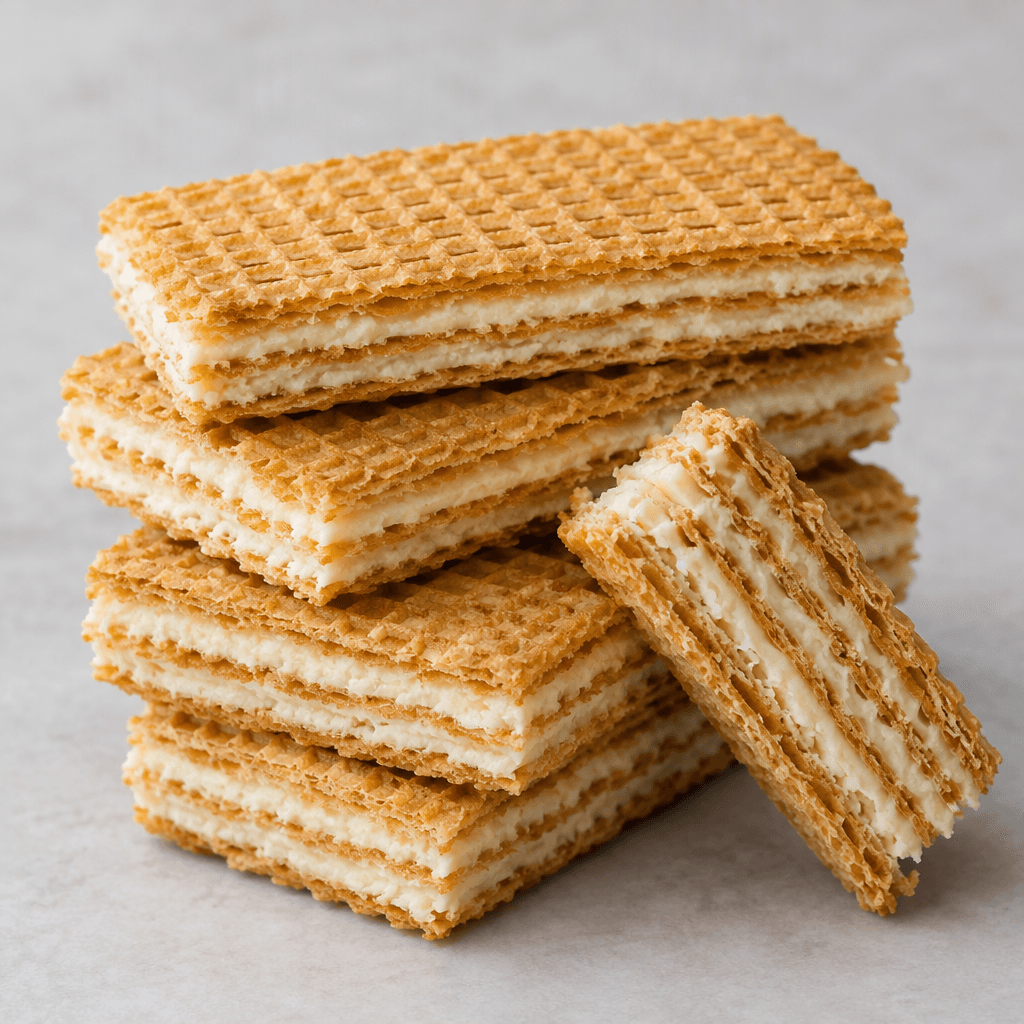
Cream Wafer Calories
Sweet snack, crispy wafer filled with sugary cream
In season: Spring · Summer · Autumn · Winter
CALORIES
GI
POTASSIUM
FIBER
Quick answer
1 piece (medium) of Cream Wafer (18 g) has 94 calories. That works out to 520 calories per 100 g. It contains 11.7 g of carbs, 0.9 g of protein, 4.7 g of fat and 0.4 g of fiber. Its glycemic index is 75 (high), so it raises blood sugar quickly.
What is Cream Wafer?
A cream wafer is a sweet snack made from thin, crisp wafer sheets layered with a smooth, sugary filling. The sheets give it a light, brittle crunch, while the cream adds sweetness and a softer bite. Recipes and flavours vary, but the crisp layers and creamy centre are what define this familiar packaged treat.
It is commonly enjoyed between meals or alongside tea or coffee, and travels easily as a small snack. It is energy-dense for its size, with 520 calories per 100 g, so one piece can be a satisfying sweet bite. For a less filling snack, have a single piece with unsweetened tea or coffee rather than serving several at once.
Cream Wafer Nutrition Facts
Selected: 100 g
520
KCAL / 100G
Carbs
65g
· 24% DV
Protein
5.2g
· 10% DV
Fat
26g
· 33% DV
Fiber
2.1g
· 8% DV
DV is the share of the daily value covered, on a 2,000 kcal reference diet.
Calories come from: Carbs 51% · Protein 4% · Fat 45%
Cream Wafer Vitamins & Minerals
Vitamins
B2
0.13mg · 10% DV
B1
0.09mg · 8% DV
B3
0.8mg · 5% DV
B5
0.25mg · 5% DV
Minerals
Phosphorus
62mg · 9% DV
Sodium
160mg · 7% DV
Iron
1mg · 6% DV
Selenium
2.5µg · 5% DV
How Nutritious Is Cream Wafer?
Nutrient density
Low
How many vitamins, minerals and how much fiber this food carries per calorie. A high score means a lot of nutrition for few calories.
Satiety score
Low
An EatBetter score computed from fiber, protein and calorie density. A high score means staying full longer on the same calories.
Both scores are calculated per 100 g and do not change with the selected portion. The satiety score is EatBetter's own calculation, not a clinical measure.
Cream Wafer Glycemic Index
GLYCEMIC INDEX
GLYCEMIC LOAD
Accounts for portion size — a more realistic measure than GI alone.
How to Burn Off Cream Wafer
To burn the 520 calories in 100 g:
🚶
Walking (5 km/h)
🏃
Running (8 km/h)
🚴
Cycling
🏊
Swimming
Times are calculated with the MET equation for a 70 kg adult. Actual burn varies with your weight, age and pace.
Is Cream Wafer Processed?
NOVA 3
Processed
1. Unprocessed
2. Minimally Processed
3. Processed
4. Ultra-Processed
NOVA classifies foods into 4 groups by industrial processing. NOVA 1 (unprocessed) is the healthiest.
Does Cream Wafer Contain Allergens?
Contains these allergens:
Which Diets Is Cream Wafer Good For?
Vegan
— Not suitable
Vegetarian
✓ Suitable
Gluten-Free
— Not suitable
Dairy-Free
— Not suitable
Mediterranean
— Not suitable
Paleo
— Not suitable
Whole30
— Not suitable
DASH
— Not suitable
Keto
— Not suitable
Low FODMAP
— Not suitable
Cream Wafer Fat Profile
SATURATED
13.5g
MONOUNSATURATED
7.8g
POLYUNSATURATED
3.1g
Omega 6:3 ratio 73.3:1
Above the ideal 4:1 (73.3:1).
Compare Cream Wafer
Foods Similar to Cream Wafer
Frequently Asked Questions About Cream Wafer
What is the cream in a cream wafer made of?
The filling in a cream wafer is usually a sweet mixture based on sugar and fat, rather than whipped cream. Recipes vary, and may include cocoa, vanilla, or nut flavouring; the wafer sheets provide the crisp layers around it.
How is a cream wafer made?
A cream wafer is made by baking thin wafer sheets, spreading filling between them, and stacking the layers. The stack is then cut into bars or pieces. Keeping the filling even helps the finished wafer hold together without crushing its delicate sheets.
Why does a cream wafer go soft after opening?
A cream wafer goes soft when its crisp sheets absorb moisture from the air. Seal the opened pack tightly or transfer the wafers to an airtight container, and keep them somewhere cool and dry rather than near steam or a kettle.
How should you store an opened cream wafer?
Store an opened cream wafer in an airtight container in a cool, dry cupboard. Avoid leaving it near heat or sunlight, which can soften the filling, and use it while the sheets still have their crisp texture.
Can you freeze a cream wafer?
Yes, you can freeze a cream wafer in moisture-proof packaging, but thawing may make the wafer less crisp. Let it come to room temperature while still wrapped, and avoid refreezing it after it has thawed.
Can you use cream wafers in desserts?
Yes, cream wafers work well crumbled over ice cream or layered into chilled desserts. Add them just before serving if you want a crisp topping; contact with pudding, frosting, or other moist fillings will soften the wafer.
Are cream wafers and wafer cookies the same thing?
They are closely related, but the names can describe different formats. A cream wafer is typically a stack of thin wafer sheets with filling between them, while “wafer cookie” may refer to filled wafers or to thinner, unfilled wafer biscuits.
Can you make a cream wafer crisp again?
Sometimes a slightly soft cream wafer can regain some crispness after brief, gentle warming in a low oven, followed by complete cooling. Watch it closely because the filling may melt; discard it if it smells or tastes spoiled.
Why does the filling squeeze out of a cream wafer?
The filling can squeeze out of a cream wafer if it has softened in warmth or if the layers are pressed too hard. Keep the wafer cool, handle it gently, and avoid stacking heavy items on top of the pack.
Is a cream wafer a good snack before exercise?
A cream wafer can provide quick carbohydrate, but it is also sweet and may not keep you full for long. If you eat one before exercise, allow time to see how it feels and choose a more substantial snack when you need lasting energy.
Have another question about Cream Wafer?
Ask the AI nutrition coach — calories, portions, alternatives and more, answered in seconds in the app.

Scan calories with your camera
Instant AI nutrition analysis

Nutrition data compiled from USDA FoodData Central and scientific sources.