

Ready & Packaged Foods
All →Vegetables & Legumes
All →Desserts & Confectionery
All →Meat & Protein
All →Grains & Bakery
All →Beverages
All →Milk & Dairy
All →

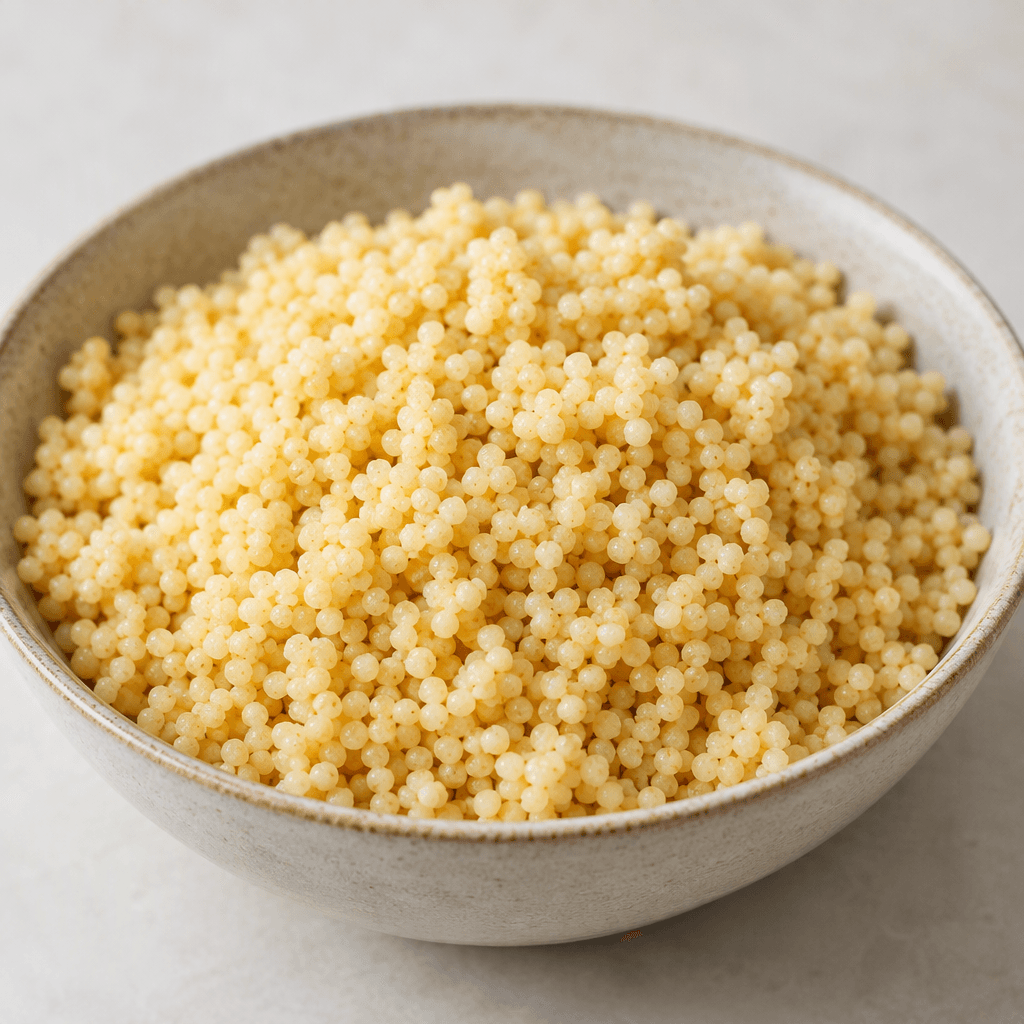
Couscous Pilaf Calories
Couscous pilaf is a quick-cooking, light side dish. Good source of carbohydrates and energy.
In season: Spring · Summer · Autumn · Winter
CALORIES
GI
POTASSIUM
FIBER
Quick answer
1 serving (medium) of Couscous Pilaf (150 g) has 180 calories. That works out to 120 calories per 100 g. It contains 33.8 g of carbs, 5.7 g of protein, 0.6 g of fat and 2.1 g of fiber. Its 0.1 mg of B1 covers 9% of the Daily Value. Its glycemic index is 65 (medium), so it raises blood sugar at a moderate pace.
What is Couscous Pilaf?
Couscous Pilaf is the Turkish-style dish made by cooking small, pasta-like semolina pieces pilaf-style. Here, “kuskus” refers to tiny pasta shapes, rather than the steamed couscous granules often associated with North African cooking. It is usually simmered in water or stock, sometimes after briefly being toasted in butter or oil.
The cooked pieces are tender and separate, making the dish a simple side for meat, chicken or vegetables at a Turkish home meal. It is mainly a carbohydrate source, with 22.5 g of carbohydrates per 100 g. For a lighter plate, use oil sparingly and serve it alongside vegetables and a protein-rich main.
Couscous Pilaf Nutrition Facts
Selected: 100 g
120
KCAL / 100G
Carbs
22.5g
· 8% DV
Protein
3.8g
· 8% DV
Fat
0.4g
· 1% DV
Fiber
1.4g
· 5% DV
DV is the share of the daily value covered, on a 2,000 kcal reference diet.
Calories come from: Carbs 83% · Protein 14% · Fat 3%

Log this food in EatBetter
100,000+ people use it
- Get your daily calorie target
- Snap your meal, log it in seconds
- See every vitamin and mineral

📸 Scan the code to get the app free.

Couscous Pilaf Vitamins & Minerals
Vitamins
B1
0.07mg · 6% DV
B5
0.2mg · 4% DV
Biotin
1.2µg · 4% DV
B3
0.6mg · 4% DV
Minerals
Selenium
2.5µg · 5% DV
Phosphorus
30mg · 4% DV
Potassium ⭐
45mg · 1% DV
Copper
0mg · 0% DV
Manganese
0mg · 0% DV
How Nutritious Is Couscous Pilaf?
Nutrient density
Medium
How many vitamins, minerals and how much fiber this food carries per calorie. A high score means a lot of nutrition for few calories.
Satiety score
Medium
An EatBetter score computed from fiber, protein and calorie density. A high score means staying full longer on the same calories.
Both scores are calculated per 100 g and do not change with the selected portion. The satiety score is EatBetter's own calculation, not a clinical measure.
Couscous Pilaf Glycemic Index
GLYCEMIC INDEX
GLYCEMIC LOAD
Accounts for portion size — a more realistic measure than GI alone.
How to Burn Off Couscous Pilaf
To burn the 120 calories in 100 g:
🚶
Walking (5 km/h)
🏃
Running (8 km/h)
🚴
Cycling
🏊
Swimming
Times are calculated with the MET equation for a 70 kg adult. Actual burn varies with your weight, age and pace.
Is Couscous Pilaf Processed?
NOVA 3
Processed
1. Unprocessed
2. Minimally Processed
3. Processed
4. Ultra-Processed
NOVA classifies foods into 4 groups by industrial processing. NOVA 1 (unprocessed) is the healthiest.
Does Couscous Pilaf Contain Allergens?
Contains these allergens:
Which Diets Is Couscous Pilaf Good For?
Vegan
— Not suitable
Vegetarian
✓ Suitable
Gluten-Free
— Not suitable
Dairy-Free
— Not suitable
Mediterranean
✓ Suitable
Paleo
— Not suitable
Whole30
— Not suitable
DASH
— Not suitable
Keto
— Not suitable
Low FODMAP
— Not suitable
Couscous Pilaf Fat Profile
SATURATED
0.08g
MONOUNSATURATED
0.05g
POLYUNSATURATED
0.09g
Omega 6:3 ratio 8:1
Above the ideal 4:1 (8:1).
Compare Couscous Pilaf
Foods Similar to Couscous Pilaf
Frequently Asked Questions About Couscous Pilaf
What is Couscous Pilaf?
Couscous Pilaf is a seasoned side dish of small couscous-like grains cooked with liquid and often toasted in oil or butter first. In Turkish cooking, “kuskus” commonly means tiny semolina pasta, rather than the steamed couscous used in North African dishes.
How do you cook Couscous Pilaf?
Toast the couscous briefly in oil or butter, add hot water or stock, then cover and simmer until tender. Follow the package’s liquid guidance, since Turkish-style kuskus pasta and North African couscous grains do not cook in exactly the same way.
How do you keep Couscous Pilaf from turning mushy?
To keep Couscous Pilaf fluffy, use the right amount of liquid for the type of couscous, cook it covered over low heat, and avoid frequent stirring. Let it rest off the heat before fluffing gently with a fork.
Is Couscous Pilaf the same as rice pilaf?
No. Couscous Pilaf uses small semolina pasta or couscous grains instead of rice, so its texture and cooking time differ. The pilaf method—briefly toasting the main ingredient before adding liquid—is common to both dishes.
What can you add to Couscous Pilaf for more flavor?
Stock, sautéed onion, garlic, herbs, and spices add flavor to Couscous Pilaf without changing its basic method. For a heartier version, stir in cooked vegetables, chickpeas, or toasted nuts after the grains are tender.
What should you serve with Couscous Pilaf?
Serve Couscous Pilaf with grilled chicken, fish, roasted vegetables, or a stew that has sauce for the grains to soak up. A crisp salad or yogurt-based side also balances a richer, buttery version.
Can you make Couscous Pilaf ahead of time?
Yes, Couscous Pilaf can be made ahead and refrigerated once it has cooled. Store it in a covered container and reheat it with a small splash of water or stock to loosen the grains and prevent them drying out.
Can you freeze Couscous Pilaf?
Yes, Couscous Pilaf freezes well for later meals. Cool it promptly, pack it in airtight, meal-sized portions, and thaw it in the refrigerator before reheating until steaming hot; the grains may be slightly softer after thawing.
Is Couscous Pilaf a good choice for people with diabetes?
People with diabetes can include Couscous Pilaf, but its carbohydrate content can affect blood glucose. Pairing a moderate portion with vegetables and a protein source can make a more balanced meal; individual meal guidance should come from a clinician or dietitian.
Does Couscous Pilaf make you gain weight?
Couscous Pilaf does not cause weight gain on its own. Large portions or generous amounts of butter and oil can add substantially to a meal, so serve a moderate portion alongside vegetables and protein.
Have another question about Couscous Pilaf?
Ask the AI nutrition coach — calories, portions, alternatives and more, answered in seconds in the app.

Scan calories with your camera
Instant AI nutrition analysis

Nutrition data compiled from USDA FoodData Central and scientific sources.