

Ready & Packaged Foods
All →Vegetables & Legumes
All →Desserts & Confectionery
All →Meat & Protein
All →Grains & Bakery
All →Beverages
All →Milk & Dairy
All →

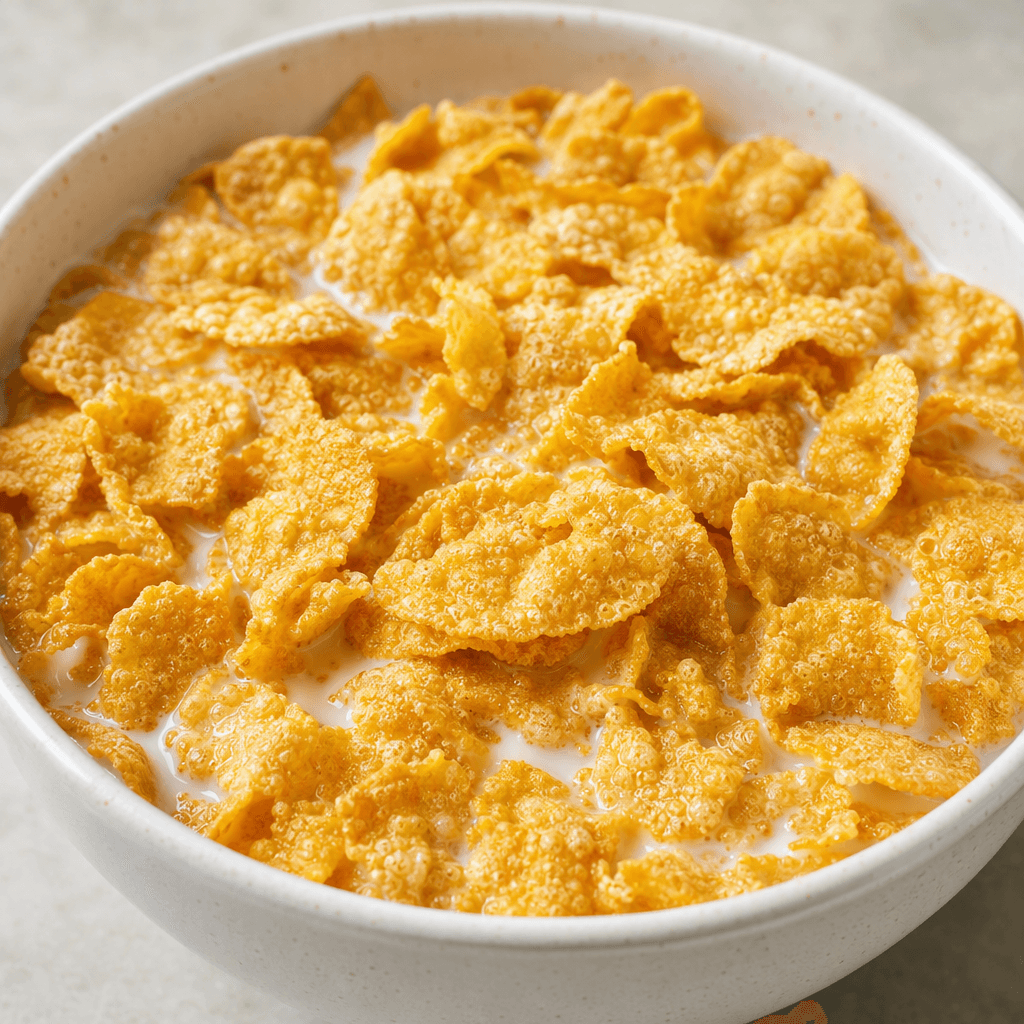
Cornflakes Calories
Popular breakfast cereal, low fat, moderate carbs, often eaten with milk
In season: Spring · Summer · Autumn · Winter
CALORIES
GI
POTASSIUM
FIBER
Quick answer
1 cup (medium) of Cornflakes (30 g) has 111 calories. That works out to 370 calories per 100 g. It contains 25.2 g of carbs, 2.3 g of protein, 0.2 g of fat and 0.9 g of fiber. Its 0.3 mg of B2 covers 25% of the Daily Value. Its glycemic index is 81 (high), so it raises blood sugar quickly.
What is Cornflakes?
Cornflakes are crisp breakfast flakes made from milled corn, cooked and toasted into thin, lightly curled pieces. They originated in the United States and are now a familiar cereal in many countries. Their flavour is mild and toasted, and they soften quickly in cold milk; some people prefer them dry for a crunchy snack. Serve them with milk or yoghurt, adding fresh fruit or nuts for more texture and variety. Cornflakes are mostly carbohydrate and very low in fat, with relatively little fibre or protein. For a more filling bowl, pair them with yoghurt or milk and fruit rather than relying on the flakes alone.
Cornflakes Nutrition Facts
Selected: 100 g
370
KCAL / 100G
Carbs
84g
· 31% DV
Protein
7.5g
· 15% DV
Fat
0.5g
· 1% DV
Fiber
3g
· 11% DV
DV is the share of the daily value covered, on a 2,000 kcal reference diet.
Calories come from: Carbs 91% · Protein 8% · Fat 1%
Cornflakes Vitamins & Minerals
Vitamins
B2
1.1mg · 85% DV
B12
2µg · 83% DV
B1
0.9mg · 75% DV
B3
12mg · 75% DV
Minerals
Iron
8mg · 44% DV
Sodium
660mg · 29% DV
Phosphorus
120mg · 17% DV
Selenium
8µg · 15% DV
How Nutritious Is Cornflakes?
Nutrient density
Medium
How many vitamins, minerals and how much fiber this food carries per calorie. A high score means a lot of nutrition for few calories.
Satiety score
Low
An EatBetter score computed from fiber, protein and calorie density. A high score means staying full longer on the same calories.
Both scores are calculated per 100 g and do not change with the selected portion. The satiety score is EatBetter's own calculation, not a clinical measure.
Cornflakes Glycemic Index
GLYCEMIC INDEX
GLYCEMIC LOAD
Accounts for portion size — a more realistic measure than GI alone.
How to Burn Off Cornflakes
To burn the 370 calories in 100 g:
🚶
Walking (5 km/h)
🏃
Running (8 km/h)
🚴
Cycling
🏊
Swimming
Times are calculated with the MET equation for a 70 kg adult. Actual burn varies with your weight, age and pace.
Is Cornflakes Processed?
NOVA 3
Processed
1. Unprocessed
2. Minimally Processed
3. Processed
4. Ultra-Processed
NOVA classifies foods into 4 groups by industrial processing. NOVA 1 (unprocessed) is the healthiest.
Does Cornflakes Contain Allergens?
Contains these allergens:
Which Diets Is Cornflakes Good For?
Vegan
— Not suitable
Vegetarian
✓ Suitable
Gluten-Free
— Not suitable
Dairy-Free
— Not suitable
Mediterranean
— Not suitable
Paleo
— Not suitable
Whole30
— Not suitable
DASH
— Not suitable
Keto
— Not suitable
Low FODMAP
— Not suitable
Cornflakes Fat Profile
SATURATED
0.1g
MONOUNSATURATED
0.1g
POLYUNSATURATED
0.2g
Compare Cornflakes
Foods Similar to Cornflakes
Frequently Asked Questions About Cornflakes
Are Cornflakes a good breakfast?
Cornflakes can be a convenient breakfast, but a bowl on its own may not keep you full for long. Pair them with milk or yogurt and add fruit or nuts for a more satisfying meal.
Can you eat Cornflakes for weight loss?
You can include Cornflakes in a weight-loss eating plan, but they do not cause weight loss by themselves. Measure a serving rather than pouring freely, and add a protein-rich food such as yogurt to help make breakfast more filling.
Can people with diabetes eat Cornflakes?
People with diabetes can eat Cornflakes, but they may raise blood sugar quickly. Pairing them with yogurt or milk and a source of protein or fiber can help make the meal more balanced; follow your individual care plan or ask a dietitian.
Why do Cornflakes get soggy in milk?
Cornflakes get soggy because their thin, porous structure absorbs milk quickly and loses its crispness. Pour milk over them just before eating, or serve the milk on the side and dip each spoonful to keep more crunch.
What are Cornflakes made of?
Cornflakes are made mainly from processed corn. Depending on the recipe, they may also contain salt, malt flavoring, added sugar, or added vitamins and minerals; ingredients differ between plain, sweetened, and flavored varieties.
Can you eat Cornflakes without milk?
Yes, Cornflakes can be eaten dry as a snack or mixed into yogurt. They also work as a crunchy topping for fruit or desserts; add them shortly before serving so moisture does not soften them.
Can Cornflakes be used as a coating for chicken?
Yes, crushed Cornflakes make a crisp coating for chicken. Dip the pieces in beaten egg, press them into coarsely crushed flakes, then bake or pan-cook until the chicken is thoroughly cooked.
Do Cornflakes contain added sugar?
Some Cornflakes have added sugar, while plain versions may contain little or none. Chocolate, honey, and other flavored varieties are often sweeter, so compare the ingredient list when choosing a product with less added sugar.
How should you store an opened box of Cornflakes?
Keep opened Cornflakes in an airtight container in a cool, dry place. Exposure to air and humidity makes the flakes lose their crunch; if the original bag does not reseal, transfer them to a tightly closed container.
Can you eat Cornflakes before a workout?
Yes, Cornflakes can be a quick pre-workout carbohydrate source, especially with milk when you have time to digest it. A large bowl right before exercise may feel uncomfortable, so choose a portion that suits your timing and appetite.
Have another question about Cornflakes?
Ask the AI nutrition coach — calories, portions, alternatives and more, answered in seconds in the app.

Scan calories with your camera
Instant AI nutrition analysis

Nutrition data compiled from USDA FoodData Central and scientific sources.