

Ready & Packaged Foods
All →Vegetables & Legumes
All →Desserts & Confectionery
All →Meat & Protein
All →Grains & Bakery
All →Beverages
All →Milk & Dairy
All →

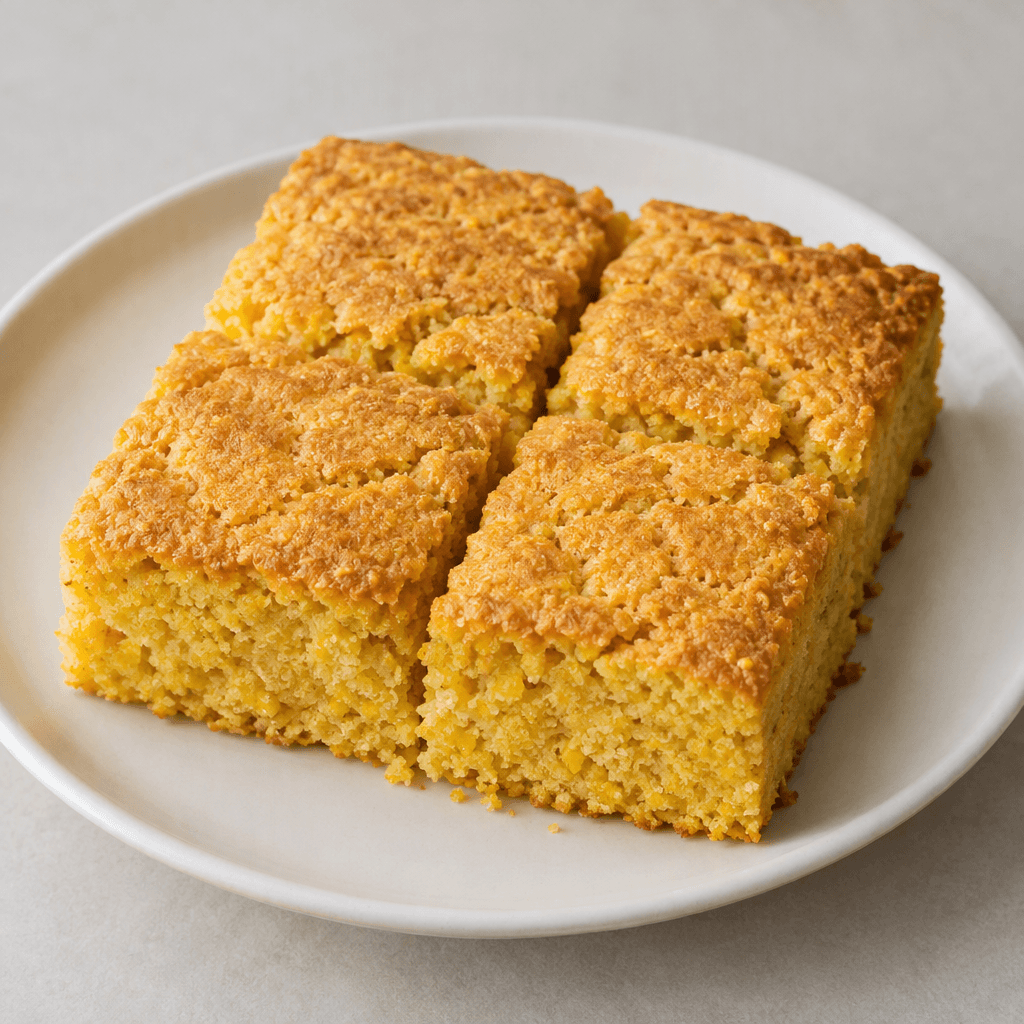
Cornbread Calories
Traditional cornbread, source of fiber and energy
In season: Autumn · Winter
CALORIES
GI
POTASSIUM
FIBER
Quick answer
1 slice (medium) of Cornbread (60 g) has 126 calories. That works out to 210 calories per 100 g. It contains 24 g of carbs, 2.7 g of protein, 2.7 g of fat and 1.3 g of fiber. Its 234 mg of Sodium covers 10% of the Daily Value. Its glycemic index is 70 (high), so it raises blood sugar quickly.
What is Cornbread?
Cornbread is a baked cornmeal bread, and this Turkish version is especially associated with the Black Sea region. Home recipes vary: cornmeal is mixed with water and salt, sometimes with other flour, then baked into a loaf or slab and cut into pieces.
It has a distinct, gently sweet corn flavour and a dense, coarse crumb that can break apart easily. In Turkey, it commonly accompanies soups, beans, cabbage dishes and fish; it can also be served at breakfast. Cornbread is mainly a source of energy from carbohydrates, with some fibre and modest protein. Pair a slice with yoghurt, eggs or a hearty soup for a more filling meal.
Cornbread Nutrition Facts
Selected: 100 g
210
KCAL / 100G
Carbs
40g
· 15% DV
Protein
4.5g
· 9% DV
Fat
4.5g
· 6% DV
Fiber
2.2g
· 8% DV
DV is the share of the daily value covered, on a 2,000 kcal reference diet.
Calories come from: Carbs 73% · Protein 8% · Fat 19%
Cornbread Vitamins & Minerals
Vitamins
B1
0.12mg · 10% DV
B3
1.2mg · 8% DV
Biotin
2.5µg · 8% DV
B2
0.08mg · 6% DV
Minerals
Sodium
390mg · 17% DV
Zinc
1mg · 9% DV
Phosphorus
65mg · 9% DV
Selenium
4.5µg · 8% DV
How Nutritious Is Cornbread?
Nutrient density
Medium
How many vitamins, minerals and how much fiber this food carries per calorie. A high score means a lot of nutrition for few calories.
Satiety score
Medium
An EatBetter score computed from fiber, protein and calorie density. A high score means staying full longer on the same calories.
Both scores are calculated per 100 g and do not change with the selected portion. The satiety score is EatBetter's own calculation, not a clinical measure.
Cornbread Glycemic Index
GLYCEMIC INDEX
GLYCEMIC LOAD
Accounts for portion size — a more realistic measure than GI alone.
How to Burn Off Cornbread
To burn the 210 calories in 100 g:
🚶
Walking (5 km/h)
🏃
Running (8 km/h)
🚴
Cycling
🏊
Swimming
Times are calculated with the MET equation for a 70 kg adult. Actual burn varies with your weight, age and pace.
Is Cornbread Processed?
NOVA 3
Processed
1. Unprocessed
2. Minimally Processed
3. Processed
4. Ultra-Processed
NOVA classifies foods into 4 groups by industrial processing. NOVA 1 (unprocessed) is the healthiest.
Does Cornbread Contain Allergens?
Contains these allergens:
Which Diets Is Cornbread Good For?
Vegan
— Not suitable
Vegetarian
✓ Suitable
Gluten-Free
— Not suitable
Dairy-Free
— Not suitable
Mediterranean
— Not suitable
Paleo
— Not suitable
Whole30
— Not suitable
DASH
— Not suitable
Keto
— Not suitable
Low FODMAP
— Not suitable
Cornbread Fat Profile
SATURATED
1.1g
MONOUNSATURATED
1.3g
POLYUNSATURATED
1.2g
Omega 6:3 ratio 36.7:1
Above the ideal 4:1 (36.7:1).
Compare Cornbread
Foods Similar to Cornbread
Frequently Asked Questions About Cornbread
How do you make cornbread from scratch?
Cornbread is made by mixing cornmeal with a liquid, a raising agent, and usually eggs and fat, then baking the batter. Many recipes add wheat flour for a softer crumb. For a more traditional, corn-forward loaf, use mostly cornmeal and avoid overmixing.
What is cornbread made of?
Cornbread is usually made with cornmeal, flour, eggs, milk or buttermilk, a leavening agent, and fat. Sugar is optional: Southern-style recipes are often savory, while many other American versions are sweet. Ingredients and texture vary by region and household.
Is cornbread supposed to be sweet or savory?
Cornbread can be either sweet or savory; there is no single style used everywhere. Many Southern US recipes contain little or no sugar, while sweeter versions are common elsewhere. If you are serving it with chili or a savory stew, choose the style you prefer.
Why does cornbread crumble?
Cornbread crumbles easily because cornmeal lacks the gluten that gives wheat bread its stretchy structure. Too much cornmeal or cutting the loaf while it is hot can make the problem worse. Let it cool fully, and use eggs or some wheat flour if you want a sturdier slice.
What does buttermilk do in cornbread?
Buttermilk adds a gentle tang and helps make cornbread tender. Its acidity also reacts with baking soda in recipes that include it, helping the batter rise. If a recipe calls for buttermilk, plain milk may produce a different flavor and texture.
Should cornbread be baked in a cast-iron skillet?
A cast-iron skillet gives cornbread a crisp, browned crust, especially when the skillet is heated before the batter is added. It is not essential: a baking pan works well too and may produce a softer crust. Follow the recipe’s pan-size guidance for even baking.
What do you serve with cornbread?
Cornbread is often served with chili, barbecue, beans, or hearty soups and stews. Its crumbly texture also makes it useful for soaking up savory sauces. Sweet cornbread can be eaten with butter or honey, while savory versions pair well with greens.
How should you store cornbread so it stays fresh?
Store cooled cornbread in an airtight container at room temperature for a short period, or refrigerate it if you need to keep it longer. Refrigeration can dry it out, so wrap it well. Discard it if you see mold or notice an unusual smell.
Can you freeze cornbread?
Yes, cornbread freezes well. Cool it completely, wrap individual slices tightly, and place them in a freezer-safe bag or container. Freezing slices separately makes it easy to thaw only what you need; warm thawed cornbread briefly before serving for a softer texture.
How do you reheat cornbread without drying it out?
Reheat cornbread in the oven, wrapped loosely in foil, to help it retain moisture. For a single slice, a short microwave warm-up works too; cover it with a slightly damp paper towel. Avoid heating it longer than needed, since cornbread dries out quickly.
Have another question about Cornbread?
Ask the AI nutrition coach — calories, portions, alternatives and more, answered in seconds in the app.

Scan calories with your camera
Instant AI nutrition analysis

Nutrition data compiled from USDA FoodData Central and scientific sources.