

Ready & Packaged Foods
All →Vegetables & Legumes
All →Desserts & Confectionery
All →Meat & Protein
All →Grains & Bakery
All →Beverages
All →Milk & Dairy
All →

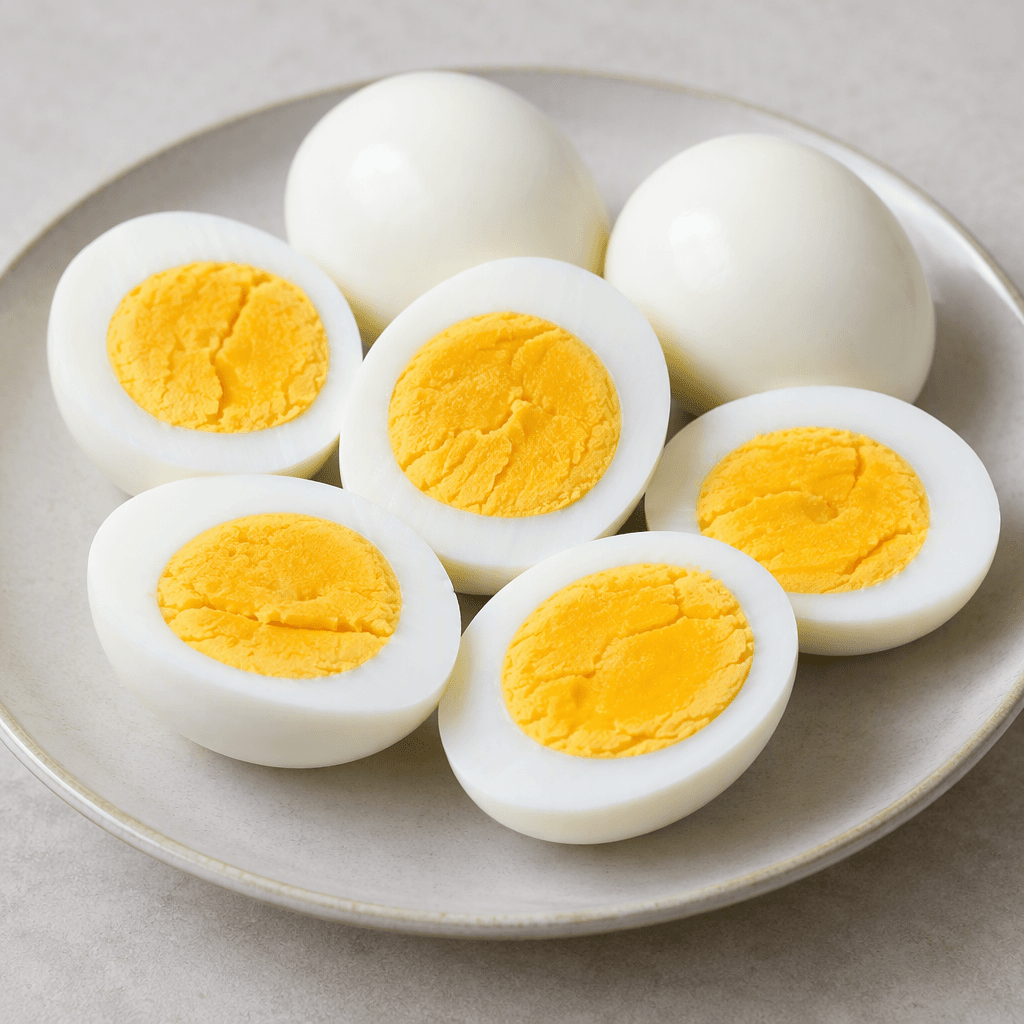
Cooked eggs Calories
Rich in high-quality protein, choline, and vitamin B12
In season: Spring · Summer · Autumn · Winter
CALORIES
GI
POTASSIUM
FIBER
Quick answer
1 piece (medium) of Cooked eggs (50 g) has 78 calories. That works out to 155 calories per 100 g. It contains 0.6 g of carbs, 6.3 g of protein, 5.3 g of fat and 0 g of fiber. Its 10 µg of Biotin covers 33% of the Daily Value. Its glycemic index is 0 (low), so it raises blood sugar slowly.
What is Cooked eggs?
Cooked eggs here are chicken eggs boiled in their shells until both the whites and yolks are firm. They’re easy to peel, eat on their own, or slice into salads and sandwiches. Cooking time determines whether the yolk stays soft or sets fully.
Across many English-speaking countries, hard-boiled eggs are a convenient breakfast or lunch option, often served with toast, added to salads, or packed for a snack. They provide high-quality protein, while the yolk contributes choline and vitamin B12. For a lighter meal, pair them with fresh vegetables or leafy greens rather than a creamy dressing; boiling a few ahead also makes quick meals easier.
Cooked eggs Nutrition Facts
Selected: 100 g
155
KCAL / 100G
Carbs
1.1g
· 0% DV
Protein
12.6g
· 25% DV
Fat
10.6g
· 14% DV
Fiber
0g
· 0% DV
DV is the share of the daily value covered, on a 2,000 kcal reference diet.
Calories come from: Carbs 3% · Protein 34% · Fat 63%
Cooked eggs Vitamins & Minerals
Vitamins
Biotin
20µg · 67% DV
B12
1.1µg · 46% DV
B2
0.5mg · 38% DV
B5
1.4mg · 28% DV
Minerals
Selenium
30.7µg · 56% DV
Iodine
47µg · 31% DV
Phosphorus
172mg · 25% DV
Iron
2mg · 11% DV
How Nutritious Is Cooked eggs?
Nutrient density
High
How many vitamins, minerals and how much fiber this food carries per calorie. A high score means a lot of nutrition for few calories.
Satiety score
Medium
An EatBetter score computed from fiber, protein and calorie density. A high score means staying full longer on the same calories.
Both scores are calculated per 100 g and do not change with the selected portion. The satiety score is EatBetter's own calculation, not a clinical measure.
Cooked eggs Glycemic Index
GLYCEMIC INDEX
GLYCEMIC LOAD
Accounts for portion size — a more realistic measure than GI alone.
How to Burn Off Cooked eggs
To burn the 155 calories in 100 g:
🚶
Walking (5 km/h)
🏃
Running (8 km/h)
🚴
Cycling
🏊
Swimming
Times are calculated with the MET equation for a 70 kg adult. Actual burn varies with your weight, age and pace.
Is Cooked eggs Processed?
NOVA 2
Minimally Processed
1. Unprocessed
2. Minimally Processed
3. Processed
4. Ultra-Processed
NOVA classifies foods into 4 groups by industrial processing. NOVA 1 (unprocessed) is the healthiest.
Does Cooked eggs Contain Allergens?
Contains these allergens:
Which Diets Is Cooked eggs Good For?
Vegan
— Not suitable
Vegetarian
✓ Suitable
Gluten-Free
✓ Suitable
Dairy-Free
— Not suitable
Mediterranean
✓ Suitable
Paleo
✓ Suitable
Whole30
— Not suitable
DASH
— Not suitable
Keto
✓ Suitable
Low FODMAP
— Not suitable
Cooked eggs Fat Profile
SATURATED
3.3g
MONOUNSATURATED
4.1g
POLYUNSATURATED
1.9g
Omega 6:3 ratio 12.7:1
Above the ideal 4:1 (12.7:1).
Compare Cooked eggs
Foods Similar to Cooked eggs
Frequently Asked Questions About Cooked eggs
How long should you boil cooked eggs for a firm yolk?
For a firm yolk, boil eggs for about 9–12 minutes once the water reaches a boil. Transfer them to cold water afterward to stop the cooking; this also helps prevent the yolks from developing a green ring.
Why do cooked eggs have a green ring around the yolk?
The green ring on a cooked egg usually forms when it is cooked too long or at too high a temperature. It is a reaction between compounds in the yolk and white, and by itself does not mean the egg has spoiled.
How do you peel cooked eggs easily?
Cool cooked eggs promptly in cold water, then gently crack the shell all over before peeling under running water. Very fresh eggs can be harder to peel, so using eggs that have been refrigerated for a few days may help.
How long do cooked eggs last in the fridge?
Cooked eggs kept in their shells can be refrigerated for up to one week. Store peeled eggs in a covered container and use them within a few days for the best quality; refrigerate them promptly after cooking.
Can you freeze cooked eggs?
You can freeze cooked eggs, but thawed whites often become rubbery and watery. Cooked yolks freeze better on their own than whole eggs; thaw them in the refrigerator and use them in a cooked dish rather than expecting the original texture.
Can you microwave cooked eggs?
Do not microwave a whole cooked egg in its shell: steam pressure can build up and make it burst, sometimes after heating. For safer reheating, peel and slice the egg, then warm it briefly in short intervals.
How can you tell whether an egg is cooked without cutting it open?
Spin the egg on a flat surface. A cooked egg spins smoothly, while a raw egg tends to wobble because its liquid interior moves; briefly stopping and releasing it can also make a raw egg start spinning again.
Can you eat cooked eggs cold?
Yes, cooked eggs can be eaten cold once they have been cooked and refrigerated safely. They work well in salads, sandwiches, or as a snack; do not eat one that has been left unrefrigerated for more than two hours.
Are cooked eggs a good breakfast for weight loss?
Cooked eggs provide protein, which can make a breakfast more filling. Pair one with vegetables or whole-grain food for a more substantial meal; eggs alone do not cause weight loss.
Why are cooked eggs sometimes difficult to peel?
Cooked eggs are often difficult to peel when they are very fresh, because the white tends to cling to the inner membrane. Cooling them quickly after boiling and cracking the shell all over can make peeling easier.
Have another question about Cooked eggs?
Ask the AI nutrition coach — calories, portions, alternatives and more, answered in seconds in the app.

Scan calories with your camera
Instant AI nutrition analysis

Nutrition data compiled from USDA FoodData Central and scientific sources.