

Ready & Packaged Foods
All →Vegetables & Legumes
All →Desserts & Confectionery
All →Meat & Protein
All →Grains & Bakery
All →Beverages
All →Milk & Dairy
All →

Cone Calories
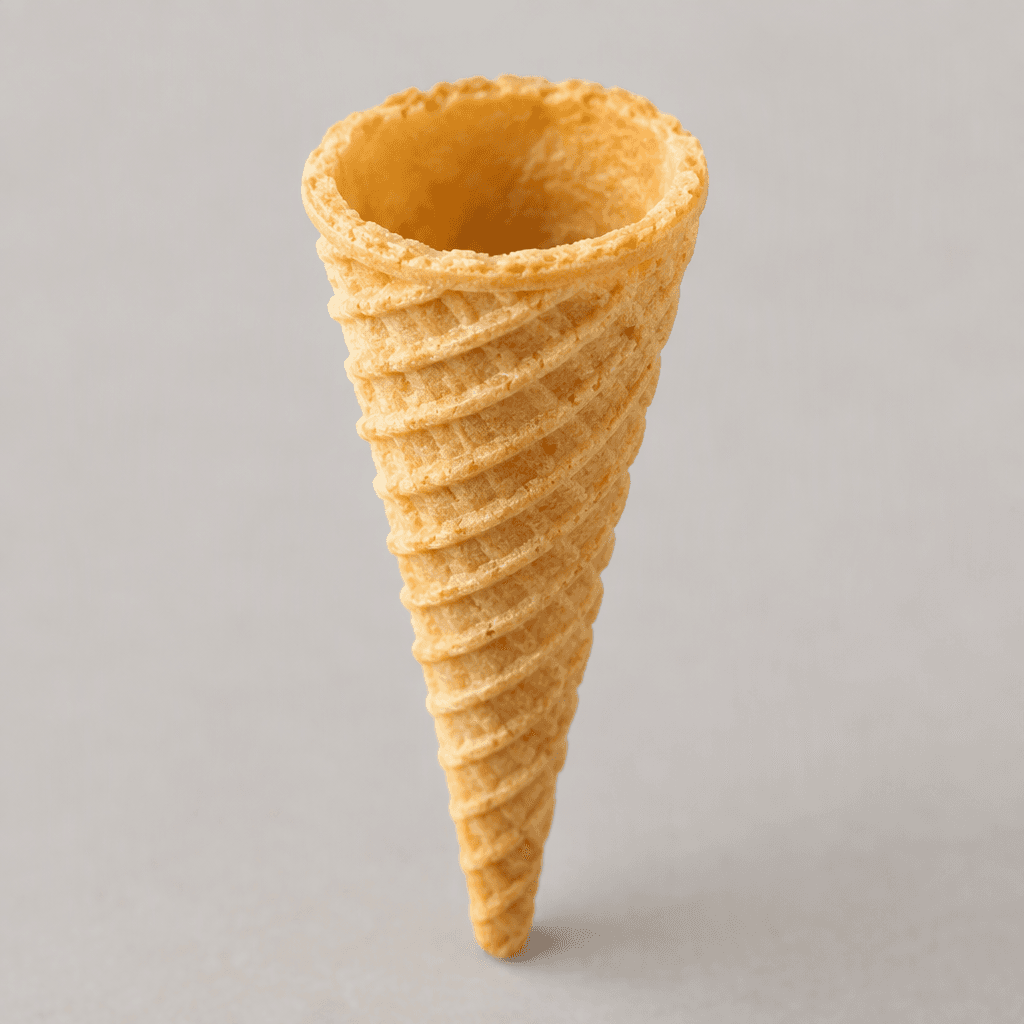
Ice cream cone, typically made from wheat flour, sugar, and fat, forming a crisp wafer.
In season: Spring · Summer
CALORIES
GI
POTASSIUM
FIBER
Quick answer
1 piece (medium) of Cone (15 g) has 63 calories. That works out to 420 calories per 100 g. It contains 12.3 g of carbs, 1.1 g of protein, 1.2 g of fat and 0.4 g of fiber. Its glycemic index is 75 (high), so it raises blood sugar quickly.
What is Cone?
A cone is a crisp, hollow wafer shaped to hold ice cream. It is usually made from a thin batter containing flour, sugar and fat, baked into a tapered shape; some versions have a ridged surface, while others are smoother or more waffle-like.
Across much of the world, cones are served with scoops of ice cream, from street vendors and parlours to home freezers. Their light crunch and mild sweetness contrast with the cold, creamy filling, though the wafer softens once it absorbs moisture. Nutritionally, a cone is mostly carbohydrate and provides relatively little protein or fibre, so it adds energy as well as texture to a dessert. For a smaller treat, choose a modest cone and keep extra toppings simple.
Cone Nutrition Facts
Selected: 100 g
420
KCAL / 100G
Carbs
82g
· 30% DV
Protein
7.5g
· 15% DV
Fat
8g
· 10% DV
Fiber
2.5g
· 9% DV
DV is the share of the daily value covered, on a 2,000 kcal reference diet.
Calories come from: Carbs 76% · Protein 7% · Fat 17%
Cone Vitamins & Minerals
Vitamins
B1
0.12mg · 10% DV
B2
0.13mg · 10% DV
B3
1.2mg · 8% DV
Biotin
2µg · 7% DV
Minerals
Phosphorus
70mg · 10% DV
Zinc
1mg · 9% DV
Sodium
150mg · 7% DV
Iron
1mg · 6% DV
How Nutritious Is Cone?
Nutrient density
Low
How many vitamins, minerals and how much fiber this food carries per calorie. A high score means a lot of nutrition for few calories.
Satiety score
Low
An EatBetter score computed from fiber, protein and calorie density. A high score means staying full longer on the same calories.
Both scores are calculated per 100 g and do not change with the selected portion. The satiety score is EatBetter's own calculation, not a clinical measure.
Cone Glycemic Index
GLYCEMIC INDEX
GLYCEMIC LOAD
Accounts for portion size — a more realistic measure than GI alone.
How to Burn Off Cone
To burn the 420 calories in 100 g:
🚶
Walking (5 km/h)
🏃
Running (8 km/h)
🚴
Cycling
🏊
Swimming
Times are calculated with the MET equation for a 70 kg adult. Actual burn varies with your weight, age and pace.
Is Cone Processed?
NOVA 3
Processed
1. Unprocessed
2. Minimally Processed
3. Processed
4. Ultra-Processed
NOVA classifies foods into 4 groups by industrial processing. NOVA 1 (unprocessed) is the healthiest.
Does Cone Contain Allergens?
Contains these allergens:
Which Diets Is Cone Good For?
Vegan
— Not suitable
Vegetarian
✓ Suitable
Gluten-Free
— Not suitable
Dairy-Free
— Not suitable
Mediterranean
— Not suitable
Paleo
— Not suitable
Whole30
— Not suitable
DASH
— Not suitable
Keto
— Not suitable
Low FODMAP
— Not suitable
Cone Fat Profile
SATURATED
2.5g
MONOUNSATURATED
2.6g
POLYUNSATURATED
2.2g
Omega 6:3 ratio 120:1
Above the ideal 4:1 (120:1).
Compare Cone
Foods Similar to Cone
Frequently Asked Questions About Cone
Can you eat an ice cream cone?
Yes, an ice cream cone is made to be eaten along with the ice cream. Its crisp wafer provides a crunchy contrast, so start at the top and eat down to the pointed end.
What is the difference between a waffle cone and a sugar cone?
A waffle cone is usually wider, patterned, and made from a richer batter, while a sugar cone is smaller, denser, and more pointed. Their textures and shapes affect how much ice cream they hold and how crisp they feel.
Why does an ice cream cone get soggy?
An ice cream cone gets soggy when moisture from melting ice cream soaks into its crisp wafer. Filling it just before serving helps; a chocolate lining can also slow moisture from reaching the cone.
How do you keep ice cream cones crisp?
Keep ice cream cones in a tightly sealed container in a cool, dry place. Moist air softens the wafer, so avoid storing them near steam or leaving an opened package exposed on the counter.
Can you make ice cream cones at home without a cone maker?
Yes, you can make ice cream cones at home without a cone maker by cooking thin batter in a waffle iron or skillet. Shape each piece around a cone-shaped form while it is still hot, before it turns crisp.
Can you freeze ice cream cones?
Yes, you can freeze ice cream cones in an airtight container, though freezing is not necessary for ordinary storage. Let them warm to room temperature while still sealed to reduce condensation that can soften the wafer.
Why is there chocolate inside some ice cream cones?
Chocolate inside some ice cream cones adds a sweet finish and can act as a barrier between the ice cream and wafer. That coating may help the cone stay crisp longer, especially near the bottom.
How long do ice cream cones stay fresh after opening?
Opened ice cream cones stay crisp best when kept dry in an airtight container; exposure to humid air makes them stale. Follow the package’s date for the product, and discard cones that smell rancid or show mold.
What can you put in an ice cream cone besides ice cream?
You can fill an ice cream cone with fruit, whipped cream, mousse, or small candies for a handheld dessert. Add moist fillings shortly before serving, since wet ingredients can soften the wafer.
Why do ice cream cones have a pointed bottom?
The pointed bottom gives an ice cream cone its familiar shape and makes it easy to hold while eating. Since the tip is fragile, handle the cone gently and avoid pressing a firm scoop down into it.
Have another question about Cone?
Ask the AI nutrition coach — calories, portions, alternatives and more, answered in seconds in the app.

Scan calories with your camera
Instant AI nutrition analysis

Nutrition data compiled from USDA FoodData Central and scientific sources.