

Ready & Packaged Foods
All →Vegetables & Legumes
All →Desserts & Confectionery
All →Meat & Protein
All →Grains & Bakery
All →Beverages
All →Milk & Dairy
All →

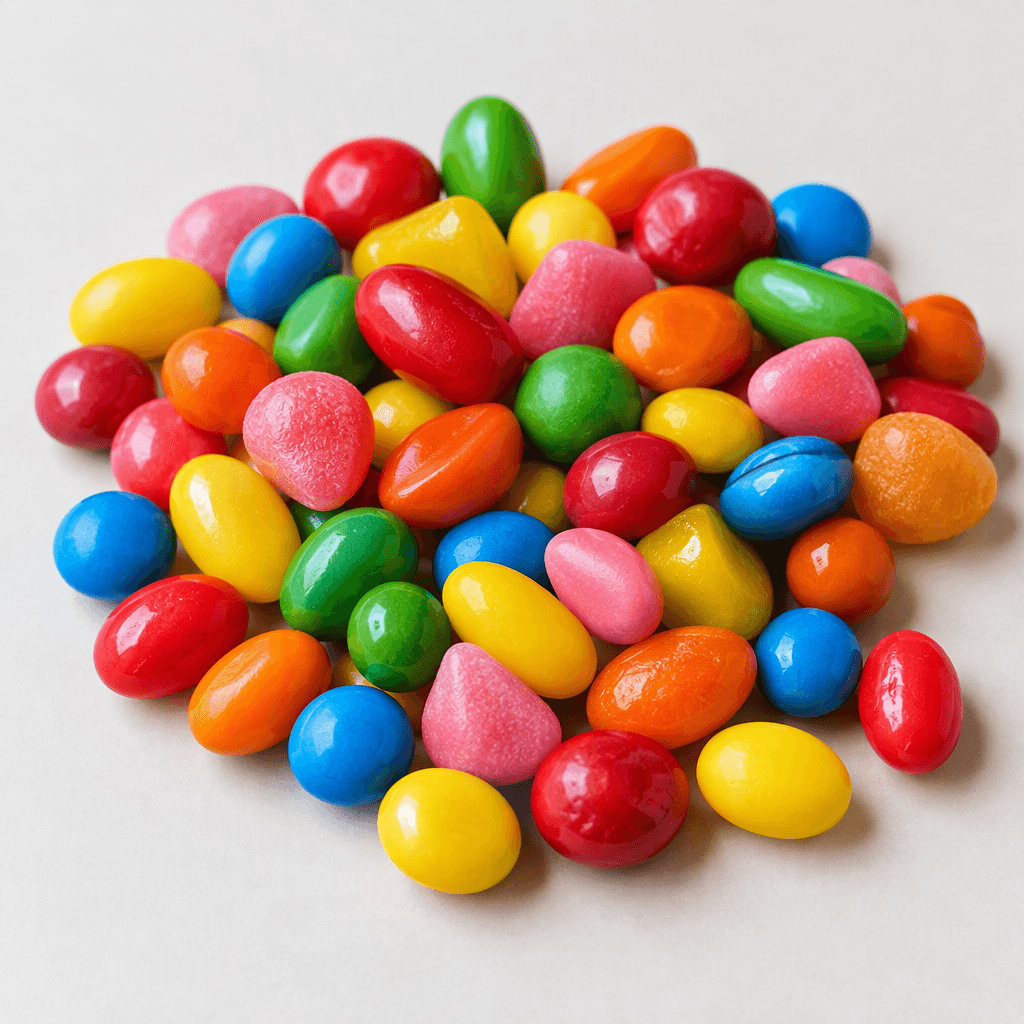
Colorful candy Calories
Colorful, sugary, popular with children
CALORIES
GI
POTASSIUM
FIBER
Quick answer
10 piece (medium) of Colorful candy (40 g) has 156 calories. That works out to 390 calories per 100 g. It contains 38.8 g of carbs, 0 g of protein, 0.1 g of fat and 0 g of fiber. Its glycemic index is 80 (high), so it raises blood sugar quickly.
What is Colorful candy?
Colorful candy is an assortment of small sweets in bright hues and varied shapes. Pieces may be hard and glossy or have a softer texture, depending on the type; mixed bags bring together different colours and forms. The name describes a broad style of confectionery rather than one particular recipe.
It is commonly offered to children, shared at parties, or enjoyed as an occasional sweet alongside tea or coffee. It tastes sugary and provides almost entirely carbohydrate, with virtually no protein or fibre; the listed value is 97 g of carbohydrates per 100 g. A small handful can be enough for a treat, or pair a few pieces with fruit or yogurt for a more balanced snack.
Colorful candy Nutrition Facts
Selected: 100 g
390
KCAL / 100G
Carbs
97g
· 35% DV
Protein
0g
· 0% DV
Fat
0.2g
· 0% DV
Fiber
0g
· 0% DV
DV is the share of the daily value covered, on a 2,000 kcal reference diet.
Calories come from: Carbs 100% · Protein 0% · Fat 0%
Colorful candy Vitamins & Minerals
Vitamins
Vitamin A
0µg · 0% DV
B1
0mg · 0% DV
B2
0mg · 0% DV
B3
0mg · 0% DV
Minerals
Calcium
2mg · 0% DV
Iron
0mg · 0% DV
Magnesium
1mg · 0% DV
Zinc
0mg · 0% DV
How Nutritious Is Colorful candy?
Nutrient density
Low
How many vitamins, minerals and how much fiber this food carries per calorie. A high score means a lot of nutrition for few calories.
Satiety score
Low
An EatBetter score computed from fiber, protein and calorie density. A high score means staying full longer on the same calories.
Both scores are calculated per 100 g and do not change with the selected portion. The satiety score is EatBetter's own calculation, not a clinical measure.
Colorful candy Glycemic Index
GLYCEMIC INDEX
GLYCEMIC LOAD
Accounts for portion size — a more realistic measure than GI alone.
How to Burn Off Colorful candy
To burn the 390 calories in 100 g:
🚶
Walking (5 km/h)
🏃
Running (8 km/h)
🚴
Cycling
🏊
Swimming
Times are calculated with the MET equation for a 70 kg adult. Actual burn varies with your weight, age and pace.
Is Colorful candy Processed?
NOVA 4
Ultra-Processed
1. Unprocessed
2. Minimally Processed
3. Processed
4. Ultra-Processed
NOVA classifies foods into 4 groups by industrial processing. NOVA 1 (unprocessed) is the healthiest.
Does Colorful candy Contain Allergens?
No known major allergens
Which Diets Is Colorful candy Good For?
Vegan
— Not suitable
Vegetarian
✓ Suitable
Gluten-Free
— Not suitable
Dairy-Free
— Not suitable
Mediterranean
— Not suitable
Paleo
— Not suitable
Whole30
— Not suitable
DASH
— Not suitable
Keto
— Not suitable
Low FODMAP
— Not suitable
Colorful candy Fat Profile
SATURATED
0.1g
MONOUNSATURATED
0.05g
POLYUNSATURATED
0.05g
Compare Colorful candy
Foods Similar to Colorful candy
Frequently Asked Questions About Colorful candy
What is colorful candy made of?
Colorful candy is usually made from sugar or glucose syrup, with flavorings and coloring added. Some varieties have a hard shell while others are chewy or coated, so ingredients differ; the package lists what is in that particular candy.
Why does colorful candy stain your tongue?
Colorful candy can leave a temporary stain because its surface coloring dissolves in saliva and transfers to the tongue. The color usually fades after rinsing, drinking water, or brushing your teeth.
Are the food dyes in colorful candy safe?
Food dyes approved for use in foods are considered safe when used within permitted limits. Colorful candy may use different dyes depending on its brand and color; people with a known sensitivity should check the ingredient list.
Does colorful candy go bad?
Colorful candy can lose quality or become unsafe if it gets wet, contaminated, or its packaging is damaged. Keep it sealed in a cool, dry place, and discard it if you notice mold, an unusual smell, or a damaged wrapper.
Can toddlers eat colorful candy?
Hard colorful candy is a choking hazard for toddlers and young children. Wait until a child can safely chew and swallow it, and have older children sit still while eating rather than running or playing with candy in their mouths.
Does colorful candy cause cavities?
Yes, eating colorful candy often can raise the risk of cavities. Mouth bacteria use sugar to produce acids that damage tooth enamel, especially when candy is sucked or chewed over a long period. Drinking water and brushing regularly help protect teeth.
Can colorful candy raise blood sugar?
Yes, the sugar in colorful candy can raise blood glucose quickly. People with diabetes should fit it into their individual food and treatment plan; a doctor or dietitian can advise on what is appropriate for them.
How do you keep colorful candy from sticking together?
Keep colorful candy in an airtight container in a cool, dry place to prevent moisture from making it sticky. Avoid warm storage areas, which can soften the candy and make pieces clump together.
Can colorful candy be melted for baking?
Some colorful candy can be melted, but the result depends on whether it is hard candy, chewy candy, or coated candy. Melt it gently and expect the colors to blend; for neat decorations, add whole pieces after baking.
Can colorful candy decorate cookies and cakes?
Yes, colorful candy works as a quick decoration for cookies, cakes, and cupcakes. Add it shortly before serving when using moist frosting, since moisture can dissolve the surface colors and cause them to run.
Have another question about Colorful candy?
Ask the AI nutrition coach — calories, portions, alternatives and more, answered in seconds in the app.

Scan calories with your camera
Instant AI nutrition analysis

Nutrition data compiled from USDA FoodData Central and scientific sources.