

Ready & Packaged Foods
All →Vegetables & Legumes
All →Desserts & Confectionery
All →Meat & Protein
All →Grains & Bakery
All →Beverages
All →Milk & Dairy
All →

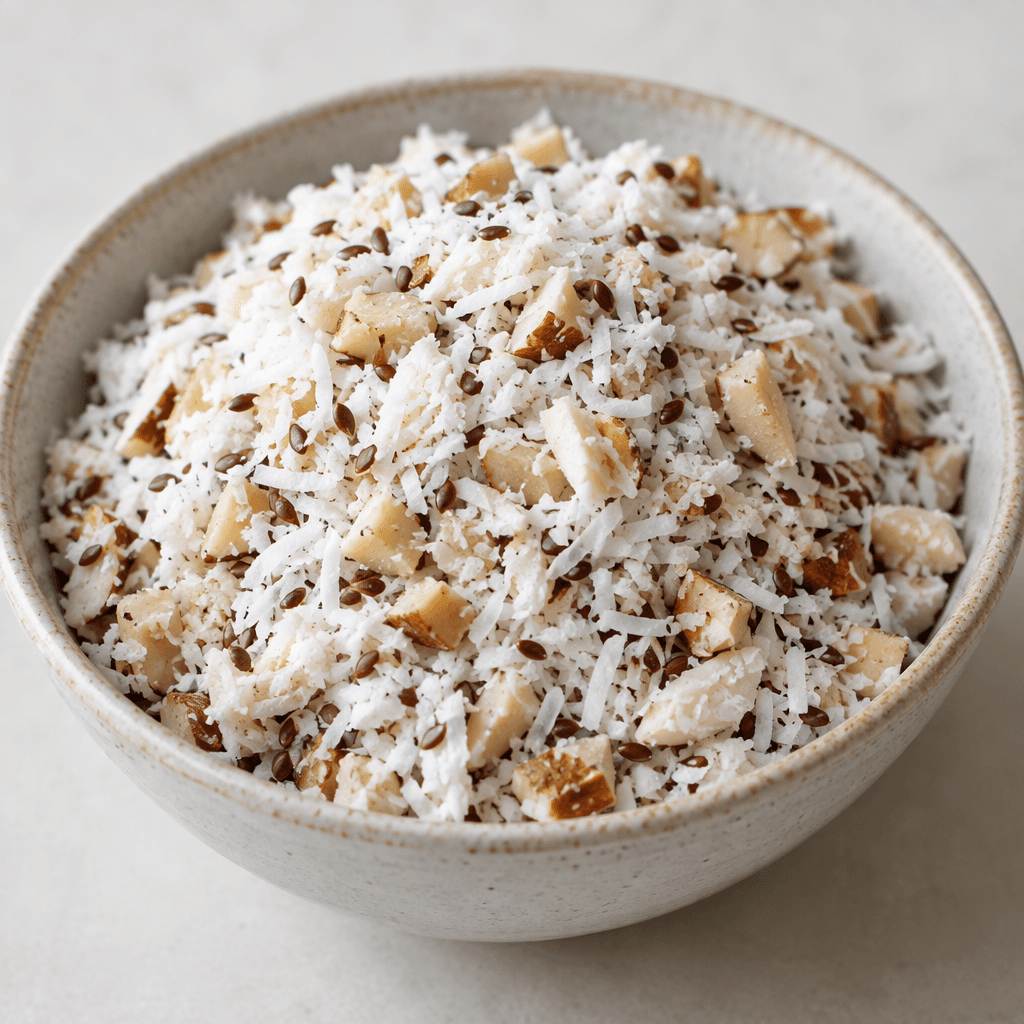
Coconut mix Calories
Coconut mix; rich in fiber, healthy fats, minerals
In season: Summer · Autumn
CALORIES
GI
POTASSIUM
FIBER
Quick answer
1 piece (medium) of Coconut mix (40 g) has 164 calories. That works out to 410 calories per 100 g. It contains 6.8 g of carbs, 1.7 g of protein, 14.4 g of fat and 4.2 g of fiber. Its 0.6 mg of Manganese covers 26% of the Daily Value. Its glycemic index is 45 (low), so it raises blood sugar slowly.
What is Coconut mix?
Coconut mix brings finely shredded coconut together with pieces of nuts and small seeds; the exact combination can vary. It can be eaten by the handful or used as a topping, rather than needing preparation as a cooked dish.
The coconut lends a gently sweet, fragrant flavour, while the nut pieces add crunch and the seeds a more savoury note. It works as a snack with tea or coffee, and can also be scattered over yoghurt, porridge or fruit. The mix is rich in fat and fibre, with 10.5 g of fibre per 100 g. Because it is energy-dense, a small handful is often plenty; pairing it with fresh fruit or plain yoghurt makes an easy breakfast or snack.
Coconut mix Nutrition Facts
Selected: 100 g
410
KCAL / 100G
Carbs
17g
· 6% DV
Protein
4.2g
· 8% DV
Fat
36g
· 46% DV
Fiber
10.5g
· 38% DV
DV is the share of the daily value covered, on a 2,000 kcal reference diet.
Calories come from: Carbs 17% · Protein 4% · Fat 79%
Coconut mix Vitamins & Minerals
Vitamins
Folate
26µg · 7% DV
B5
0.3mg · 6% DV
B1
0.06mg · 5% DV
Biotin
1.5µg · 5% DV
Minerals
Manganese
2mg · 87% DV
Selenium
7µg · 13% DV
Phosphorus
90mg · 13% DV
Iron
2mg · 11% DV
How Nutritious Is Coconut mix?
Nutrient density
High
How many vitamins, minerals and how much fiber this food carries per calorie. A high score means a lot of nutrition for few calories.
Satiety score
Medium
An EatBetter score computed from fiber, protein and calorie density. A high score means staying full longer on the same calories.
Both scores are calculated per 100 g and do not change with the selected portion. The satiety score is EatBetter's own calculation, not a clinical measure.
Coconut mix Glycemic Index
GLYCEMIC INDEX
GLYCEMIC LOAD
Accounts for portion size — a more realistic measure than GI alone.
How to Burn Off Coconut mix
To burn the 410 calories in 100 g:
🚶
Walking (5 km/h)
🏃
Running (8 km/h)
🚴
Cycling
🏊
Swimming
Times are calculated with the MET equation for a 70 kg adult. Actual burn varies with your weight, age and pace.
Is Coconut mix Processed?
NOVA 2
Minimally Processed
1. Unprocessed
2. Minimally Processed
3. Processed
4. Ultra-Processed
NOVA classifies foods into 4 groups by industrial processing. NOVA 1 (unprocessed) is the healthiest.
Does Coconut mix Contain Allergens?
No known major allergens
Which Diets Is Coconut mix Good For?
Vegan
✓ Suitable
Vegetarian
✓ Suitable
Gluten-Free
✓ Suitable
Dairy-Free
— Not suitable
Mediterranean
✓ Suitable
Paleo
✓ Suitable
Whole30
— Not suitable
DASH
— Not suitable
Keto
✓ Suitable
Low FODMAP
— Not suitable
Coconut mix Fat Profile
SATURATED
30g
MONOUNSATURATED
2.5g
POLYUNSATURATED
0.3g
Omega 6:3 ratio 8.3:1
Above the ideal 4:1 (8.3:1).
Compare Coconut mix
Foods Similar to Coconut mix
Frequently Asked Questions About Coconut mix
What is in coconut mix?
Coconut mix is a blend of shredded or flaked coconut with pieces such as nuts and seeds. There is no single standard recipe, so check the ingredient list if you need to know exactly which components a particular mix contains.
How do you use coconut mix?
Add coconut mix to yogurt, oatmeal, smoothie bowls, or fruit for extra crunch and coconut flavor. It also works as a topping for puddings and baked desserts; add it just before serving when you want it to stay crisp.
Can you toast coconut mix?
Yes, you can toast coconut mix in a dry pan or on a baking sheet. Stir or check it frequently because shredded coconut and small seeds brown quickly, and take it off the heat as soon as it smells toasted.
Is coconut mix the same as trail mix?
No, coconut mix is not necessarily trail mix. Coconut is its defining ingredient, while trail mix usually centers on nuts and dried fruit; a coconut mix may contain seeds or nuts but does not have one fixed recipe.
Can coconut mix be used in baking?
Yes, coconut mix can be stirred into cookies, granola, or cake batter, or sprinkled over baked goods. Its nut and seed pieces make the texture chunkier than plain shredded coconut, so use it where that added crunch suits the recipe.
How should you store coconut mix?
Keep coconut mix in a tightly sealed container in a cool, dry place, away from sunlight and heat. Its coconut and nut oils can turn stale over time; discard it if it develops a rancid smell, dampness, or mold.
Can coconut mix replace coconut flour?
No, coconut mix is not a direct substitute for coconut flour. The mix contains larger coconut, nut, or seed pieces, while coconut flour is finely ground and absorbs liquid differently in recipes.
Does coconut mix need to be soaked before eating?
No, coconut mix can be eaten as it is and does not need soaking. It softens when added to milk, yogurt, or porridge; sprinkle it on immediately before eating if you prefer a crunchy topping.
Can you make coconut mix at home?
Yes, combine shredded coconut with chopped nuts and seeds to make coconut mix at home. Choose pieces of similar size for an even blend, and store the finished mixture in an airtight container to keep it dry.
Why does coconut mix go rancid?
Coconut mix can go rancid because its coconut and nut ingredients contain oils that deteriorate with exposure to heat, air, and light. A bitter taste or stale, paint-like smell is a reason to discard the mixture.
Have another question about Coconut mix?
Ask the AI nutrition coach — calories, portions, alternatives and more, answered in seconds in the app.

Scan calories with your camera
Instant AI nutrition analysis

Nutrition data compiled from USDA FoodData Central and scientific sources.