

Ready & Packaged Foods
All →Vegetables & Legumes
All →Desserts & Confectionery
All →Meat & Protein
All →Grains & Bakery
All →Beverages
All →Milk & Dairy
All →

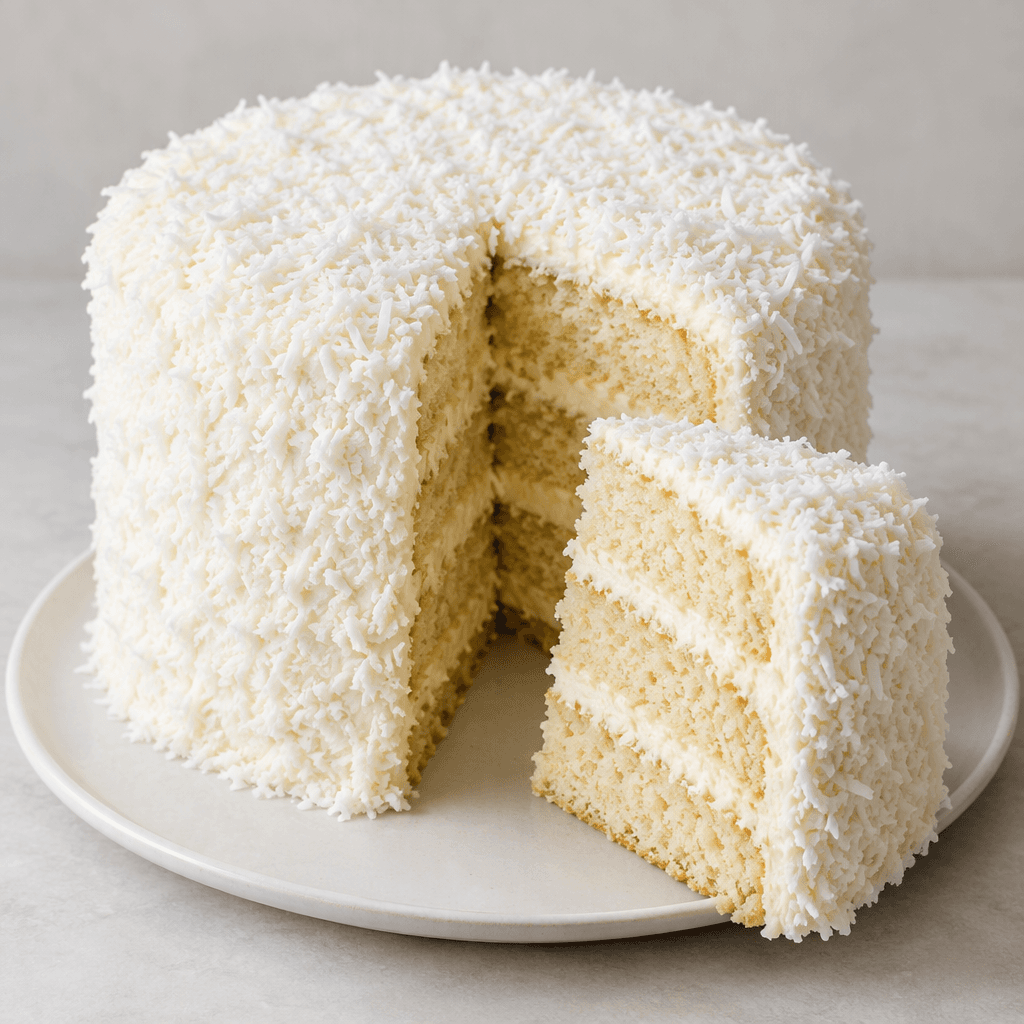
Coconut cake Calories
Moist cake with coconut flavor
In season: Spring · Summer · Autumn · Winter
CALORIES
GI
POTASSIUM
FIBER
Quick answer
1 slice (medium) of Coconut cake (70 g) has 238 calories. That works out to 340 calories per 100 g. It contains 31.5 g of carbs, 2.9 g of protein, 10.5 g of fat and 1.6 g of fiber. Its 0.1 mg of Copper covers 10% of the Daily Value. Its glycemic index is 65 (high), so it raises blood sugar quickly.
What is Coconut cake?
Coconut cake is a soft cake made with coconut folded into the batter, often finished with frosting and a coating of fine coconut flakes. It has no single point of origin: versions appear in many baking traditions, with recipes ranging from simple teatime loaves to tall, layered celebration cakes like this one.
Its moist crumb and sweet, fragrant coconut flavour make it a natural choice for birthdays, gatherings, or an afternoon slice with tea or coffee. In the United States, frosted layer cakes are a familiar celebration style; elsewhere, simpler coconut cakes are also common at home and in cafés. It is an energy-dense sweet, with 340 calories per 100 g. A modest slice with fresh fruit makes for a lighter serving.
Coconut cake Nutrition Facts
Selected: 100 g
340
KCAL / 100G
Carbs
45g
· 16% DV
Protein
4.2g
· 8% DV
Fat
15g
· 19% DV
Fiber
2.3g
· 8% DV
DV is the share of the daily value covered, on a 2,000 kcal reference diet.
Calories come from: Carbs 54% · Protein 5% · Fat 41%
Coconut cake Vitamins & Minerals
Vitamins
B2
0.09mg · 7% DV
Biotin
2.1µg · 7% DV
B1
0.07mg · 6% DV
B12
0.15µg · 6% DV
Minerals
Selenium
7µg · 13% DV
Phosphorus
90mg · 13% DV
Sodium
210mg · 9% DV
Calcium
65mg · 7% DV
How Nutritious Is Coconut cake?
Nutrient density
Low
How many vitamins, minerals and how much fiber this food carries per calorie. A high score means a lot of nutrition for few calories.
Satiety score
Low
An EatBetter score computed from fiber, protein and calorie density. A high score means staying full longer on the same calories.
Both scores are calculated per 100 g and do not change with the selected portion. The satiety score is EatBetter's own calculation, not a clinical measure.
Coconut cake Glycemic Index
GLYCEMIC INDEX
GLYCEMIC LOAD
Accounts for portion size — a more realistic measure than GI alone.
How to Burn Off Coconut cake
To burn the 340 calories in 100 g:
🚶
Walking (5 km/h)
🏃
Running (8 km/h)
🚴
Cycling
🏊
Swimming
Times are calculated with the MET equation for a 70 kg adult. Actual burn varies with your weight, age and pace.
Is Coconut cake Processed?
NOVA 3
Processed
1. Unprocessed
2. Minimally Processed
3. Processed
4. Ultra-Processed
NOVA classifies foods into 4 groups by industrial processing. NOVA 1 (unprocessed) is the healthiest.
Does Coconut cake Contain Allergens?
Contains these allergens:
Which Diets Is Coconut cake Good For?
Vegan
— Not suitable
Vegetarian
— Not suitable
Gluten-Free
— Not suitable
Dairy-Free
— Not suitable
Mediterranean
— Not suitable
Paleo
— Not suitable
Whole30
— Not suitable
DASH
— Not suitable
Keto
— Not suitable
Low FODMAP
— Not suitable
Coconut cake Fat Profile
SATURATED
9.2g
MONOUNSATURATED
3.1g
POLYUNSATURATED
0.8g
Omega 6:3 ratio 7.3:1
Above the ideal 4:1 (7.3:1).
Compare Coconut cake
Foods Similar to Coconut cake
Frequently Asked Questions About Coconut cake
How do you make coconut cake?
Coconut cake is made by mixing flour, sugar, eggs, butter or oil, leavening, and shredded coconut into a batter, then baking until set. Once the layers are completely cool, spread on frosting and coat the outside with more coconut.
How do you make coconut cake moist?
To keep coconut cake moist, measure the flour accurately and take the cake out as soon as a tester comes out clean. Coconut absorbs moisture, so avoid adding extra shredded coconut to the batter unless the recipe accounts for it.
What frosting goes best with coconut cake?
Cream cheese frosting and buttercream both pair well with coconut cake. Cream cheese frosting adds a slight tang that balances the sweet coconut, while buttercream gives a richer, sweeter finish. Chill cream cheese-frosted cake after decorating.
Can you use fresh coconut in coconut cake?
Yes, fresh coconut can be used in coconut cake, but it contains more moisture than dried shredded coconut and may change the crumb. Finely shredded dried coconut is easier to mix evenly into the batter and is the usual choice for decorating.
Why did my coconut cake turn out dense?
Coconut cake can turn dense if the batter is overmixed after adding flour, which develops gluten and tightens the crumb. Too much flour or expired leavening can also prevent a light rise; mix only until the ingredients are combined.
How do you keep coconut flakes on the sides of a coconut cake?
Press the coconut flakes onto the sides of a freshly frosted coconut cake while the frosting is still soft. Set the cake over a tray to catch loose flakes, then gently pat them onto any bare spots before the frosting sets.
How should coconut cake be stored?
Store coconut cake in an airtight container. If its frosting contains cream cheese or whipped cream, refrigerate it; a cake with shelf-stable buttercream can generally stay covered in a cool room. Let chilled slices sit briefly before serving for a softer texture.
Can you freeze coconut cake?
Yes, coconut cake freezes well, especially as unfrosted layers. Wrap each cooled layer tightly and freeze; thaw it while still wrapped to limit drying, then add frosting and coconut. Frosted slices can also be frozen, though the frosting may soften after thawing.
What filling can you put in coconut cake?
Coconut cake works well with lemon curd, raspberry preserves, or a thin layer of coconut pastry cream between its layers. Use a modest amount so the filling does not squeeze out when the cake is stacked or make the layers slide.
Where did coconut cake originate?
Coconut cake does not have one universally agreed place of origin; versions developed in several cuisines where coconut became a popular baking ingredient. The tall, frosted layer cake coated in shredded coconut is especially associated with American home baking and celebrations.
Have another question about Coconut cake?
Ask the AI nutrition coach — calories, portions, alternatives and more, answered in seconds in the app.

Scan calories with your camera
Instant AI nutrition analysis

Nutrition data compiled from USDA FoodData Central and scientific sources.