

Ready & Packaged Foods
All →Vegetables & Legumes
All →Desserts & Confectionery
All →Meat & Protein
All →Grains & Bakery
All →Beverages
All →Milk & Dairy
All →

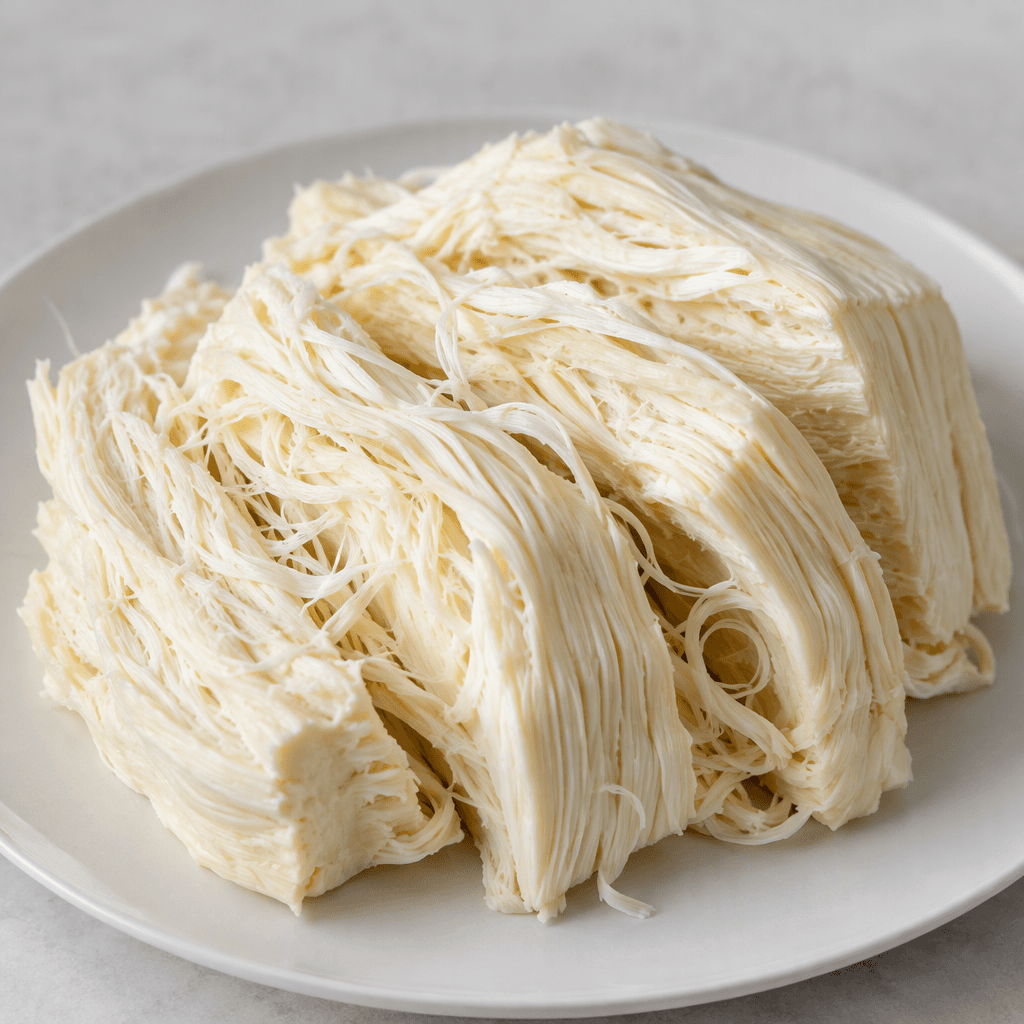
Circassian Cheese Calories
Traditional, mildly salty, semi-hard cheese
In season: Spring · Summer · Autumn · Winter
CALORIES
GI
POTASSIUM
FIBER
Quick answer
1 slice (medium) of Circassian Cheese (30 g) has 96 calories. That works out to 320 calories per 100 g. It contains 0.8 g of carbs, 6.6 g of protein, 7.5 g of fat and 0 g of fiber. Its 195 mg of Calcium covers 20% of the Daily Value. Its glycemic index is 30 (low), so it raises blood sugar slowly.
What is Circassian Cheese?
Circassian cheese is a traditional cheese associated with Circassian communities of the North Caucasus and their foodways in Turkey. It is commonly made from cow’s milk: the curds are drained and salted, giving the cheese a compact, layered texture that can separate into fine strands. Its flavour is mild, milky and gently salty.
In Circassian cooking and in Turkey, it can be served at breakfast with bread, added to salads or cooked into pastries and other dishes. It holds its shape when sliced and softens when heated. With 22 g of protein per 100 g, it is a filling choice; pair a modest portion with fresh vegetables for a lighter plate.
Circassian Cheese Nutrition Facts
Selected: 100 g
320
KCAL / 100G
Carbs
2.5g
· 1% DV
Protein
22g
· 44% DV
Fat
25g
· 32% DV
Fiber
0g
· 0% DV
DV is the share of the daily value covered, on a 2,000 kcal reference diet.
Calories come from: Carbs 3% · Protein 27% · Fat 70%
Circassian Cheese Vitamins & Minerals
Vitamins
B12
1.2µg · 50% DV
B2
0.35mg · 27% DV
Vitamin A
220µg · 24% DV
B5
0.5mg · 10% DV
Minerals
Calcium
650mg · 65% DV
Phosphorus
420mg · 60% DV
Sodium
650mg · 28% DV
Zinc
3mg · 27% DV
How Nutritious Is Circassian Cheese?
Nutrient density
High
How many vitamins, minerals and how much fiber this food carries per calorie. A high score means a lot of nutrition for few calories.
Satiety score
Medium
An EatBetter score computed from fiber, protein and calorie density. A high score means staying full longer on the same calories.
Both scores are calculated per 100 g and do not change with the selected portion. The satiety score is EatBetter's own calculation, not a clinical measure.
Circassian Cheese Glycemic Index
GLYCEMIC INDEX
GLYCEMIC LOAD
Accounts for portion size — a more realistic measure than GI alone.
How to Burn Off Circassian Cheese
To burn the 320 calories in 100 g:
🚶
Walking (5 km/h)
🏃
Running (8 km/h)
🚴
Cycling
🏊
Swimming
Times are calculated with the MET equation for a 70 kg adult. Actual burn varies with your weight, age and pace.
Is Circassian Cheese Processed?
NOVA 2
Minimally Processed
1. Unprocessed
2. Minimally Processed
3. Processed
4. Ultra-Processed
NOVA classifies foods into 4 groups by industrial processing. NOVA 1 (unprocessed) is the healthiest.
Does Circassian Cheese Contain Allergens?
Contains these allergens:
Which Diets Is Circassian Cheese Good For?
Vegan
— Not suitable
Vegetarian
✓ Suitable
Gluten-Free
✓ Suitable
Dairy-Free
— Not suitable
Mediterranean
✓ Suitable
Paleo
— Not suitable
Whole30
— Not suitable
DASH
— Not suitable
Keto
— Not suitable
Low FODMAP
— Not suitable
Circassian Cheese Fat Profile
SATURATED
16g
MONOUNSATURATED
7g
POLYUNSATURATED
1.2g
Omega 6:3 ratio 3.8:1
Below the ideal 4:1 — a good omega balance.
Compare Circassian Cheese
Foods Similar to Circassian Cheese
Frequently Asked Questions About Circassian Cheese
What does Circassian cheese taste like?
Circassian cheese tastes mild, milky, and lightly salty, with a firm, layered texture that pulls into fine strands. Smoked versions have a stronger, savory aroma than the unsmoked cheese.
How is Circassian cheese traditionally made?
Circassian cheese is traditionally made by heating milk and separating the curds with an acidic ingredient or whey. The curds are drained, worked or folded into layers, pressed, and salted; methods vary between makers.
Can you fry Circassian cheese?
Yes, you can pan-fry Circassian cheese in thick slices with a little oil. It softens and browns, though it may not hold its shape as firmly as halloumi, so handle it gently.
Is Circassian cheese the same as Adyghe cheese?
They are closely related names for cheeses associated with the Circassian people and the North Caucasus, but they are not always identical products. Recipes and textures differ by region, and Circassian cheese is often notably layered and fibrous.
Why is Circassian cheese stringy?
Circassian cheese has a stringy, layered texture because the curds are worked and folded during production. The resulting strands can be pulled apart by hand, unlike the smooth, uniform texture of many fresh cheeses.
Is Circassian cheese smoked?
Not always. Circassian cheese is sold both unsmoked and smoked; the smoked variety has a deeper, more pronounced flavor and often a darker exterior. Check the product description if you want a particular style.
How do you serve Circassian cheese?
Serve Circassian cheese sliced or pulled into strands, with bread, vegetables, olives, or fresh herbs. It also works in salads, sandwiches, and savory pastries; its mild flavor pairs especially well with bright, fresh ingredients.
How should you store Circassian cheese after opening?
Keep opened Circassian cheese refrigerated in an airtight container or its original packaging, and use clean utensils when serving it. Eat it within a few days, and discard it if it develops an off smell, discoloration, or a slimy surface.
Can you freeze Circassian cheese?
Yes, Circassian cheese can be frozen, but thawing may make its texture drier or more crumbly. Frozen cheese is better used in cooked dishes, such as pastries, than served in slices.
Can Circassian cheese replace halloumi in recipes?
Sometimes, but Circassian cheese is usually softer and more layered, so it may not keep its shape as well when grilled. It works best as a substitute in fillings or lightly pan-fried dishes rather than recipes that depend on firm grillable slices.
Have another question about Circassian Cheese?
Ask the AI nutrition coach — calories, portions, alternatives and more, answered in seconds in the app.

Scan calories with your camera
Instant AI nutrition analysis

Nutrition data compiled from USDA FoodData Central and scientific sources.