

Ready & Packaged Foods
All →Vegetables & Legumes
All →Desserts & Confectionery
All →Meat & Protein
All →Grains & Bakery
All →Beverages
All →Milk & Dairy
All →

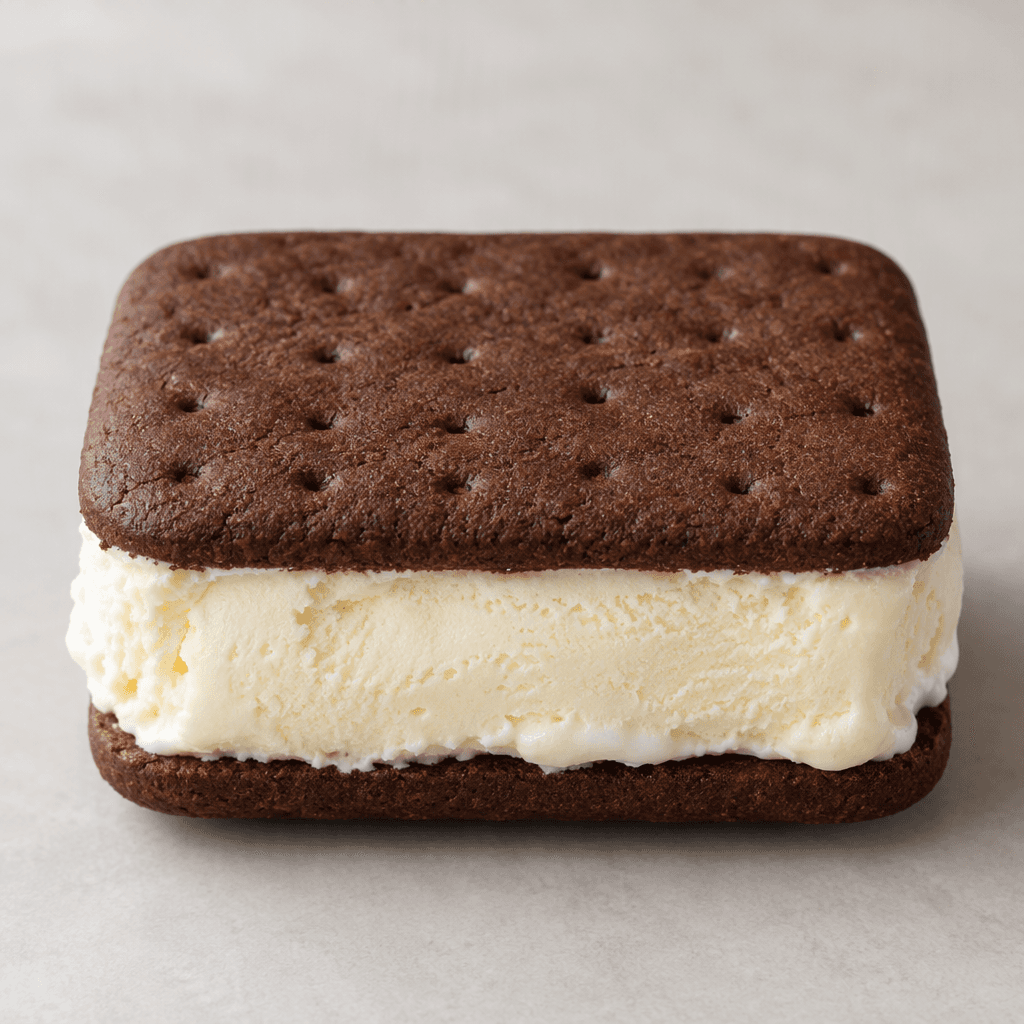
Chocolate ice cream sandwich Calories
Sweet, frozen, chocolate processed dessert
In season: Spring · Summer · Autumn · Winter
CALORIES
GI
POTASSIUM
FIBER
Quick answer
1 piece (medium) of Chocolate ice cream sandwich (85 g) has 247 calories. That works out to 290 calories per 100 g. It contains 34.9 g of carbs, 3.9 g of protein, 10.2 g of fat and 1.4 g of fiber. Its 112.2 mg of Phosphorus covers 16% of the Daily Value. Its glycemic index is 58 (medium), so it raises blood sugar at a moderate pace.
What is Chocolate ice cream sandwich?
A chocolate ice cream sandwich is a frozen treat made by placing ice cream between two chocolate biscuits or cookies. It is sold in many countries as a packaged snack and is also easy to find at ice-cream shops; it is not tied to one particular regional tradition. The contrast between crisp chocolate layers and soft, creamy filling is part of its appeal.
People commonly eat one as a warm-weather snack or an easy dessert, letting it soften briefly after taking it from the freezer. It is sweet and energy-dense, with most of its energy coming from carbohydrates and fat; 100 g provides 290 calories. Pair it with unsweetened coffee or fresh fruit, and skip extra sauces if you want to keep the treat simple.
Chocolate ice cream sandwich Nutrition Facts
Selected: 100 g
290
KCAL / 100G
Carbs
41g
· 15% DV
Protein
4.6g
· 9% DV
Fat
12g
· 15% DV
Fiber
1.6g
· 6% DV
DV is the share of the daily value covered, on a 2,000 kcal reference diet.
Calories come from: Carbs 56% · Protein 6% · Fat 38%
Chocolate ice cream sandwich Vitamins & Minerals
Vitamins
B12
0.38µg · 16% DV
B2
0.18mg · 14% DV
Vitamin A
78µg · 9% DV
B5
0.45mg · 9% DV
Minerals
Phosphorus
132mg · 19% DV
Calcium
118mg · 12% DV
Zinc
1mg · 9% DV
Selenium
4.2µg · 8% DV
How Nutritious Is Chocolate ice cream sandwich?
Nutrient density
Low
How many vitamins, minerals and how much fiber this food carries per calorie. A high score means a lot of nutrition for few calories.
Satiety score
Low
An EatBetter score computed from fiber, protein and calorie density. A high score means staying full longer on the same calories.
Both scores are calculated per 100 g and do not change with the selected portion. The satiety score is EatBetter's own calculation, not a clinical measure.
Chocolate ice cream sandwich Glycemic Index
GLYCEMIC INDEX
GLYCEMIC LOAD
Accounts for portion size — a more realistic measure than GI alone.
How to Burn Off Chocolate ice cream sandwich
To burn the 290 calories in 100 g:
🚶
Walking (5 km/h)
🏃
Running (8 km/h)
🚴
Cycling
🏊
Swimming
Times are calculated with the MET equation for a 70 kg adult. Actual burn varies with your weight, age and pace.
Is Chocolate ice cream sandwich Processed?
NOVA 4
Ultra-Processed
1. Unprocessed
2. Minimally Processed
3. Processed
4. Ultra-Processed
NOVA classifies foods into 4 groups by industrial processing. NOVA 1 (unprocessed) is the healthiest.
Does Chocolate ice cream sandwich Contain Allergens?
Contains these allergens:
Which Diets Is Chocolate ice cream sandwich Good For?
Vegan
— Not suitable
Vegetarian
✓ Suitable
Gluten-Free
— Not suitable
Dairy-Free
— Not suitable
Mediterranean
— Not suitable
Paleo
— Not suitable
Whole30
— Not suitable
DASH
— Not suitable
Keto
— Not suitable
Low FODMAP
— Not suitable
Chocolate ice cream sandwich Fat Profile
SATURATED
6.1g
MONOUNSATURATED
3.1g
POLYUNSATURATED
0.7g
Omega 6:3 ratio 20.7:1
Above the ideal 4:1 (20.7:1).
Compare Chocolate ice cream sandwich
Foods Similar to Chocolate ice cream sandwich
Frequently Asked Questions About Chocolate ice cream sandwich
What is a chocolate ice cream sandwich made of?
A chocolate ice cream sandwich is made of ice cream pressed between two chocolate biscuits or wafers. The exact ice cream and biscuit ingredients vary by product, while homemade versions can use plain ice cream and cocoa biscuits.
How do you make a chocolate ice cream sandwich at home?
To make a chocolate ice cream sandwich at home, place softened ice cream between two chocolate biscuits, gently press them together, and freeze until firm. Work quickly so the ice cream does not melt, and wrap each sandwich to help prevent freezer odors.
Why do the cookies in a chocolate ice cream sandwich stay soft?
The cookies in a chocolate ice cream sandwich are usually soft because they absorb moisture from the ice cream and are designed to remain biteable when frozen. Leaving the sandwich out longer makes them softer as the ice cream begins to melt.
How should you store a chocolate ice cream sandwich?
Store a chocolate ice cream sandwich tightly wrapped in the freezer. The wrapping helps limit freezer odors and moisture, which can affect the biscuit texture. For homemade sandwiches, wrapping them individually makes it easier to take out only what you plan to serve.
Can you refreeze a chocolate ice cream sandwich?
You can refreeze a chocolate ice cream sandwich if it has stayed cold and is still frozen, though its texture may suffer. Do not refreeze one that has fully melted and sat at room temperature; the biscuits can become soggy and the melted ice cream may be unsafe.
How long can a chocolate ice cream sandwich sit out?
A chocolate ice cream sandwich should be eaten soon after it is taken out of the freezer. As it warms, the ice cream melts and the biscuits soften; return it to the freezer promptly if it is still cold and has not been sitting out.
Where did the chocolate ice cream sandwich come from?
The chocolate ice cream sandwich is a variation of the ice cream sandwich, a frozen treat strongly associated with the United States. Versions differ around the world, but the basic idea—ice cream held between two handheld layers—makes it easy to eat without a bowl.
What is the best way to eat a chocolate ice cream sandwich without it falling apart?
The easiest way to eat a chocolate ice cream sandwich without it falling apart is to let it soften just slightly, then hold it by the biscuits and take small bites. If it starts to melt, set it on a plate rather than squeezing the sides.
Can you make a chocolate ice cream sandwich with different ice cream flavors?
Yes, a chocolate ice cream sandwich works with many ice cream flavors, including vanilla, coffee, or mint. Choose a firm flavor that pairs well with cocoa biscuits, and freeze the assembled sandwiches until solid so the filling does not slide out.
Does a chocolate ice cream sandwich make you gain weight?
A chocolate ice cream sandwich can contribute to weight gain if it is eaten often or in large portions, because it combines sweet ice cream with biscuits. Having one occasionally or sharing it is a simple way to keep the portion smaller.
Have another question about Chocolate ice cream sandwich?
Ask the AI nutrition coach — calories, portions, alternatives and more, answered in seconds in the app.

Scan calories with your camera
Instant AI nutrition analysis

Nutrition data compiled from USDA FoodData Central and scientific sources.