

Ready & Packaged Foods
All →Vegetables & Legumes
All →Desserts & Confectionery
All →Meat & Protein
All →Grains & Bakery
All →Beverages
All →Milk & Dairy
All →

Churchkhela Calories
Traditional Georgian sweet made with walnuts and grape must
In season: Autumn · Winter
CALORIES
GI
POTASSIUM
FIBER
Quick answer
1 piece (medium) of Churchkhela (50 g) has 170 calories. That works out to 340 calories per 100 g. It contains 34 g of carbs, 3.3 g of protein, 3.8 g of fat and 1.4 g of fiber. Its 0.2 mg of Copper covers 17% of the Daily Value. Its glycemic index is 65 (high), so it raises blood sugar quickly.
What is Churchkhela?
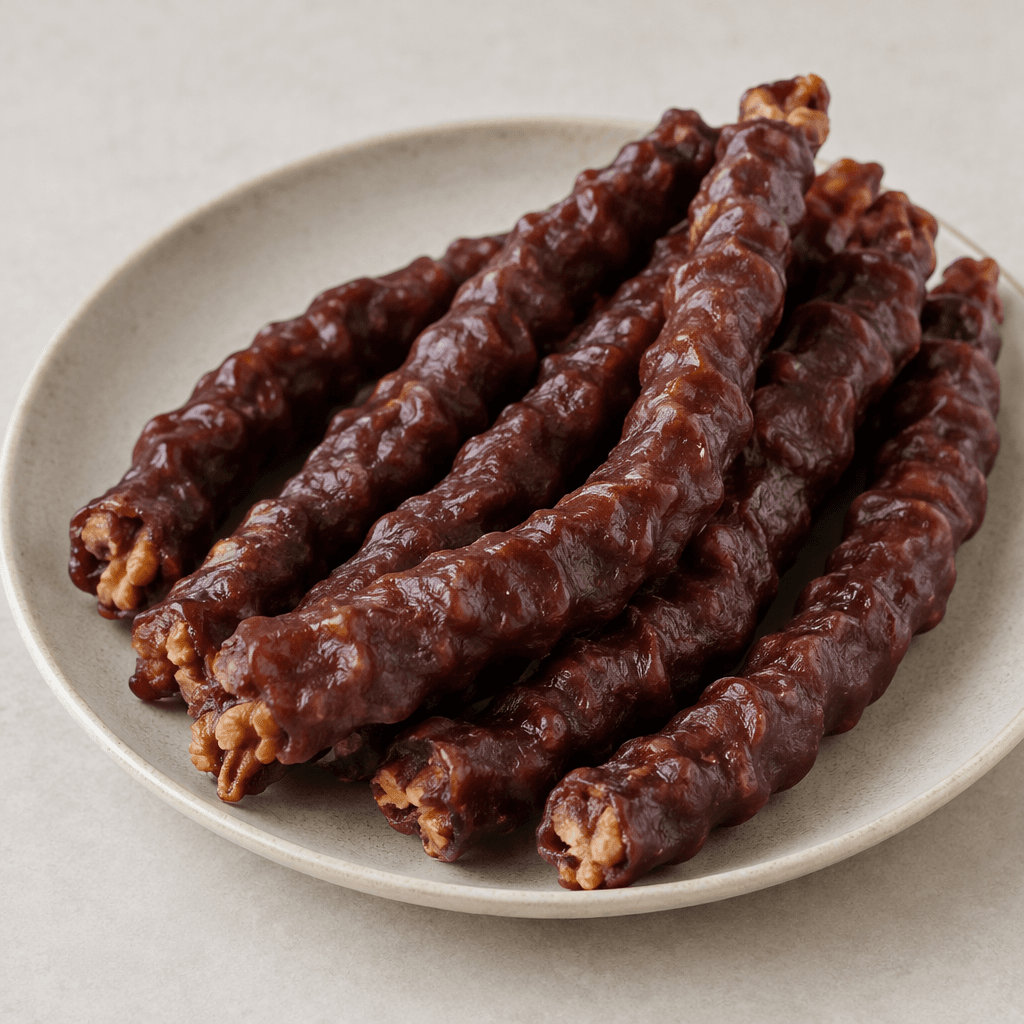
Churchkhela is a traditional Georgian sweet made by threading walnuts onto a string, coating them in thickened grape must and letting the strands dry. The result is a long, curved sweet with a chewy, wrinkled grape coating and firm pieces of walnut inside.
Its fruity sweetness is balanced by the walnuts’ rich, slightly bitter flavour. In Georgia, it is enjoyed as a snack and is often associated with harvest time; elsewhere, it makes a distinctive treat to serve with tea or coffee, or to pack for a journey. The grape coating contributes most of its carbohydrates, while walnuts add fat and some protein, making churchkhela energy-dense. Slice a strand into small pieces and pair it with fresh fruit if you’d like a lighter snack.
Churchkhela Nutrition Facts
Selected: 100 g
340
KCAL / 100G
Carbs
68g
· 25% DV
Protein
6.5g
· 13% DV
Fat
7.5g
· 10% DV
Fiber
2.8g
· 10% DV
DV is the share of the daily value covered, on a 2,000 kcal reference diet.
Calories come from: Carbs 74% · Protein 7% · Fat 19%
Churchkhela Vitamins & Minerals
Vitamins
B1
0.09mg · 8% DV
Biotin
2.5µg · 8% DV
B6
0.12mg · 7% DV
B5
0.3mg · 6% DV
Minerals
Manganese
1mg · 43% DV
Phosphorus
85mg · 12% DV
Zinc
1mg · 9% DV
Magnesium
32mg · 8% DV
How Nutritious Is Churchkhela?
Nutrient density
Medium
How many vitamins, minerals and how much fiber this food carries per calorie. A high score means a lot of nutrition for few calories.
Satiety score
Low
An EatBetter score computed from fiber, protein and calorie density. A high score means staying full longer on the same calories.
Both scores are calculated per 100 g and do not change with the selected portion. The satiety score is EatBetter's own calculation, not a clinical measure.
Churchkhela Glycemic Index
GLYCEMIC INDEX
GLYCEMIC LOAD
Accounts for portion size — a more realistic measure than GI alone.
How to Burn Off Churchkhela
To burn the 340 calories in 100 g:
🚶
Walking (5 km/h)
🏃
Running (8 km/h)
🚴
Cycling
🏊
Swimming
Times are calculated with the MET equation for a 70 kg adult. Actual burn varies with your weight, age and pace.
Is Churchkhela Processed?
NOVA 3
Processed
1. Unprocessed
2. Minimally Processed
3. Processed
4. Ultra-Processed
NOVA classifies foods into 4 groups by industrial processing. NOVA 1 (unprocessed) is the healthiest.
Does Churchkhela Contain Allergens?
Contains these allergens:
Which Diets Is Churchkhela Good For?
Vegan
— Not suitable
Vegetarian
✓ Suitable
Gluten-Free
— Not suitable
Dairy-Free
— Not suitable
Mediterranean
✓ Suitable
Paleo
— Not suitable
Whole30
— Not suitable
DASH
— Not suitable
Keto
— Not suitable
Low FODMAP
— Not suitable
Churchkhela Fat Profile
SATURATED
0.7g
MONOUNSATURATED
1.5g
POLYUNSATURATED
4.2g
Omega 6:3 ratio 7.4:1
Above the ideal 4:1 (7.4:1).
Compare Churchkhela
Foods Similar to Churchkhela
Frequently Asked Questions About Churchkhela
What is Churchkhela?
Churchkhela is a traditional Georgian sweet made by threading walnuts onto a string, coating them in thickened grape must, and drying the strand. Its long shape and chewy outer layer have earned it the nickname “Georgian walnut sausage.”
Where does Churchkhela come from?
Churchkhela comes from Georgia, where it is a longstanding homemade sweet, especially associated with grape-growing regions. It is also made in parts of the Caucasus, but the walnut-and-grape-must confection is most closely identified with Georgian food traditions.
How is Churchkhela made?
To make Churchkhela, whole walnuts are threaded onto a string and dipped into grape must thickened with flour. The coated strands are hung up to dry, sometimes dipped more than once, until the outside forms a firm, chewy layer.
What is Churchkhela made of?
Traditional Churchkhela is made from walnuts, grape must, and flour to thicken the coating. Recipes can vary by region and may use juice from other fruits, but walnuts coated in concentrated grape must are the classic combination.
What does Churchkhela taste like?
Churchkhela tastes sweet and fruity, with a concentrated grape flavor balanced by the earthy, slightly bitter taste of walnuts. The outside is chewy and the nuts inside remain firm; sweetness and texture vary with the grapes and drying method.
How do you eat Churchkhela?
You can eat Churchkhela as it is, either in bites or sliced into rounds. It is served as a snack or dessert in Georgia and pairs well with tea or coffee. If the coating is firm, slice it with a sharp knife.
How should you store Churchkhela?
Store Churchkhela in a cool, dry place away from direct sunlight, ideally in an airtight container. Keeping moisture out helps preserve its chewy coating and prevents it from absorbing odors from other foods.
How long does Churchkhela last?
Properly dried Churchkhela can keep for a long time in cool, dry storage, but its shelf life depends on how it was made and packaged. Discard it if you see mold or notice an unusual sour smell or dampness.
Is Churchkhela the same as Georgian walnut sausage?
Yes, “Georgian walnut sausage” is a common English nickname for Churchkhela, referring to its long shape. It is not a meat sausage: the strand consists of walnuts covered in a dried grape-must mixture.
Why is Churchkhela sometimes hard?
Churchkhela can become hard when its grape coating dries out, especially after prolonged exposure to air. Store it airtight to slow drying; if it is unusually hard, slicing it thinly makes it easier to eat.
Have another question about Churchkhela?
Ask the AI nutrition coach — calories, portions, alternatives and more, answered in seconds in the app.

Scan calories with your camera
Instant AI nutrition analysis

Nutrition data compiled from USDA FoodData Central and scientific sources.