

Ready & Packaged Foods
All →Vegetables & Legumes
All →Desserts & Confectionery
All →Meat & Protein
All →Grains & Bakery
All →Beverages
All →Milk & Dairy
All →

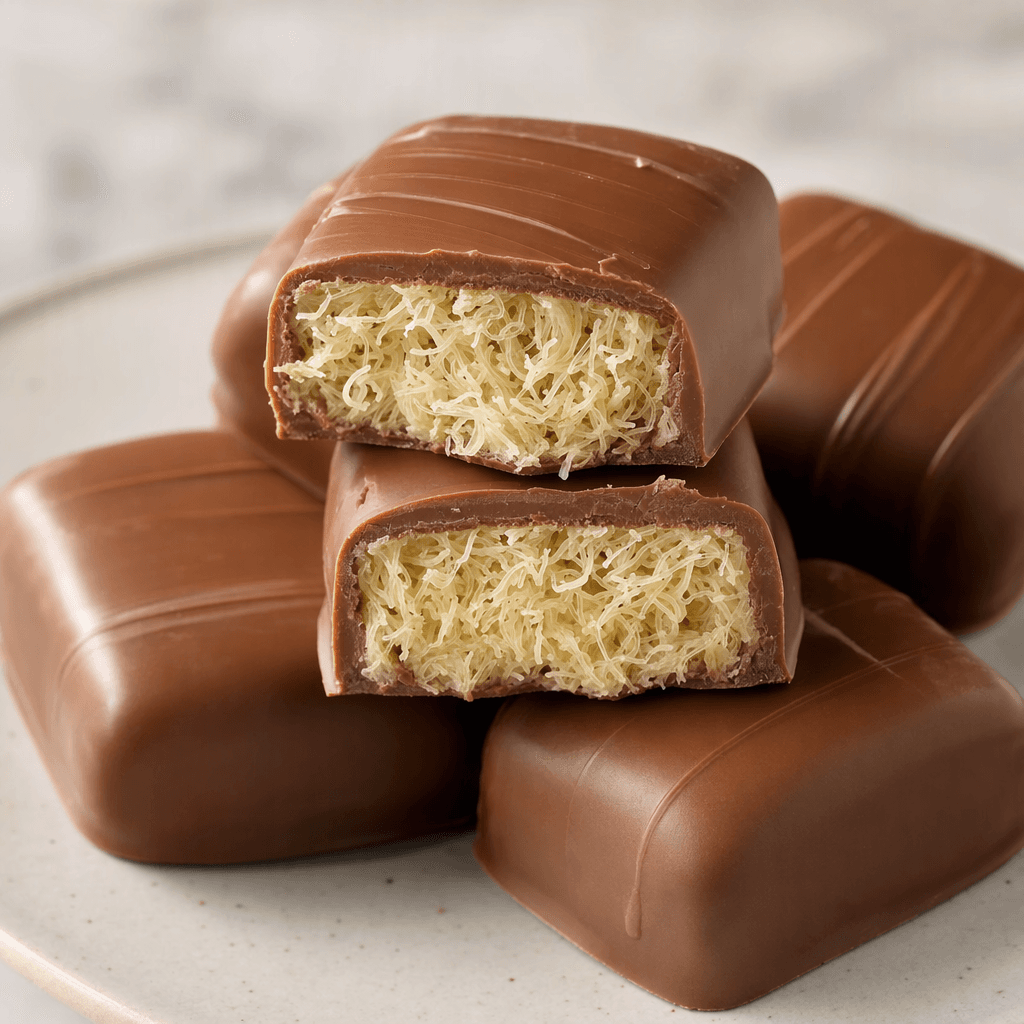
Chocolate with Pişmaniye Filling Calories
Chocolate filled with traditional Turkish pişmaniye (floss halva).
In season: Winter · Spring · Autumn · Summer
CALORIES · 100 G
GI
POTASSIUM · 100 G
FIBER · 100 G
Quick answer
1 piece (medium) of Chocolate with Pişmaniye Filling (30 g) has 141 calories. That works out to 470 calories per 100 g. It contains 17.7 g of carbs, 1.6 g of protein, 6.6 g of fat and 1.1 g of fiber. Its 0.1 mg of Copper covers 10% of the Daily Value. Its glycemic index is 55 (medium), so it raises blood sugar at a moderate pace.
Chocolate with Pişmaniye Filling Nutrition Facts
Selected: 1 piece (medium) · 30 g
141
KCAL / 30G
Carbs
17.7g
· 6% DV
Protein
1.6g
· 3% DV
Fat
6.6g
· 8% DV
Fiber
1.1g
· 4% DV
DV is the share of the daily value covered, on a 2,000 kcal reference diet.
Calories come from: Carbs 52% · Protein 5% · Fat 43%
Chocolate with Pişmaniye Filling nutrition facts table · 1 piece (medium) (30 g)
| Nutrient | Amount | % DV |
|---|---|---|
| Calories | 141 kcal | |
| Total fat | 6.6 g | 8% |
| Saturated fat | 3.96 g | 20% |
| Trans fat | 0.02 g | |
| Sodium | 11 mg | 0% |
| Total carbohydrate | 17.7 g | 6% |
| Fiber | 1.1 g | 4% |
| Protein | 1.6 g | 3% |
Calories: Calories measure energy. Average daily need is 2,000 kcal. Excess calories are stored as fat, too few cause weight loss.
Carbs: Your body's primary energy source. The brain runs exclusively on carbs. Daily need: 275g.
Protein: Essential for muscle repair and cell growth. Daily need: 50g. Keeps you full and boosts metabolism.
Fat: Needed for hormone production and vitamin absorption. Daily need: 78g. Limit saturated fats, choose unsaturated.
Fiber: Critical for digestive health and satiety. Daily need: 28g. Stabilizes blood sugar, lowers cholesterol.

Log this food in EatBetter
100,000+ people use it
- Get your daily calorie target
- Snap your meal, log it in seconds
- See every vitamin and mineral

📸 Scan the code to get the app free.

How Many Calories in 1 Medium Chocolate with Pişmaniye Filling?
| Serving | Amount | Calories |
|---|---|---|
| 1 piece (medium) | 30 g | 141 kcal |
| 1 piece (small) | 20 g | 94 kcal |
| 1 slice (thin) | 25 g | 118 kcal |
| 1 slice (thick) | 40 g | 188 kcal |
| 1 piece (large) | 45 g | 212 kcal |
| 2 piece (double) | 60 g | 282 kcal |
| 100 g | 100 g | 470 kcal |
| 1 pack (whole) | 100 g | 470 kcal |
Calculated from 470 calories per 100 g.
Frequently Asked Questions About Chocolate with Pişmaniye Filling
What is chocolate with Pişmaniye Filling?
Chocolate with Pişmaniye Filling is chocolate paired with pişmaniye, a traditional Turkish floss halva made of fine, thread-like strands. The filling is fibrous rather than creamy, so each product can have a noticeably different texture depending on how the pişmaniye is packed.
Is pişmaniye in chocolate the same as cotton candy?
No. Pişmaniye is a Turkish sweet made by working sugar with roasted flour into fine strands, while cotton candy is spun sugar. Both look airy, but pişmaniye has a more substantial, slightly floury texture and a different flavor.
How is chocolate with Pişmaniye Filling made?
It is usually made by enclosing pişmaniye inside a chocolate shell or combining the strands with chocolate in a molded piece. At home, coat a mold with melted chocolate, add loose pişmaniye, then cover it with more chocolate and let it set.
Why is the filling in chocolate with Pişmaniye Filling stringy?
The filling is stringy because pişmaniye itself is made of delicate strands, not a smooth paste. Chocolate can press those strands together, so the center may feel compact while still separating into fine threads when you bite into it.
What does chocolate with Pişmaniye Filling taste like?
It combines chocolate’s cocoa flavor with pişmaniye’s sweet, lightly toasted taste. The contrast is as much about texture as flavor: the chocolate is firm or smooth, while the filling is airy and thread-like rather than soft like ganache.
How should you serve chocolate with Pişmaniye Filling?
Serve chocolate with Pişmaniye Filling in small pieces with Turkish coffee, tea, or another unsweetened drink. The strands can be delicate and messy, so keep the pieces intact until serving and use a plate rather than eating them over a carpet or upholstery.
How should chocolate with Pişmaniye Filling be stored?
Keep chocolate with Pişmaniye Filling in its closed packaging in a cool, dry place away from sunlight and strong odors. Heat can soften the chocolate, while moisture can affect the pişmaniye’s texture; follow the package directions once it has been opened.
Can you freeze chocolate with Pişmaniye Filling?
Freezing is usually unnecessary and may affect the texture when the chocolate thaws. Condensation can form as it warms, making the chocolate surface dull and the pişmaniye strands less crisp; store it in a cool, dry place instead.
Can you use chocolate with Pişmaniye Filling in baking?
You can, but the pişmaniye strands lose their distinct texture when heated and may make the melted chocolate uneven. For a clearer contrast, bake with plain chocolate and add crumbled pişmaniye filling as a topping after the dessert has cooled.
Does chocolate with Pişmaniye Filling contain actual pişmaniye?
Some versions contain pişmaniye strands, while recipes and fillings can vary by manufacturer. The name describes the style of the sweet, but it does not guarantee a particular proportion or exact recipe; the ingredient list is the reliable way to confirm what a specific product contains.
Chocolate with Pişmaniye Filling Vitamins & Minerals
Vitamins
B2
0.05mg · 4% DV
Vitamin E
0.39mg · 3% DV
B5
0.09mg · 2% DV
B1
0.02mg · 2% DV
Minerals
Copper
0.09mg · 10% DV
Phosphorus
33mg · 5% DV
Manganese
0.09mg · 4% DV
Iron
0.63mg · 4% DV
Potassium ⭐
63mg · 2% DV
Sodium
11mg · 0% DV
Chocolate with Pişmaniye Filling Glycemic Index
GLYCEMIC INDEX
GLYCEMIC LOAD
Accounts for portion size — a more realistic measure than GI alone.
How to Burn Off Chocolate with Pişmaniye Filling
To burn the 141 calories in 1 piece (medium) (30 g):
🚶
Walking (5 km/h)
🏃
Running (8 km/h)
🚴
Cycling
🏊
Swimming
Times are calculated with the MET equation for a 70 kg adult. Actual burn varies with your weight, age and pace.
What is Chocolate with Pişmaniye Filling?
Chocolate with Pişmaniye Filling pairs a chocolate coating with pişmaniye, a traditional Turkish sweet made by drawing a sugar-and-flour mixture into fine, cottony strands. The filling is light and feathery in texture, with a sweet, slightly toasted flavour that contrasts with the richer chocolate around it. It is a confection rather than a bar of plain chocolate, and the strands give each bite a distinctive soft, fibrous feel.
In Turkey, it is often offered with tea or coffee and served as a small treat for guests or on festive occasions. For readers elsewhere, it works well as an after-dinner sweet or alongside an unsweetened drink. It is rich in carbohydrates and fat, so a modest piece is usually satisfying; pairing it with plain tea or coffee keeps the overall snack from feeling overly sweet.
How Nutritious Is Chocolate with Pişmaniye Filling?
Nutrient density
Low
How many vitamins, minerals and how much fiber this food carries per calorie. A high score means a lot of nutrition for few calories.
Satiety score
Low
An EatBetter score computed from fiber, protein and calorie density. A high score means staying full longer on the same calories.
Both scores are calculated per 100 g and do not change with the selected portion. The satiety score is EatBetter's own calculation, not a clinical measure.
Is Chocolate with Pişmaniye Filling Processed?
NOVA 3
Processed
1. Unprocessed
2. Minimally Processed
3. Processed
4. Ultra-Processed
NOVA classifies foods into 4 groups by industrial processing. NOVA 1 (unprocessed) is the healthiest.
Does Chocolate with Pişmaniye Filling Contain Allergens?
Contains these allergens:
Which Diets Is Chocolate with Pişmaniye Filling Good For?
Vegan
— Not suitable
Vegetarian
✓ Suitable
Gluten-Free
— Not suitable
Dairy-Free
— Not suitable
Mediterranean
✓ Suitable
Paleo
— Not suitable
Whole30
— Not suitable
DASH
— Not suitable
Keto
— Not suitable
Low FODMAP
— Not suitable
Chocolate with Pişmaniye Filling Fat Profile
SATURATED
3.96g
MONOUNSATURATED
1.74g
POLYUNSATURATED
0.45g
Omega 6:3 ratio 39:1
Above the ideal 4:1 (39:1).
Compare Chocolate with Pişmaniye Filling
Foods Similar to Chocolate with Pişmaniye Filling
Have another question about Chocolate with Pişmaniye Filling?
Ask the AI nutrition coach — calories, portions, alternatives and more, answered in seconds in the app.

Scan calories with your camera
Instant AI nutrition analysis

Nutrition data compiled from USDA FoodData Central and scientific sources.