

Ready & Packaged Foods
All →Vegetables & Legumes
All →Desserts & Confectionery
All →Meat & Protein
All →Grains & Bakery
All →Beverages
All →Milk & Dairy
All →

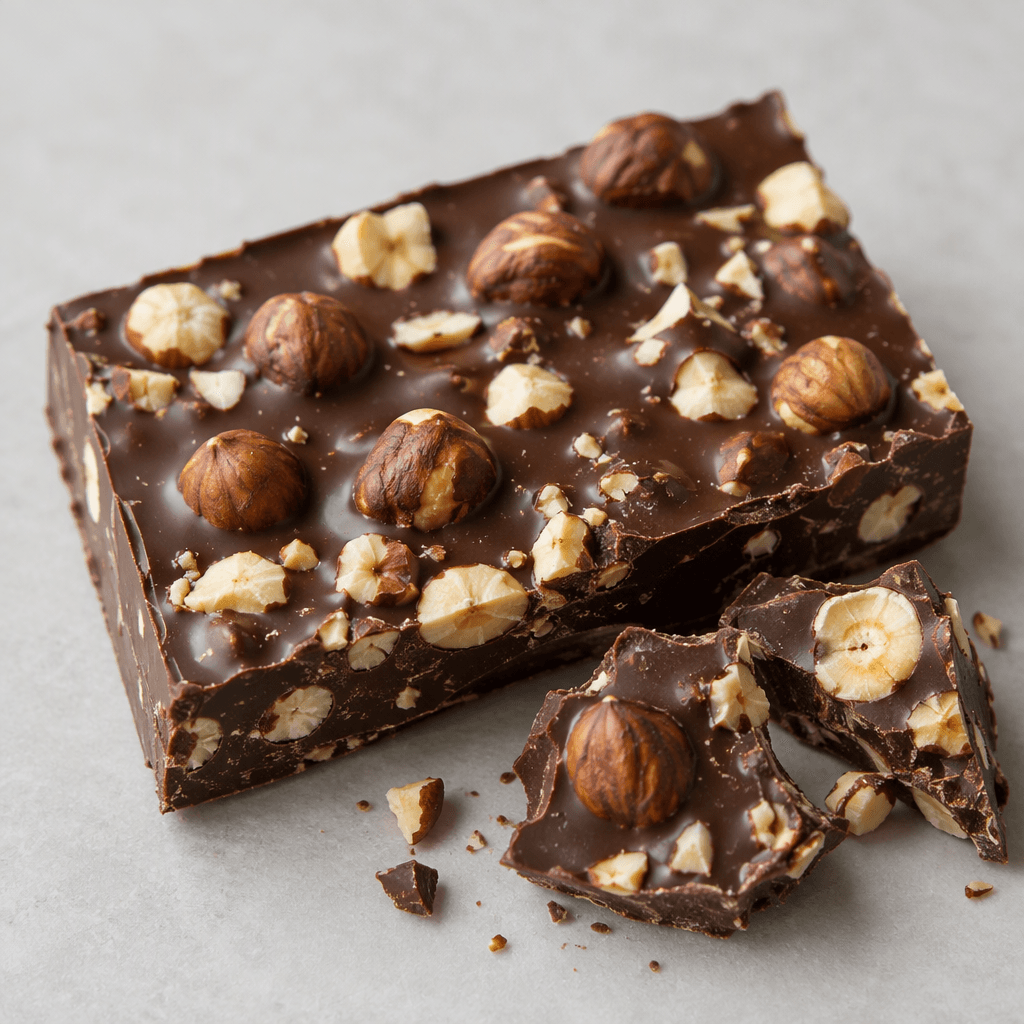
Chocolate with hazelnuts Calories
Blend of chocolate and hazelnuts, energy and healthy fats
In season: Winter · Autumn
CALORIES
GI
POTASSIUM
FIBER
Quick answer
1 piece (medium) of Chocolate with hazelnuts (25 g) has 135 calories. That works out to 540 calories per 100 g. It contains 11 g of carbs, 1.8 g of protein, 9 g of fat and 1.6 g of fiber. Its 0.3 mg of Copper covers 33% of the Daily Value. Its glycemic index is 45 (medium), so it raises blood sugar at a moderate pace.
What is Chocolate with hazelnuts?
Chocolate with hazelnuts combines chocolate with whole or chopped hazelnuts, either mixed through the bar or pressed into its surface. It may be made with milk or dark chocolate, so sweetness and cocoa intensity vary by type.
The crisp nuts contrast with the chocolate’s smooth, melting texture. It is enjoyed as a small treat, broken into pieces for sharing, or served with coffee or tea; it can also be chopped over ice cream or desserts. With 540 calories per 100 g, it is energy-dense, so a modest piece works well when you want something sweet without making it the centre of a snack.
Chocolate with hazelnuts Nutrition Facts
Selected: 100 g
540
KCAL / 100G
Carbs
44g
· 16% DV
Protein
7.2g
· 14% DV
Fat
36g
· 46% DV
Fiber
6.5g
· 23% DV
DV is the share of the daily value covered, on a 2,000 kcal reference diet.
Calories come from: Carbs 33% · Protein 5% · Fat 62%
Chocolate with hazelnuts Vitamins & Minerals
Vitamins
Vitamin E
3.2mg · 21% DV
Biotin
5µg · 17% DV
B2
0.18mg · 14% DV
Vitamin K
9µg · 8% DV
Minerals
Copper
1mg · 111% DV
Manganese
1mg · 43% DV
Phosphorus
180mg · 26% DV
Magnesium
90mg · 21% DV
How Nutritious Is Chocolate with hazelnuts?
Nutrient density
Medium
How many vitamins, minerals and how much fiber this food carries per calorie. A high score means a lot of nutrition for few calories.
Satiety score
Medium
An EatBetter score computed from fiber, protein and calorie density. A high score means staying full longer on the same calories.
Both scores are calculated per 100 g and do not change with the selected portion. The satiety score is EatBetter's own calculation, not a clinical measure.
Chocolate with hazelnuts Glycemic Index
GLYCEMIC INDEX
GLYCEMIC LOAD
Accounts for portion size — a more realistic measure than GI alone.
How to Burn Off Chocolate with hazelnuts
To burn the 540 calories in 100 g:
🚶
Walking (5 km/h)
🏃
Running (8 km/h)
🚴
Cycling
🏊
Swimming
Times are calculated with the MET equation for a 70 kg adult. Actual burn varies with your weight, age and pace.
Is Chocolate with hazelnuts Processed?
NOVA 3
Processed
1. Unprocessed
2. Minimally Processed
3. Processed
4. Ultra-Processed
NOVA classifies foods into 4 groups by industrial processing. NOVA 1 (unprocessed) is the healthiest.
Does Chocolate with hazelnuts Contain Allergens?
Contains these allergens:
Which Diets Is Chocolate with hazelnuts Good For?
Vegan
— Not suitable
Vegetarian
✓ Suitable
Gluten-Free
— Not suitable
Dairy-Free
— Not suitable
Mediterranean
— Not suitable
Paleo
— Not suitable
Whole30
— Not suitable
DASH
— Not suitable
Keto
— Not suitable
Low FODMAP
— Not suitable
Chocolate with hazelnuts Fat Profile
SATURATED
13.5g
MONOUNSATURATED
18.5g
POLYUNSATURATED
3.2g
Omega 6:3 ratio 35.7:1
Above the ideal 4:1 (35.7:1).
Compare Chocolate with hazelnuts
Foods Similar to Chocolate with hazelnuts
Frequently Asked Questions About Chocolate with hazelnuts
What is chocolate with hazelnuts made of?
Chocolate with hazelnuts is made from chocolate and whole, chopped, or crushed hazelnuts. The chocolate may be dark, milk, or another style, so ingredients and sweetness vary by product; some versions also include extra fillings or flavourings.
Is chocolate with hazelnuts dark or milk chocolate?
Chocolate with hazelnuts can be either dark or milk chocolate. Dark versions have a more pronounced cocoa taste, while milk versions are usually sweeter and creamier; the hazelnuts are added to either style.
How should you store chocolate with hazelnuts?
Store chocolate with hazelnuts in a cool, dry place away from sunlight and strong-smelling foods. Keep it sealed to protect its texture and flavour; heat can soften it, while humidity can cause a pale surface coating.
Why has chocolate with hazelnuts turned white?
A white coating on chocolate with hazelnuts is usually fat or sugar bloom caused by temperature changes or moisture. It can affect the appearance and texture but does not by itself mean the chocolate is spoiled; discard it if it smells or looks moldy.
Can you freeze chocolate with hazelnuts?
Yes, you can freeze chocolate with hazelnuts, though condensation during thawing may change its surface. Seal it airtight before freezing and let it return to room temperature while still wrapped to reduce moisture exposure.
How do you melt chocolate with hazelnuts?
Melt chocolate with hazelnuts gently over low heat or in short microwave bursts, stirring between intervals. The nuts can make the mixture heat unevenly, so avoid high heat and stop as soon as the chocolate is soft enough to stir.
What goes well with chocolate with hazelnuts?
Coffee, fresh berries, and plain yogurt pair well with chocolate with hazelnuts because their bitterness or tartness balances its richness. It can also be chopped over porridge or used as a topping for ice cream.
Does chocolate with hazelnuts contain caffeine?
Yes, chocolate with hazelnuts contains some caffeine from the cocoa. The amount varies with the type and cocoa content of the chocolate, so people sensitive to caffeine may prefer to avoid it close to bedtime.
Is chocolate with hazelnuts good for you?
Chocolate with hazelnuts provides fats from the nuts and cocoa compounds from the chocolate, but it is also a rich sweet. Enjoying a modest portion can fit into an eating pattern; it is not a substitute for whole nuts or unsweetened cocoa.
Can dogs eat chocolate with hazelnuts?
No, do not give chocolate with hazelnuts to dogs. Chocolate can be toxic to them, and hazelnuts may also cause digestive upset or pose a choking risk; contact a veterinarian promptly if your dog eats some.
Have another question about Chocolate with hazelnuts?
Ask the AI nutrition coach — calories, portions, alternatives and more, answered in seconds in the app.

Scan calories with your camera
Instant AI nutrition analysis

Nutrition data compiled from USDA FoodData Central and scientific sources.