

Ready & Packaged Foods
All →Vegetables & Legumes
All →Desserts & Confectionery
All →Meat & Protein
All →Grains & Bakery
All →Beverages
All →Milk & Dairy
All →

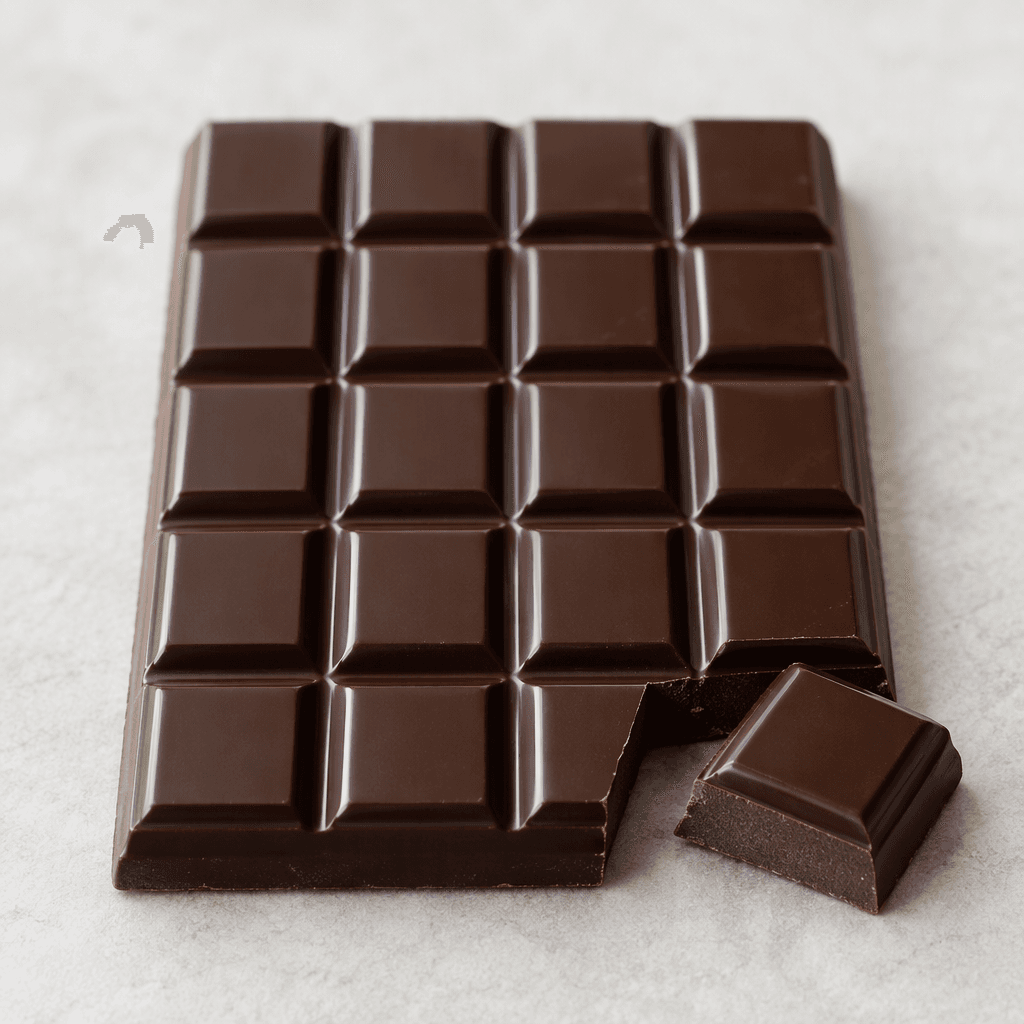
Chocolate (tablet/bar) Calories
High energy, antioxidant, magnesium source
CALORIES · 100 G
GI
POTASSIUM · 100 G
FIBER · 100 G
Quick answer
1 piece (medium) of Chocolate (tablet/bar) (25 g) has 134 calories. That works out to 535 calories per 100 g. It contains 13.8 g of carbs, 1.9 g of protein, 8 g of fat and 1.8 g of fiber. Its 0.5 mg of Copper covers 50% of the Daily Value. Its glycemic index is 40 (medium), so it raises blood sugar at a moderate pace.
Chocolate (tablet/bar) Nutrition Facts
Selected: 1 piece (medium) · 25 g
134
KCAL / 25G
Carbs
13.8g
· 5% DV
Protein
1.9g
· 4% DV
Fat
8g
· 10% DV
Fiber
1.8g
· 6% DV
DV is the share of the daily value covered, on a 2,000 kcal reference diet.
Calories come from: Carbs 41% · Protein 6% · Fat 53%
Chocolate (tablet/bar) nutrition facts table · 1 piece (medium) (25 g)
| Nutrient | Amount | % DV |
|---|---|---|
| Calories | 134 kcal | |
| Total fat | 8 g | 10% |
| Saturated fat | 5 g | 25% |
| Trans fat | 0.03 g | |
| Sodium | 5 mg | 0% |
| Total carbohydrate | 13.8 g | 5% |
| Fiber | 1.8 g | 6% |
| Protein | 1.9 g | 4% |
Calories: Calories measure energy. Average daily need is 2,000 kcal. Excess calories are stored as fat, too few cause weight loss.
Carbs: Your body's primary energy source. The brain runs exclusively on carbs. Daily need: 275g.
Protein: Essential for muscle repair and cell growth. Daily need: 50g. Keeps you full and boosts metabolism.
Fat: Needed for hormone production and vitamin absorption. Daily need: 78g. Limit saturated fats, choose unsaturated.
Fiber: Critical for digestive health and satiety. Daily need: 28g. Stabilizes blood sugar, lowers cholesterol.

Log this food in EatBetter
100,000+ people use it
- Get your daily calorie target
- Snap your meal, log it in seconds
- See every vitamin and mineral

📸 Scan the code to get the app free.

How Many Calories in 1 Medium Chocolate (tablet/bar)?
| Serving | Amount | Calories |
|---|---|---|
| 1 piece (medium) | 25 g | 134 kcal |
| 1 piece (small) | 10 g | 54 kcal |
| 1 slice (thin) | 15 g | 80 kcal |
| 1 slice (thick) | 30 g | 161 kcal |
| 1 piece (large) | 40 g | 214 kcal |
| 1 pack (medium) | 50 g | 268 kcal |
| 100 g | 100 g | 535 kcal |
| 1 piece (jumbo) | 100 g | 535 kcal |
| 1 pack (large) | 100 g | 535 kcal |
Calculated from 535 calories per 100 g.
Frequently Asked Questions About Chocolate (tablet/bar)
Is a chocolate bar good for you?
A chocolate bar can provide cocoa compounds, but it is also an energy-dense sweet, and its benefits depend on the type and portion. Dark chocolate generally contains more cocoa than milk chocolate; neither needs to be treated as a health food.
Is dark chocolate better for you than milk chocolate?
Dark chocolate usually has more cocoa and less milk than milk chocolate, while milk chocolate is typically sweeter and creamier. The difference depends on the bar’s recipe, so “dark” does not automatically mean low in sugar or suitable for every diet.
How should you store a chocolate bar?
Keep a chocolate bar wrapped in a cool, dry place away from strong odors and direct sunlight. Refrigeration is usually unnecessary; if warm weather makes it necessary, seal the bar well and let it return to room temperature before opening to avoid condensation.
Why does a chocolate bar turn white?
The pale coating on a chocolate bar is usually harmless fat bloom or sugar bloom. Temperature changes can bring cocoa butter to the surface, while moisture can make sugar crystallize. The bar may taste or feel different, but it is generally still safe to eat.
How do you melt a chocolate bar without burning it?
Melt a chocolate bar gently in a dry bowl over simmering water, keeping the bowl clear of the water. Stir often and prevent even a little water from getting into the chocolate, as it can seize; in a microwave, use short bursts and stir between them.
Can dogs eat a chocolate bar?
No, dogs should not eat a chocolate bar. Theobromine and caffeine in chocolate can be toxic to them, and darker chocolate is generally more concerning. If your dog has eaten any, contact a veterinarian promptly with the type and estimated amount.
Does a chocolate bar contain caffeine?
Yes, a chocolate bar contains some caffeine, and bars with more cocoa tend to contain more. It also contains theobromine, another stimulant. The amounts vary by product, so a chocolate bar may affect caffeine-sensitive people differently.
Can eating a chocolate bar at night keep you awake?
Yes, a chocolate bar can make it harder for some people to fall asleep, especially if it is dark and eaten late. Its caffeine and theobromine have stimulating effects, so people sensitive to them may prefer chocolate earlier in the day.
Does a chocolate bar cause acne?
A chocolate bar has not been shown to cause acne on its own. Diets high in sugary foods may be associated with acne for some people, but blaming a single bar as the direct cause oversimplifies what is known.
Can you use a chocolate bar instead of baking chocolate?
Yes, you can chop a chocolate bar into cakes or cookies, but the result may be sweeter than a recipe made with unsweetened baking chocolate. For a coating that needs to set glossy and firm, a regular bar may not behave like couverture chocolate.
Chocolate (tablet/bar) Vitamins & Minerals
Vitamins
B2
0.06mg · 5% DV
B3
0.3mg · 2% DV
B5
0.09mg · 2% DV
B1
0.02mg · 2% DV
Minerals
Copper
0.45mg · 50% DV
Manganese
0.25mg · 11% DV
Phosphorus
53mg · 8% DV
Magnesium
30mg · 7% DV
Potassium ⭐
93mg · 3% DV
Sodium
5mg · 0% DV
Chocolate (tablet/bar) Glycemic Index
GLYCEMIC INDEX
GLYCEMIC LOAD
Accounts for portion size — a more realistic measure than GI alone.
How to Burn Off Chocolate (tablet/bar)
To burn the 134 calories in 1 piece (medium) (25 g):
🚶
Walking (5 km/h)
🏃
Running (8 km/h)
🚴
Cycling
🏊
Swimming
Times are calculated with the MET equation for a 70 kg adult. Actual burn varies with your weight, age and pace.
What is Chocolate (tablet/bar)?
Made from cacao beans, cocoa butter and usually sugar, a chocolate bar is set in a mould into a firm, breakable slab. Cacao has deep roots in the Americas, while the familiar solid bar became popular through European chocolate-making. Milk and dark varieties differ in sweetness, bitterness and how quickly they melt.
People around the world break off a square to enjoy with coffee or tea, as a small dessert, or in baking. It is energy-dense, and cocoa also contributes fibre and magnesium. For a less rich snack, have a small piece with fruit; darker bars pair especially well with coffee.
How Nutritious Is Chocolate (tablet/bar)?
Nutrient density
Medium
How many vitamins, minerals and how much fiber this food carries per calorie. A high score means a lot of nutrition for few calories.
Satiety score
Medium
An EatBetter score computed from fiber, protein and calorie density. A high score means staying full longer on the same calories.
Both scores are calculated per 100 g and do not change with the selected portion. The satiety score is EatBetter's own calculation, not a clinical measure.
Is Chocolate (tablet/bar) Processed?
NOVA 3
Processed
1. Unprocessed
2. Minimally Processed
3. Processed
4. Ultra-Processed
NOVA classifies foods into 4 groups by industrial processing. NOVA 1 (unprocessed) is the healthiest.
Does Chocolate (tablet/bar) Contain Allergens?
No known major allergens
Which Diets Is Chocolate (tablet/bar) Good For?
Vegan
— Not suitable
Vegetarian
✓ Suitable
Gluten-Free
— Not suitable
Dairy-Free
— Not suitable
Mediterranean
— Not suitable
Paleo
— Not suitable
Whole30
— Not suitable
DASH
— Not suitable
Keto
— Not suitable
Low FODMAP
— Not suitable
Chocolate (tablet/bar) Fat Profile
SATURATED
5g
MONOUNSATURATED
2g
POLYUNSATURATED
0.3g
Omega 6:3 ratio 13:1
Above the ideal 4:1 (13:1).
Compare Chocolate (tablet/bar)
Foods Similar to Chocolate (tablet/bar)
Have another question about Chocolate (tablet/bar)?
Ask the AI nutrition coach — calories, portions, alternatives and more, answered in seconds in the app.

Scan calories with your camera
Instant AI nutrition analysis

Nutrition data compiled from USDA FoodData Central and scientific sources.