

Ready & Packaged Foods
All →Vegetables & Legumes
All →Desserts & Confectionery
All →Meat & Protein
All →Grains & Bakery
All →Beverages
All →Milk & Dairy
All →

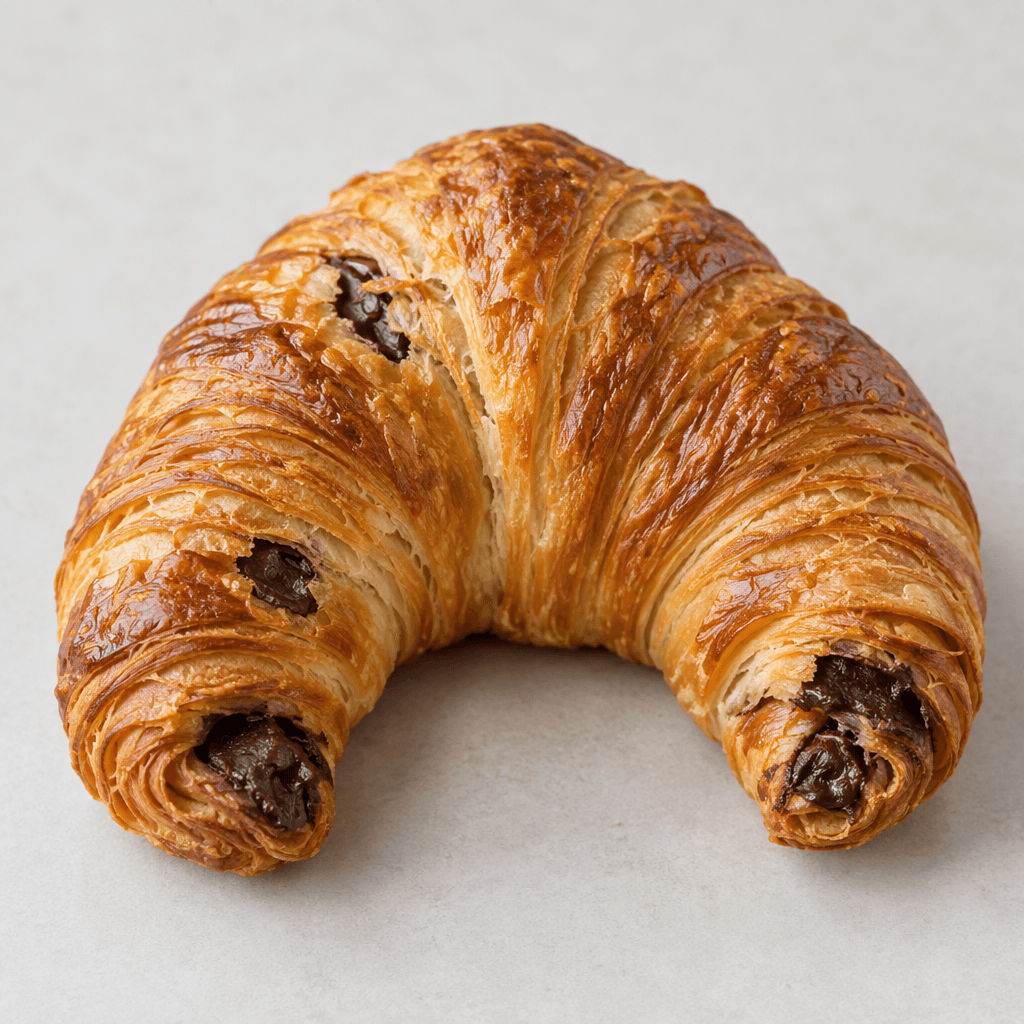
Chocolate Croissant Calories
Buttery pastry, chocolate filling, sweet and flaky
In season: Spring · Summer · Autumn · Winter
CALORIES
GI
POTASSIUM
FIBER
Quick answer
1 piece (medium) of Chocolate Croissant (65 g) has 267 calories. That works out to 410 calories per 100 g. It contains 28.9 g of carbs, 4.6 g of protein, 14.4 g of fat and 1.6 g of fiber. Its 0.1 mg of B2 covers 9% of the Daily Value. Its glycemic index is 65 (medium), so it raises blood sugar at a moderate pace.
What is Chocolate Croissant?
A chocolate croissant is a flaky, crescent-shaped pastry made from buttery, laminated dough with chocolate tucked inside. It belongs to the French-style bakery tradition; the layers bake crisp and golden outside while staying tender within, with chocolate peeking through the ends or breaking through the crust.
Across many English-speaking countries, it is a familiar bakery breakfast or coffee-break treat, usually served warm or at room temperature with coffee or tea. The buttery pastry and chocolate make it energy-dense and more of a sweet treat than an everyday staple. For a lighter-feeling breakfast or snack, pair it with fresh fruit, or enjoy a smaller piece alongside an unsweetened drink.
Chocolate Croissant Nutrition Facts
Selected: 100 g
410
KCAL / 100G
Carbs
44.5g
· 16% DV
Protein
7.1g
· 14% DV
Fat
22.2g
· 28% DV
Fiber
2.5g
· 9% DV
DV is the share of the daily value covered, on a 2,000 kcal reference diet.
Calories come from: Carbs 44% · Protein 7% · Fat 49%
Chocolate Croissant Vitamins & Minerals
Vitamins
B2
0.18mg · 14% DV
B1
0.13mg · 11% DV
B5
0.5mg · 10% DV
Vitamin A
70µg · 8% DV
Minerals
Selenium
8µg · 15% DV
Sodium
330mg · 14% DV
Phosphorus
90mg · 13% DV
Iron
2mg · 11% DV
How Nutritious Is Chocolate Croissant?
Nutrient density
Low
How many vitamins, minerals and how much fiber this food carries per calorie. A high score means a lot of nutrition for few calories.
Satiety score
Low
An EatBetter score computed from fiber, protein and calorie density. A high score means staying full longer on the same calories.
Both scores are calculated per 100 g and do not change with the selected portion. The satiety score is EatBetter's own calculation, not a clinical measure.
Chocolate Croissant Glycemic Index
GLYCEMIC INDEX
GLYCEMIC LOAD
Accounts for portion size — a more realistic measure than GI alone.
How to Burn Off Chocolate Croissant
To burn the 410 calories in 100 g:
🚶
Walking (5 km/h)
🏃
Running (8 km/h)
🚴
Cycling
🏊
Swimming
Times are calculated with the MET equation for a 70 kg adult. Actual burn varies with your weight, age and pace.
Is Chocolate Croissant Processed?
NOVA 3
Processed
1. Unprocessed
2. Minimally Processed
3. Processed
4. Ultra-Processed
NOVA classifies foods into 4 groups by industrial processing. NOVA 1 (unprocessed) is the healthiest.
Does Chocolate Croissant Contain Allergens?
Contains these allergens:
Which Diets Is Chocolate Croissant Good For?
Vegan
— Not suitable
Vegetarian
— Not suitable
Gluten-Free
— Not suitable
Dairy-Free
— Not suitable
Mediterranean
✓ Suitable
Paleo
— Not suitable
Whole30
— Not suitable
DASH
— Not suitable
Keto
— Not suitable
Low FODMAP
— Not suitable
Chocolate Croissant Fat Profile
SATURATED
12.2g
MONOUNSATURATED
6.5g
POLYUNSATURATED
2.1g
Omega 6:3 ratio 11.3:1
Above the ideal 4:1 (11.3:1).
Compare Chocolate Croissant
Foods Similar to Chocolate Croissant
Frequently Asked Questions About Chocolate Croissant
How do you make a Chocolate Croissant?
A Chocolate Croissant is made by enclosing chocolate in laminated, yeast-raised dough, then proofing and baking it until golden. Traditional dough is folded with butter to create flaky layers; ready-made puff pastry is a quicker home shortcut, though the texture differs.
Is a Chocolate Croissant the same as pain au chocolat?
No. A Chocolate Croissant is usually crescent-shaped, while pain au chocolat is typically a rectangular pastry with chocolate batons inside. Both use laminated dough, but the shape and the traditional chocolate filling are different.
How do you reheat a Chocolate Croissant?
Reheat a Chocolate Croissant in the oven to bring back its crisp exterior. Warm it briefly in a preheated oven at about 325°F (160°C), checking often so the chocolate does not become excessively hot. A microwave tends to make the pastry soft.
How should you store a Chocolate Croissant?
Store a Chocolate Croissant in an airtight container at room temperature and eat it within a day or so for the best texture. Refrigeration can make its flaky layers stale; briefly warming it in the oven can help refresh it.
Can you freeze a Chocolate Croissant?
Yes, a Chocolate Croissant freezes well. Let it cool completely, wrap it tightly, and freeze it in an airtight container. Thaw it at room temperature, then warm it briefly in the oven to restore some crispness.
What chocolate is best for a Chocolate Croissant?
Dark chocolate or sturdy chocolate batons work well in a Chocolate Croissant because they keep a distinct chocolate flavor after baking. Chocolate chips are convenient, but some varieties hold their shape rather than melting into a smooth filling.
Why does the chocolate leak out of a Chocolate Croissant?
Chocolate leaks out of a Chocolate Croissant when the dough is not sealed well or the filling sits too close to an open edge. Keep the chocolate centered, tuck in the ends, and place the seam underneath before baking.
Why isn't my Chocolate Croissant flaky?
A Chocolate Croissant loses its flaky layers when the butter melts into the dough before baking. Keep the dough cool while shaping, avoid over-proofing it in a warm place, and bake in a fully preheated oven so the layers can rise.
Can you make a Chocolate Croissant with puff pastry?
Yes, store-bought puff pastry can make a quick Chocolate Croissant-style treat. Wrap the chocolate in the pastry and bake according to the package directions; it will be flaky, but usually less airy and buttery than one made with laminated croissant dough.
Does a Chocolate Croissant make a good breakfast?
A Chocolate Croissant can be part of breakfast, but it may not keep you full for long on its own. Pairing it with yogurt, eggs, or another protein-rich food makes a more sustaining meal than having it alone with coffee.
Have another question about Chocolate Croissant?
Ask the AI nutrition coach — calories, portions, alternatives and more, answered in seconds in the app.

Scan calories with your camera
Instant AI nutrition analysis

Nutrition data compiled from USDA FoodData Central and scientific sources.