

Ready & Packaged Foods
All →Vegetables & Legumes
All →Desserts & Confectionery
All →Meat & Protein
All →Grains & Bakery
All →Beverages
All →Milk & Dairy
All →

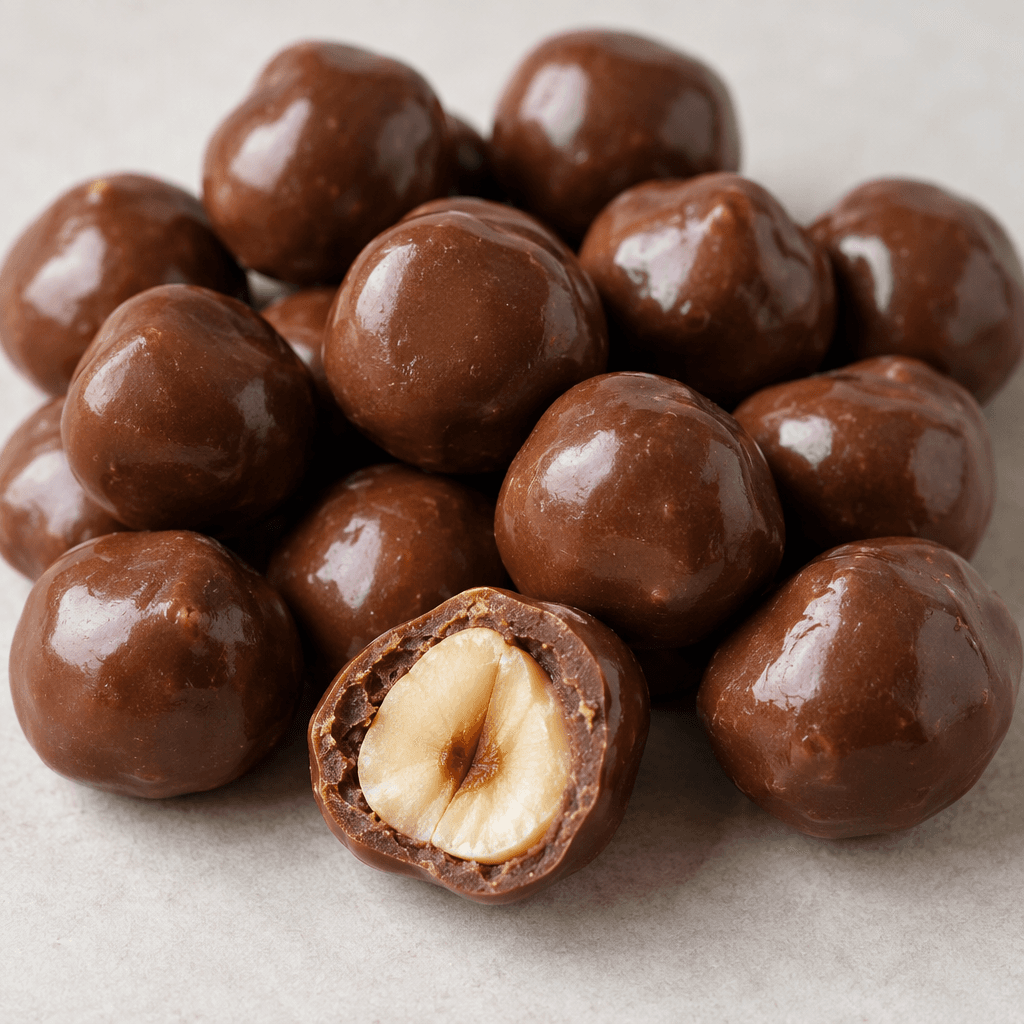
Chocolate-coated hazelnut Calories
Crunchy hazelnut center with a chocolate coating, sweet and energy-dense
In season: Autumn · Winter
CALORIES
GI
POTASSIUM
FIBER
Quick answer
10 piece (medium) of Chocolate-coated hazelnut (30 g) has 162 calories. That works out to 540 calories per 100 g. It contains 14.4 g of carbs, 2.2 g of protein, 10.8 g of fat and 2 g of fiber. Its 0.2 mg of Copper covers 27% of the Daily Value. Its glycemic index is 45 (medium), so it raises blood sugar at a moderate pace.
What is Chocolate-coated hazelnut?
A chocolate-coated hazelnut is a whole or large hazelnut wrapped in a layer of chocolate. The shell is sweet and smooth, while the centre stays crisp and nutty; the balance varies with the chocolate, from milky and mellow to more cocoa-forward.
It is commonly sold as a small confectionery treat and served with coffee or tea, offered to guests, or added to a dessert topping. Although compact, it is energy-dense, with 540 calories per 100 g, so a small handful can feel satisfying. Pair a few with fresh fruit or unsweetened coffee, or use them sparingly to add crunch and sweetness to yogurt or a bowl of ice cream.
Chocolate-coated hazelnut Nutrition Facts
Selected: 100 g
540
KCAL / 100G
Carbs
48g
· 17% DV
Protein
7.2g
· 14% DV
Fat
36g
· 46% DV
Fiber
6.5g
· 23% DV
DV is the share of the daily value covered, on a 2,000 kcal reference diet.
Calories come from: Carbs 35% · Protein 5% · Fat 60%
Chocolate-coated hazelnut Vitamins & Minerals
Vitamins
Vitamin E
5.5mg · 37% DV
Biotin
5µg · 17% DV
B1
0.15mg · 13% DV
B5
0.5mg · 10% DV
Minerals
Copper
1mg · 111% DV
Manganese
2mg · 87% DV
Phosphorus
170mg · 24% DV
Magnesium
90mg · 21% DV
How Nutritious Is Chocolate-coated hazelnut?
Nutrient density
Medium
How many vitamins, minerals and how much fiber this food carries per calorie. A high score means a lot of nutrition for few calories.
Satiety score
Medium
An EatBetter score computed from fiber, protein and calorie density. A high score means staying full longer on the same calories.
Both scores are calculated per 100 g and do not change with the selected portion. The satiety score is EatBetter's own calculation, not a clinical measure.
Chocolate-coated hazelnut Glycemic Index
GLYCEMIC INDEX
GLYCEMIC LOAD
Accounts for portion size — a more realistic measure than GI alone.
How to Burn Off Chocolate-coated hazelnut
To burn the 540 calories in 100 g:
🚶
Walking (5 km/h)
🏃
Running (8 km/h)
🚴
Cycling
🏊
Swimming
Times are calculated with the MET equation for a 70 kg adult. Actual burn varies with your weight, age and pace.
Is Chocolate-coated hazelnut Processed?
NOVA 3
Processed
1. Unprocessed
2. Minimally Processed
3. Processed
4. Ultra-Processed
NOVA classifies foods into 4 groups by industrial processing. NOVA 1 (unprocessed) is the healthiest.
Does Chocolate-coated hazelnut Contain Allergens?
Contains these allergens:
Which Diets Is Chocolate-coated hazelnut Good For?
Vegan
— Not suitable
Vegetarian
✓ Suitable
Gluten-Free
— Not suitable
Dairy-Free
— Not suitable
Mediterranean
— Not suitable
Paleo
— Not suitable
Whole30
— Not suitable
DASH
— Not suitable
Keto
— Not suitable
Low FODMAP
— Not suitable
Chocolate-coated hazelnut Fat Profile
SATURATED
11g
MONOUNSATURATED
20g
POLYUNSATURATED
5g
Omega 6:3 ratio 67.1:1
Above the ideal 4:1 (67.1:1).
Compare Chocolate-coated hazelnut
Foods Similar to Chocolate-coated hazelnut
Frequently Asked Questions About Chocolate-coated hazelnut
What is a chocolate-coated hazelnut?
A chocolate-coated hazelnut is a whole or broken hazelnut covered in chocolate, sometimes with extra coating layers. The outside is sweet and crisp, while the center retains the nut’s firm crunch.
How are chocolate-coated hazelnuts made?
Chocolate-coated hazelnuts are made by covering hazelnuts with melted chocolate and letting the coating set. Commercial makers may tumble the nuts as they add layers, creating an even shell around each hazelnut.
Can you make chocolate-coated hazelnuts at home?
Yes, chocolate-coated hazelnuts are easy to make at home. Dip roasted hazelnuts in melted chocolate, let the excess drip off, then place them on parchment and chill until the coating is firm.
How should you store chocolate-coated hazelnuts?
Store chocolate-coated hazelnuts in an airtight container in a cool, dry place away from sunlight. Heat can soften or melt the chocolate, while moisture can make the coating sticky.
Why do chocolate-coated hazelnuts turn white?
A white film on chocolate-coated hazelnuts is usually chocolate bloom, caused by fat or sugar rising to the surface after temperature changes or moisture exposure. It can affect the appearance and texture, but does not by itself mean the sweets have spoiled.
Are chocolate-coated hazelnuts the same as Ferrero Rocher?
No, chocolate-coated hazelnuts are not necessarily the same as Ferrero Rocher. Ferrero Rocher has a layered structure that includes a wafer shell and hazelnut filling, while a chocolate-coated hazelnut is typically a hazelnut with chocolate around it.
Can you use chocolate-coated hazelnuts in baking?
Yes, chocolate-coated hazelnuts can be added to cookies, cakes, or ice cream. The coating may melt in the oven, so for a distinct crunchy finish, add them to cold desserts or use them as a topping after baking.
Are chocolate-coated hazelnuts healthy?
Chocolate-coated hazelnuts provide hazelnuts and their nutrients, but the chocolate coating adds sugar and the sweets are energy-dense. They can fit as an occasional treat, rather than replacing whole nuts or other everyday foods.
Do chocolate-coated hazelnuts cause weight gain?
Chocolate-coated hazelnuts can contribute to weight gain if you eat them often or in large amounts, because they are energy-dense. Keeping them to a small treat can help limit how much they add to your overall intake.
Can people with diabetes eat chocolate-coated hazelnuts?
Chocolate-coated hazelnuts can raise blood sugar because their chocolate coating contains carbohydrates and sugar. If you have diabetes, account for the portion in your meal plan; a dietitian can help tailor advice to your needs.
Have another question about Chocolate-coated hazelnut?
Ask the AI nutrition coach — calories, portions, alternatives and more, answered in seconds in the app.

Scan calories with your camera
Instant AI nutrition analysis

Nutrition data compiled from USDA FoodData Central and scientific sources.