

Ready & Packaged Foods
All →Vegetables & Legumes
All →Desserts & Confectionery
All →Meat & Protein
All →Grains & Bakery
All →Beverages
All →Milk & Dairy
All →

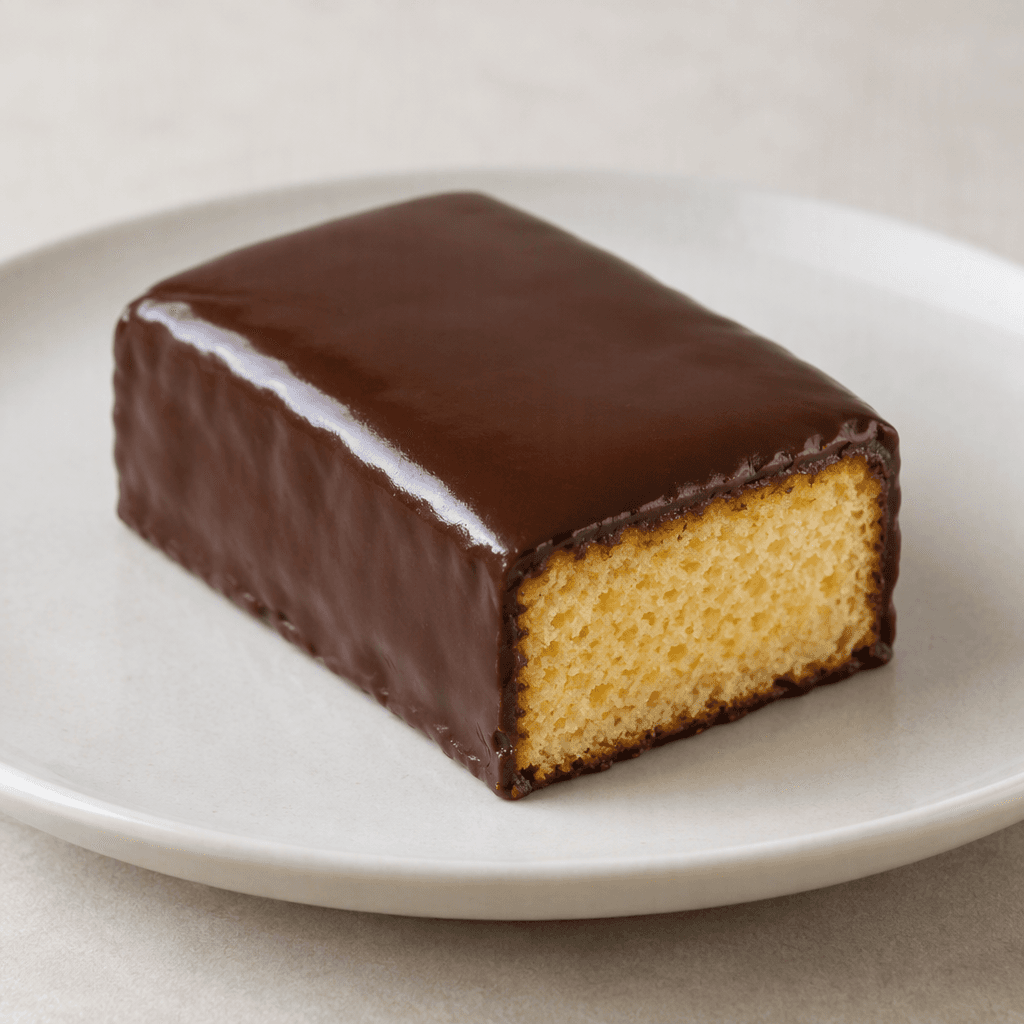
Chocolate-coated cake Calories
High energy, sugar and fat content, chocolate flavor
In season: Spring · Summer · Autumn · Winter
CALORIES
GI
POTASSIUM
FIBER
Quick answer
1 piece (medium) of Chocolate-coated cake (50 g) has 205 calories. That works out to 410 calories per 100 g. It contains 27.5 g of carbs, 2.6 g of protein, 9 g of fat and 1.1 g of fiber. Its 0.1 mg of Copper covers 7% of the Daily Value. Its glycemic index is 65 (high), so it raises blood sugar quickly.
What is Chocolate-coated cake?
Chocolate-coated cake pairs a soft sponge or plain cake base with a smooth layer of chocolate over the outside. It is sold by bakeries and as a packaged sweet, and is also easy to make at home; the coating may be thin or thick depending on the recipe.
The exterior is firm and chocolatey, while the crumb underneath stays light and tender. It is commonly served as a teatime or coffee-break treat, or as a simple dessert after a meal. Its combination of sugar and fat makes it an energy-dense sweet rather than an everyday snack. A modest slice goes well with unsweetened tea or coffee, and fresh berries can add a tart contrast to the rich coating.
Chocolate-coated cake Nutrition Facts
Selected: 100 g
410
KCAL / 100G
Carbs
55g
· 20% DV
Protein
5.2g
· 10% DV
Fat
18g
· 23% DV
Fiber
2.2g
· 8% DV
DV is the share of the daily value covered, on a 2,000 kcal reference diet.
Calories come from: Carbs 55% · Protein 5% · Fat 40%
Chocolate-coated cake Vitamins & Minerals
Vitamins
B2
0.14mg · 11% DV
B1
0.09mg · 8% DV
Biotin
2.5µg · 8% DV
B5
0.3mg · 6% DV
Minerals
Phosphorus
95mg · 14% DV
Iron
2mg · 11% DV
Selenium
6µg · 11% DV
Zinc
1mg · 9% DV
How Nutritious Is Chocolate-coated cake?
Nutrient density
Low
How many vitamins, minerals and how much fiber this food carries per calorie. A high score means a lot of nutrition for few calories.
Satiety score
Low
An EatBetter score computed from fiber, protein and calorie density. A high score means staying full longer on the same calories.
Both scores are calculated per 100 g and do not change with the selected portion. The satiety score is EatBetter's own calculation, not a clinical measure.
Chocolate-coated cake Glycemic Index
GLYCEMIC INDEX
GLYCEMIC LOAD
Accounts for portion size — a more realistic measure than GI alone.
How to Burn Off Chocolate-coated cake
To burn the 410 calories in 100 g:
🚶
Walking (5 km/h)
🏃
Running (8 km/h)
🚴
Cycling
🏊
Swimming
Times are calculated with the MET equation for a 70 kg adult. Actual burn varies with your weight, age and pace.
Is Chocolate-coated cake Processed?
NOVA 3
Processed
1. Unprocessed
2. Minimally Processed
3. Processed
4. Ultra-Processed
NOVA classifies foods into 4 groups by industrial processing. NOVA 1 (unprocessed) is the healthiest.
Does Chocolate-coated cake Contain Allergens?
Contains these allergens:
Which Diets Is Chocolate-coated cake Good For?
Vegan
— Not suitable
Vegetarian
— Not suitable
Gluten-Free
— Not suitable
Dairy-Free
— Not suitable
Mediterranean
— Not suitable
Paleo
— Not suitable
Whole30
— Not suitable
DASH
— Not suitable
Keto
— Not suitable
Low FODMAP
— Not suitable
Chocolate-coated cake Fat Profile
SATURATED
7.2g
MONOUNSATURATED
6.1g
POLYUNSATURATED
2.1g
Omega 6:3 ratio 43.3:1
Above the ideal 4:1 (43.3:1).
Compare Chocolate-coated cake
Foods Similar to Chocolate-coated cake
Frequently Asked Questions About Chocolate-coated cake
How do you make chocolate-coated cake at home?
Chocolate-coated cake is made by baking a sponge, letting it cool completely, then pouring melted chocolate over it. Set the cake on a wire rack first so excess coating can drip away and the sides get covered evenly.
What is the best way to coat a cake with chocolate?
The best way to coat chocolate-coated cake is to pour smoothly melted chocolate over a completely cool cake on a wire rack. Start in the centre and let it flow over the edges; avoid spreading it repeatedly, which can leave marks.
Why does the chocolate coating on chocolate-coated cake crack?
The coating on chocolate-coated cake can crack when a thick chocolate layer cools too quickly or the cake and coating are at very different temperatures. Let the cake reach room temperature and use a thin, even coating to reduce cracking.
Can chocolate-coated cake be made with a ready-made sponge cake?
Yes, chocolate-coated cake can be made with a ready-made sponge cake. Choose a firm, plain sponge, trim any loose crumbs, and chill it briefly before coating so it holds together as you pour on the chocolate.
Should chocolate-coated cake be refrigerated?
Chocolate-coated cake does not usually need refrigeration if the room is cool and the cake has no perishable filling. Store it covered; refrigerate cakes with cream or custard, and let them sit out briefly before serving for a softer texture.
How long does chocolate-coated cake keep, and how should it be stored?
Chocolate-coated cake keeps for a few days when stored in an airtight container in a cool, dry place. Keep it away from sunlight and heat, which can soften the coating, and cover cut surfaces to stop the sponge drying out.
Can you freeze chocolate-coated cake?
Yes, chocolate-coated cake can be frozen. Wait until the chocolate has fully set, wrap the cake tightly, and thaw it in the refrigerator while still wrapped; this helps limit condensation on the coating.
Why is the chocolate on chocolate-coated cake still sticky?
Chocolate on chocolate-coated cake may stay sticky if it contains too much cream or has not had a cool place to set. Use less liquid in the coating and allow it to firm up before covering or stacking the cake.
What kind of chocolate works best for chocolate-coated cake?
Couverture chocolate gives chocolate-coated cake a smooth, glossy finish because it is formulated to melt and flow well. Regular baking chocolate also works; melt it gently and avoid introducing water, which can make it seize.
What goes well with chocolate-coated cake?
Fresh berries, sliced pear, or unsweetened coffee pair well with chocolate-coated cake because their freshness or bitterness balances the sweet coating. For a simple dessert, serve a small slice with tea or a spoonful of lightly whipped cream.
Have another question about Chocolate-coated cake?
Ask the AI nutrition coach — calories, portions, alternatives and more, answered in seconds in the app.

Scan calories with your camera
Instant AI nutrition analysis

Nutrition data compiled from USDA FoodData Central and scientific sources.